

8 AI Tool Offboarding and Deprovisioning Platforms for 2026
 Chris Shuptrine
•
Jun 8, 2026
•
15 min read
Chris Shuptrine
•
Jun 8, 2026
•
15 min read

Compare 8 AI tool offboarding and deprovisioning platforms that revoke access, kill shadow AI, and prove SOC 2 evidence.
Ask about this article
Opens Claude in a new tab to answer, using this article as the source.
AI tool offboarding broke in 2026 because the access surface stopped looking like a SaaS list. Verizon’s 2025 DBIR found that “15% of employees were routinely accessing GenAI systems on their corporate devices (at least once every 15 days)”, and that of those employees, 72 percent “were either using non-corporate emails as the identifiers of their accounts” (Verizon 2025 Data Breach Investigations Report). Grip Security’s 2025 SaaS Security Risks Report, released in October 2024, reported that “90% of SaaS applications and 91% of AI tools within organizations remain unmanaged” (CIO Influence, reporting Grip Security’s 2025 SaaS Security Risks Report). Day 1 is no longer the hardest day; Day Last is.
Termination still flips a flag in Okta, but the ChatGPT history, the Cursor token, and the n8n agent that ex-employee built keep working. A Beyond Identity study found that “a vast majority of employees (83%) admitted to maintaining continued access to accounts from a previous employer”, and that “more than half of these employees (56%) said they had used this continued digital access with the specific intent of harming their former employer” (Beyond Identity). On the regulatory side, the EU AI Act’s Article 50 transparency obligations took effect on August 2, 2026, while the AI Omnibus that entered into force on July 27, 2026 moved the Annex III high-risk rules back: “High-risk AI systems in Annex III: Rules apply starting 2 December 2027” (European Commission). SOC 2 CC9.2, the criterion covering how an entity assesses and manages risks associated with vendors and business partners, is where auditors now ask for AI-specific revocation evidence.
The eight platforms below each cover a different piece of AI deprovisioning, from OAuth-token sweeps to shadow-AI discovery through personal email. Some focus on the identity layer; others surface accounts created outside SSO. Most IT teams in 2026 layer two of them.
15 percent of employees routinely use GenAI on corporate devices, and 72 percent of those use non-corporate emails as their account identifier (Verizon 2025 DBIR) · 91 percent of AI tools within organizations remain unmanaged (Grip Security, 2025 SaaS Security Risks Report, released October 2024) · 83 percent of employees kept access to a previous employer's accounts, and 56 percent of those used it intending to cause harm (Beyond Identity) · more than 80 machine identities per human (CyberArk, 2025) · EU AI Act Article 50 transparency obligations effective August 2, 2026, with Annex III high-risk rules moved to December 2, 2027 (European Commission).
★ = low · ★★ = medium · ★★★ = high
| Tool | Shadow AI Coverage | Automation Depth | Audit Evidence | Reviews |
|---|---|---|---|---|
| Torii | ★★★ | ★★★ | ★★★ | ★★ |
| BetterCloud | ★★ | ★★★ | ★★ | ★ |
| Lumos | ★ | ★★ | ★★ | ★★★ |
| Nudge Security | ★★★ | ★ | ★★ | ★★ |
| Okta Lifecycle Management | ★ | ★★★ | ★★ | ★★ |
| Reco | ★★ | ★★ | ★★★ | ★ |
| Rippling IT | ★ | ★★★ | ★★ | ★★ |
| Zluri | ★★★ | ★★ | ★★ | ★ |
Table of Contents
Torii
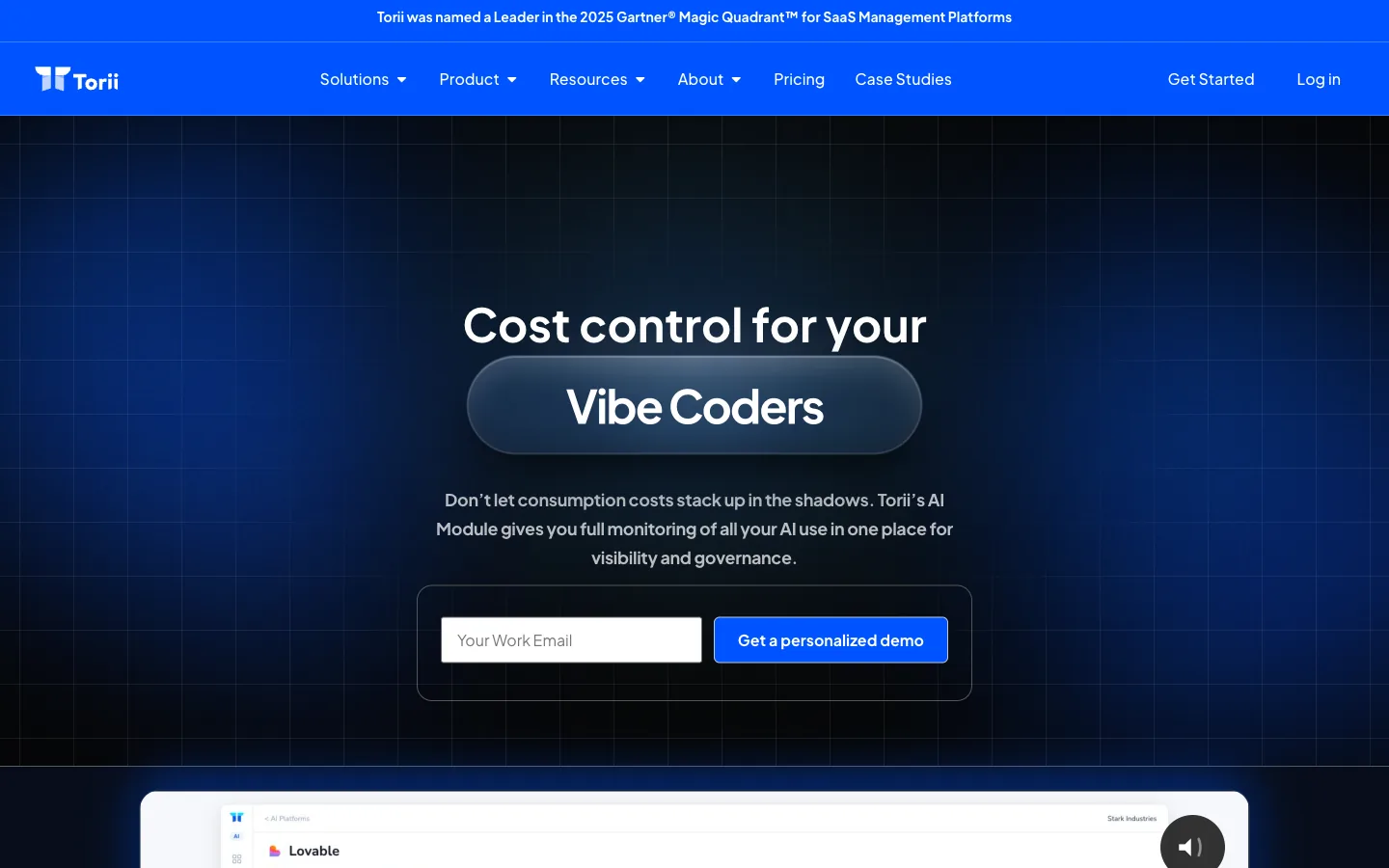
Torii treats AI offboarding as a discovery problem before it becomes a revocation problem at the AI management layer. The platform fuses SSO logs, OAuth grants, browser-extension signals, finance feeds, and HRIS data to surface every AI tool an employee actually used, including the personal-email ChatGPT and Cursor sign-ups SCIM never sees. The same discovery feeds Cursor Business and Enterprise seat management, so a reclaimed seat at offboarding never silently renews. When BambooHR, Workday, or Okta fires a termination event, Torii’s workflow engine revokes the matching seats inside the same minute and writes a per-employee evidence log.
Coverage stretches well into the messier edges of AI deprovisioning beyond the IdP cutoff. Torii reclaims dormant Claude, Gemini, and Midjourney seats, rotates orphaned API tokens flagged by its license-overlap scanner, and exports an audit trail to Splunk or Datadog for SOC 2 CC9.2 evidence. The same engine kills OAuth grants for embedded AI inside Notion or Slack, where pulling the parent seat leaves the assistant alive. Take the Torii AI Dashboard walkthrough for the full deprovisioning loop.
Pros:
- Multi-source discovery catches AI tools that bypass SSO, including personal-email ChatGPT and expensed Cursor
- HRIS-triggered revocation fires across discovered AI apps inside the same minute as termination
- Per-employee evidence log streams to Splunk and Datadog for SOC 2 CC9.2 audits
- License-overlap scanner reclaims dormant Claude, Gemini, and Midjourney seats automatically
Cons:
- Pricing reflects enterprise-grade coverage, not entry-level point pricing
- Built for SaaS and Shadow-IT environments; no on-premise deployment
| G2: 4.5/5 (302 reviews) | Capterra: 4.9/5 (26 reviews) |
BetterCloud
BetterCloud runs offboarding as a chained workflow engine, and its 2026 release points that engine squarely at OAuth grants. When HR fires the termination event, the platform suspends the account, kills active sessions, revokes every third-party OAuth grant including Copilot and Gemini, and removes MFA recovery in a single sequence.
A separate Shadow AI module flags unsanctioned signups through OAuth scans and a browser extension, which is where most unmanaged AI access actually lives. A separate model-training-risk flag identifies AI apps that train on company data, which IT can route into an auto-suspend branch. Offboarding workflows also handle file ownership transfer with Slack and Teams approvals, then push device wipe through Jamf or Intune. The chained design carries some admin lift, but the OAuth focus closes the gap most lifecycle tools miss. The BetterCloud shadow AI guide details the playbook.
Pros:
- HRIS-triggered chain revokes OAuth grants for Copilot, Gemini, and unsanctioned AI tools inside one run
- Shadow AI module catches model-training risk and unsanctioned signups through OAuth and SSO logs
- BetterCloud advertises 100+ integrations and 1,000+ out-of-the-box actions, covering most AI SaaS revocation paths
Cons:
- Agentic AI control plane added through CoreStack is still maturing
- Heavier admin lift than newer AppStore-style request layers
| G2: 4.4/5 (565 reviews) | Capterra: 4.5/5 (76 reviews) |
Lumos

Lumos builds dynamic offboarding checklists from live app-access data instead of static role mappings. Every AI tool the leaver actually touched, including any entry surfaced in the AppStore catalog, gets a revocation task assigned to its real app owner with audit-trail tracking. HRIS sync triggers the cascade across the “300+ integrations” Lumos lists, spanning SaaS, cloud, on-prem, and IdPs.
Lumos pairs the checklist engine with Albus, an AI agent acting as an in-platform identity analyst. Albus surfaces dormant Claude or Cursor accounts, flags segregation-of-duties violations created when an exiting employee still owns a Copilot tenant, and powers AI-driven access reviews with evidence-based reasoning. Lumos publishes its headline numbers as named customer outcomes rather than platform averages: a four-minute time-to-resolution on access requests at Code42, and a 99 percent reduction in time-to-resolution at Chegg (Lumos). Check the Lumos lifecycle management page for the full workflow.
Pros:
- App-owner routing keeps revocation accountability with the people who run each AI tool
- Albus AI agent surfaces dormant AI accounts and runs natural-language access queries
- 300+ listed integrations across SaaS, cloud, on-prem, and IdP coverage
- Four-minute time-to-resolution on access requests, as reported by Lumos customer Code42
Cons:
- Less depth on shadow-AI discovery than dedicated SaaS-management tools
- AI tools without SCIM still require manual revocation steps in the checklist
| G2: 4.8/5 (200 reviews) | Capterra: 4.6/5 (10 reviews) |
Nudge Security
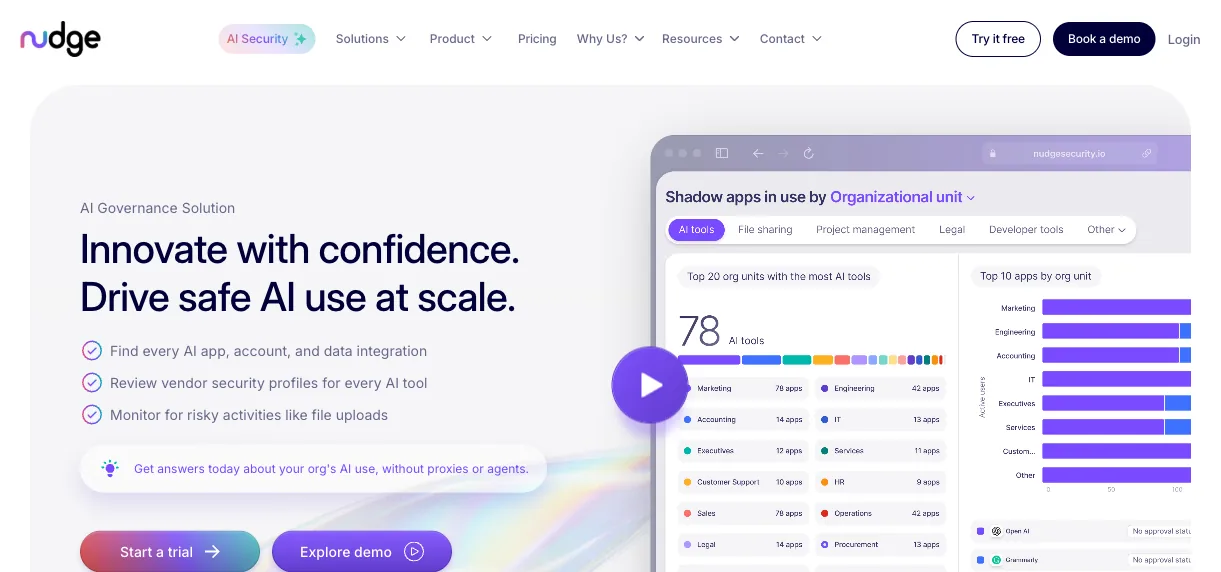
Nudge Security reads inbound mail from SaaS and AI vendors to surface every account an employee ever created. The angle matters at offboarding because personal-email ChatGPT, Claude, Perplexity, and Cursor signups never appeared in Okta, which means IdP-only tools cannot revoke them. During termination, Nudge inventories every discovered AI tool tied to the leaver, revokes OAuth grants, resets passwords on unmanaged accounts, and flags app-to-app integrations that could leave data flowing.
Automated nudges go to the technical contact of each app, not just IT, with instructions to delete sensitive data and reassign owned resources. The platform now also catches shadow AI agents like Zapier agents, OpenAI Workflows, and Rovo automations whose owners are leaving the company. That coverage matters because an abandoned agent with an active token is harder to trace than a dormant user account. The Nudge Security AI use case page walks through the offboarding flow.
Pros:
- Email-based discovery reaches personal-email AI accounts SSO-based tools cannot see
- Automated nudges route revocation tasks to each app’s technical owner
- Catalog covers shadow AI agents like Zapier agents, OpenAI Workflows, and Rovo
Cons:
- Behavior-led approach assumes app owners will read and act on guidance
- Lighter on SCIM-style automated revocation than IGA-grade tools
| G2: 4.8/5 (33 reviews) | Capterra: 4.7/5 (19 reviews) |
Torii fuses SSO, OAuth, browser, finance, and HRIS signals into one AI inventory, then routes each discovered tool into HR-triggered revocation workflows with SOC 2-grade evidence logs. The same engine handles dormant-seat reclaim and orphaned-token rotation after the leaver is gone. See the Torii AI Dashboard.
Okta Lifecycle Management
Okta Lifecycle Management approaches AI offboarding through the SCIM and IdP layer it already owns. A deactivation in Universal Directory fires SCIM push to every connected app, flipping the user’s active flag and triggering downstream deprovisioning across the “more than 8,000 ready-to-use, pre-built integrations” in the Okta Integration Network. ChatGPT Enterprise, Claude for Work, and Microsoft Copilot all carry native SCIM integrations with Deactivate, Group Push, and Attribute Writeback.
Okta Workflows fills the gap for AI tools without native SCIM by scripting OAuth revocation and custom vendor API calls. The April 2026 Okta for AI Agents release treats agents as first-class identities with discovered owners, short-lived credentials, and a kill switch that revokes access across connected apps. Okta is also pushing the ID-JAG standard for non-human identity governance, which closes some of the API-token gap on the long tail of free-tier AI apps. The Okta Lifecycle Management page covers the integration set.
Pros:
- SCIM-based deactivation across 8,000+ OIN apps including ChatGPT Enterprise and Claude for Work
- Okta for AI Agents adds a kill switch for agent identities across connected systems
- Okta Workflows scripts OAuth revocation for AI tools without native SCIM support
- Deep Entra ID federation reaches Microsoft Copilot deprovisioning
Cons:
- Workflows tier carries a real premium for advanced branching logic
- Coverage depends on each AI vendor exposing SCIM or SAML, which many free tiers do not
| G2: 4.5/5 (1,000+ reviews) | Capterra: 4.7/5 (110 reviews) |
Reco
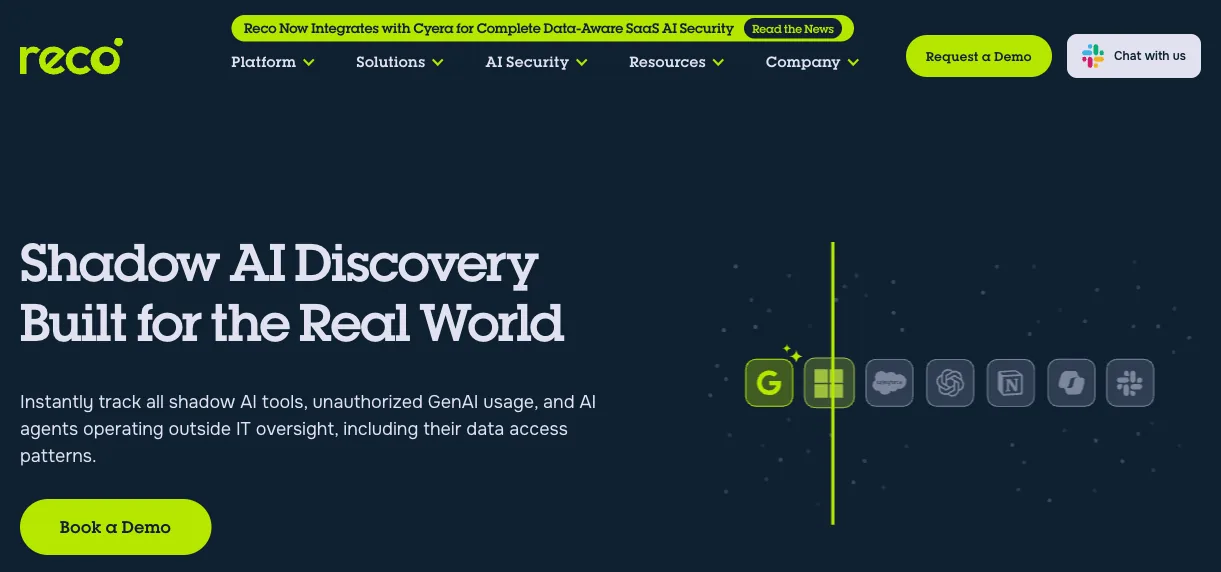
Reco is built around a specific gap in offboarding: HR checklists ignore non-human identities, and those NHIs hold the OAuth grants and API keys that AI tools actually run on. CyberArk’s 2025 research put the scale of that population at more than 80 machine identities for every human (CyberArk). Reco says its Identity Context Agent scans more than 200 connected apps for accounts that should be deprovisioned and removes lingering tokens that standard offboarding misses.
Reco covers agentic AI through dedicated discovery for Copilot, n8n, Cursor, and Agentforce agents. The platform finds every agent and service account, then flags orphaned ones whose owners have left. Reco says it also delivers automated proof-of-deprovisioning validation and continuous re-monitoring for resurfaced access, with more than 3,200 controls re-evaluated every 24 hours. That re-validation matters because OAuth grants and service accounts sometimes come back after a deactivation through a re-auth or token refresh. See the Reco SaaS offboarding use case for the full sweep.
Pros:
- Identity Context Agent sweeps the 200+ apps Reco lists for orphaned tokens and OAuth grants after termination
- Continuous re-validation catches resurfaced access after the initial offboarding cutoff
- Agentic AI discovery covers Copilot, n8n, Cursor, and Agentforce agents
- 3,200+ controls re-evaluated every 24 hours, per Reco
Cons:
- Posture-led design assumes another tool runs the primary revocation workflow
- Smaller integration catalog than identity-first IGA platforms
G2: 4.6/5 (28 reviews)
Rippling IT
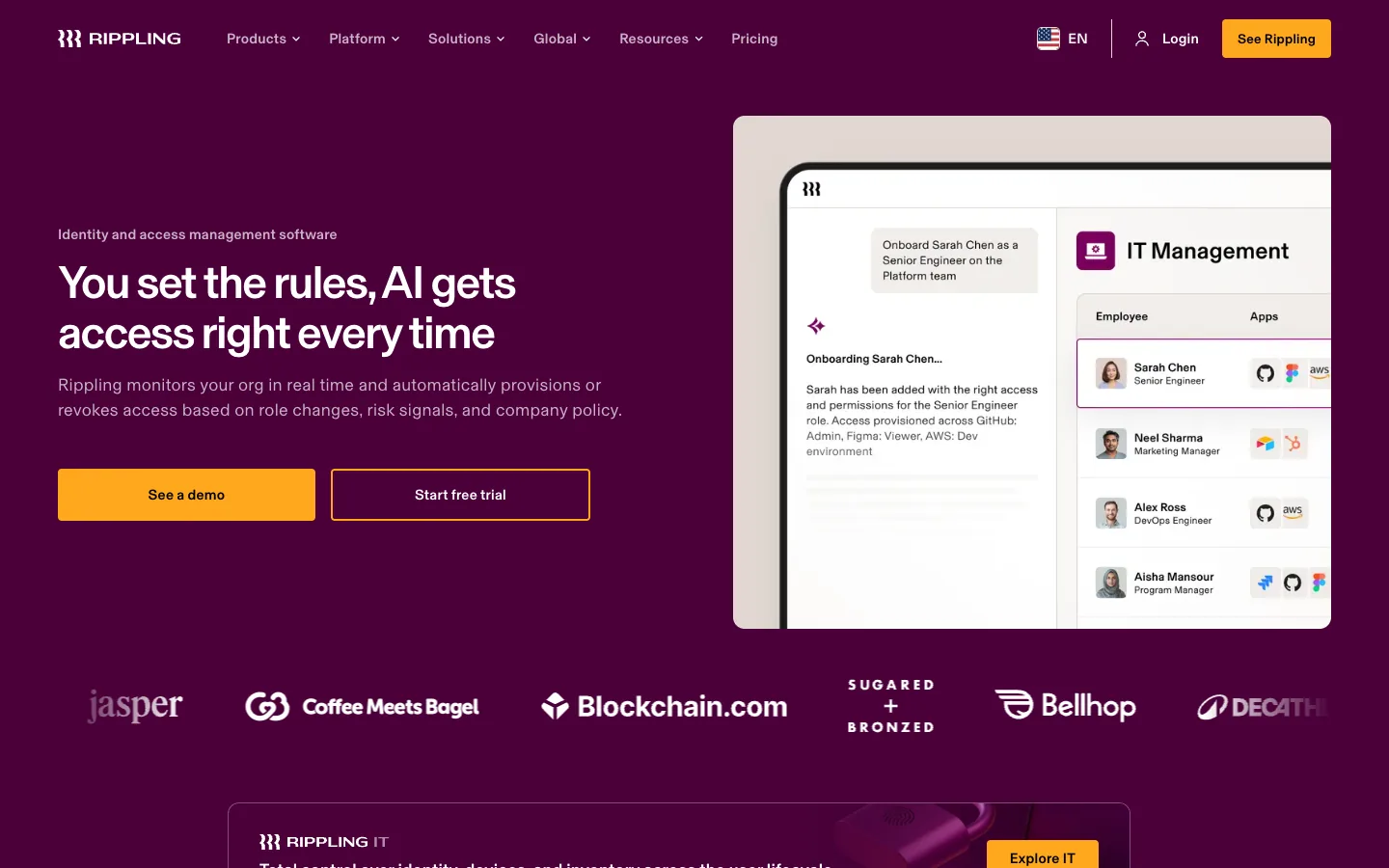
Rippling IT collapses HR and IT into one platform, which removes the handoff that breaks most offboarding flows. A termination logged in HR cascades instantly to IT with no ticket, no Slack ping, and no separate escalation path. Workflow Studio fires SSO session revocation, SCIM deprovisioning across the 650-plus integrated apps Rippling lists, and device retrieval in parallel, including AI seats tied to those integrations.
The Application Access Count Report gives IT a real-time audit confirming every AI app has actually been deprovisioned, not just marked deactivated. Rippling’s IAM layer surfaces OAuth grants and shadow AI usage so AI tool access is severed alongside standard SaaS, and custom SCIM integrations cover AI tools outside that catalog. Mid-market teams that struggle with the HR-IT handoff get the biggest lift here. The Rippling IAM page walks through the unified flow.
Pros:
- HR termination cascades to IT inside the same platform without a separate handoff
- 650+ integrated apps listed by Rippling, with SCIM deprovisioning fired in parallel with device retrieval
- Application Access Count Report confirms post-offboarding access is actually closed
Cons:
- All-in-one model locks payroll, HR, and IT together more than some teams want
- Shadow-AI discovery is lighter than dedicated SaaS-management platforms
| G2: 4.8/5 (2,400+ reviews) | Capterra: 4.9/5 (3,400+ reviews) |
Zluri
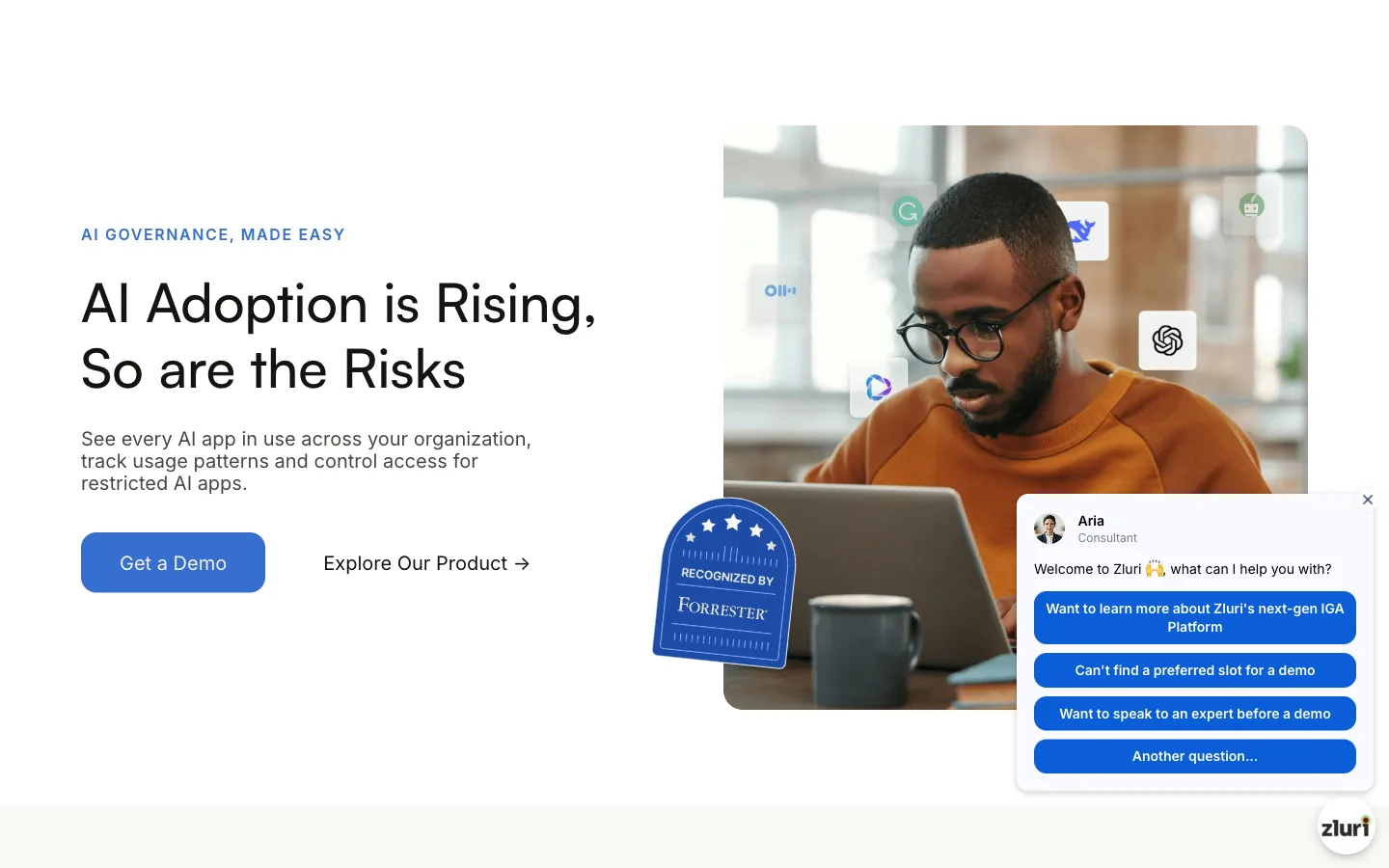
Zluri sits at the IGA end of this list with a dedicated GenAI Governance module bolted onto its offboarding engine. Its patented five-method discovery layer blends browser activity, finance data, SSO logs, direct integrations, and desktop agents to surface AI apps that no IdP-only tool sees. Zluri’s own research puts it bluntly: “IT teams have visibility into less than 20% of the AI applications employees actually use” (Zluri). That is exactly the gap most AI risk reviews never close.
The GenAI Governance module gives real-time visibility into ChatGPT, DeepSeek, and Claude, auto-detects unsanctioned use, and executes automated access revocation for restricted GenAI apps. Role-specific playbooks then run the broader offboarding sequence across federated, unfederated, and shadow apps, with device de-authentication, data backup, license removal, and SSO cutoff in order. Admin trigger points live inside Slack, email, and Jira so the deprovisioning flow stays where the team works. The IRIS layer builds on Zluri’s “300+ integrations with 1,500+ granular workflow actions” (Zluri). Tour the Zluri lifecycle management page for the full module set.
Pros:
- GenAI Governance module auto-revokes restricted ChatGPT, DeepSeek, and Claude access
- Five-method discovery surfaces AI apps SSO-only tools miss
- Role-specific playbooks cover federated, unfederated, and shadow AI apps
- 1,500+ granular workflow actions for post-offboarding cleanup
Cons:
- IGA-first design carries deployment effort that lighter request tools avoid
- Discovery depth varies by integration coverage in specific stacks
| G2: 4.8/5 (570 reviews) | Capterra: 4.9/5 (12 reviews) |
How to Choose an AI Offboarding Tool
Pick the tool that matches where your offboarding actually fails today. If federated SCIM works for your top AI vendors, Okta and Rippling IT can do the heavy lifting; if the leak is shadow signups and orphaned OAuth tokens, Torii, Nudge Security, and Reco are the layer to add; if owner accountability is the gap, Lumos and Zluri put a name on every revocation task.
Most IT teams in 2026 pair an identity layer with a SaaS-grounded discovery and revocation engine. Torii finds the personal-email shadow LLM sign-ups SSO never saw, kills the seat on the same termination event, and exports timestamped evidence for SOC 2 CC9.2 and EU AI Act audits.
OAuth grant revocation for your top five AI vendors · HRIS-triggered cutoff inside one minute of termination · shadow-AI discovery from at least three signal sources (SSO, OAuth, finance, browser) · non-human identity sweep for orphaned tokens and agents · per-employee evidence export for SOC 2 CC9.2 · continuous re-validation that revoked access does not resurface.
Frequently Asked Questions
AI offboarding failed because the access surface stopped looking like a simple SaaS list: employees authenticate with personal email, many AI tools sit outside IT catalogs, and OAuth tokens, agent identities, and third-party integrations often persist after termination.
Shadow AI and personal-email signups hide accounts from SCIM and IdP deprovisioning. Effective deprovisioning needs multi-source discovery—SSO, OAuth scans, browser telemetry, finance and HR signals—to find unmanaged ChatGPT, Cursor, agents, and orphaned tokens before revocation workflows run.
Tools that reach beyond SSO include Torii, Nudge Security, Reco, Zluri and similar SaaS-discovery platforms. They combine HRIS, email, browser signals, finance feeds and token sweeps to surface personal-email accounts, agents, and orphaned OAuth grants invisible to IdP-only tools.
Auditors now expect timestamped, per-employee revocation evidence: logs or exports to Splunk/Datadog showing OAuth grant revocation, token rotation, agent kill actions and continuous monitoring. This supports SOC 2 CC9.2 compliance and EU AI Act monitoring, which since the July 2026 AI Omnibus runs to December 2, 2027 for Annex III high-risk systems.
Choose a tool that matches where your offboarding fails: use Okta or Rippling for SCIM-heavy vendors; add Torii, Reco, or Nudge for shadow signups and token sweeps; prefer platforms that automate OAuth revocation, owner routing and export audit evidence.
Verify OAuth grant revocation for your top AI vendors; HRIS-triggered cutoff within one minute of termination; discovery from at least three signals (SSO, OAuth, finance, browser); non-human identity sweeps; timestamped per-employee evidence export; and continuous re-validation.