

7 Tools to Manage AI Compliance and Audit Readiness in 2026
 Chris Shuptrine
•
Jun 30, 2026
•
17 min read
•
Updated August 19, 2026
Chris Shuptrine
•
Jun 30, 2026
•
17 min read
•
Updated August 19, 2026
Compare 7 AI compliance tools for SOC 2, ISO 42001, and EU AI Act audit readiness across your AI tools and shadow AI in 2026.
Ask about this article
Opens Claude in a new tab to answer, using this article as the source.
AI compliance became a board-level problem in 2026, and the deadlines are not theoretical, though one of the big ones moved. The EU AI Act’s Article 50 transparency obligations took effect on August 2, 2026, but the AI Omnibus, in force since July 27, 2026, moved the Annex III high-risk obligations to December 2, 2027 and high-risk AI embedded in regulated products to August 2, 2028 (European Commission). Fines for prohibited AI practices still reach 35 million euros or 7 percent of global turnover, whichever is higher, and that top tier applies to the Article 5 prohibitions specifically. The Act itself says those penalties must be “effective, proportionate and dissuasive.” ISO/IEC 42001, which ISO describes as the standard that “specifies requirements for establishing, implementing, maintaining, and continually improving an Artificial Intelligence Management System (AIMS) within organizations,” keeps appearing in enterprise RFPs. SOC 2 auditors now treat AI as a supply-chain risk, testing model lineage and how you vet OpenAI or Anthropic as subprocessors.
The catch is that most companies cannot see their own AI footprint. Microsoft’s 2025 Work Trend Index found that 78 percent of AI users bring their own AI tools to work, outside anything their employer provided. Governance has not kept up: Deloitte reports that only about 21 percent of companies have a mature model for governing AI agents. The gap is measurable: a Gartner survey of 302 cybersecurity leaders run between March and May 2025 found that 69 percent of organizations suspect or have evidence that employees are using prohibited public GenAI. IBM found that shadow AI was a factor in 20 percent of breaches, adding 670,000 dollars to the average cost.
The seven tools below tackle AI compliance from different angles, from shadow-AI discovery and access control to framework mapping, evidence automation, and model testing. None covers every base alone, so the goal is matching the tool to the gap your next audit will expose.
The EU AI Act's Article 50 transparency obligations took effect on August 2, 2026, while the July 2026 AI Omnibus moved Annex III high-risk obligations to December 2, 2027 and product-embedded high-risk systems to August 2, 2028 (European Commission). Fines for prohibited practices reach 35 million euros or 7 percent of global turnover. Microsoft's 2025 Work Trend Index found that 78 percent of AI users bring their own AI tools to work, and Deloitte reports only about 21 percent of companies have a mature model for governing AI agents. Gartner surveyed 302 cybersecurity leaders in March to May 2025 and found 69 percent of organizations suspect or have evidence that employees are using prohibited public GenAI.
★ = low · ★★ = medium · ★★★ = high
| Tool | Shadow AI Discovery | Framework Coverage | Model Testing | Evidence & Access Automation | Ease of Deployment |
|---|---|---|---|---|---|
| Torii | ★★★ | ★ | ★ | ★★★ | ★★★ |
| Vanta | ★ | ★★★ | ★ | ★★ | ★ |
| Drata | ★★ | ★★★ | ★ | ★ | ★ |
| Secureframe | ★ | ★★ | ★ | ★★★ | ★ |
| Anecdotes | ★ | ★★★ | ★ | ★★ | ★ |
| Credo AI | ★ | ★★★ | ★★ | ★ | ★ |
| Holistic AI | ★ | ★★ | ★★★ | ★ | ★ |
Table of Contents
Torii
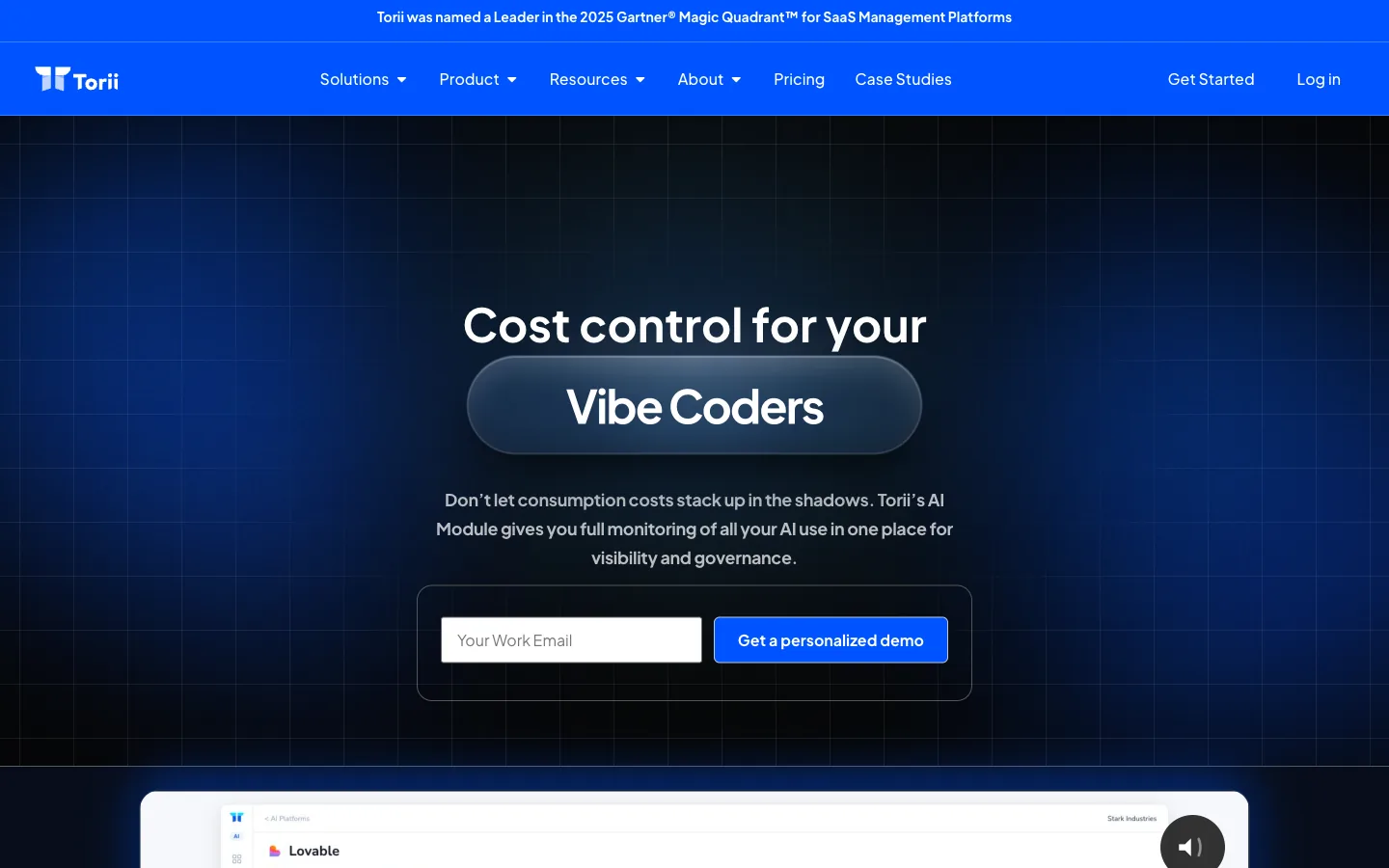
Most AI audits stall on the same problem, which is that nobody has a full list of the AI tools employees actually use. Torii is an AI Management Platform that works at the app, identity, and spend layers rather than testing models. Its discovery engine pulls from SSO logs, identity providers, browser extensions, finance and expense data, OAuth grants, and HRIS to surface every unsanctioned AI tool in use. That inventory is the starting point for SOC 2, ISO 42001, or EU AI Act work, since teams routinely find far more AI than they expected.
For audit readiness, Torii scores each discovered AI app on the factors auditors ask about. It checks SOC 2 status, data residency, breach history, and DPA coverage, then routes approvals and access certifications through Slack. The Torii AI Management Platform also tracks AI spend and token usage across Claude, ChatGPT, the OpenAI API, Gemini, and Cursor, so finance and security read from the same numbers. Joiner-mover-leaver automation revokes AI access the moment someone changes roles or leaves.
What Torii gives an audit team:
- A live inventory of every AI tool, including shadow signups outside SSO
- Per-app risk scores covering SOC 2, data residency, and breach history
- Access certifications and approvals tracked as audit evidence
- Automatic AI access removal when employees leave or move teams
Pros:
- Surfaces shadow AI tools that model-level scanners never see
- Ties each AI app to a documented risk score for auditors
- Revokes AI access automatically during role changes and exits
- Connects AI spend and access in one record for review
Cons:
- Pricing reflects enterprise coverage, not entry-level point pricing
- Built for SaaS and shadow IT, with no on-premise deployment
Capterra: 4.9/5 (26 reviews), checked August 19, 2026.
Vanta
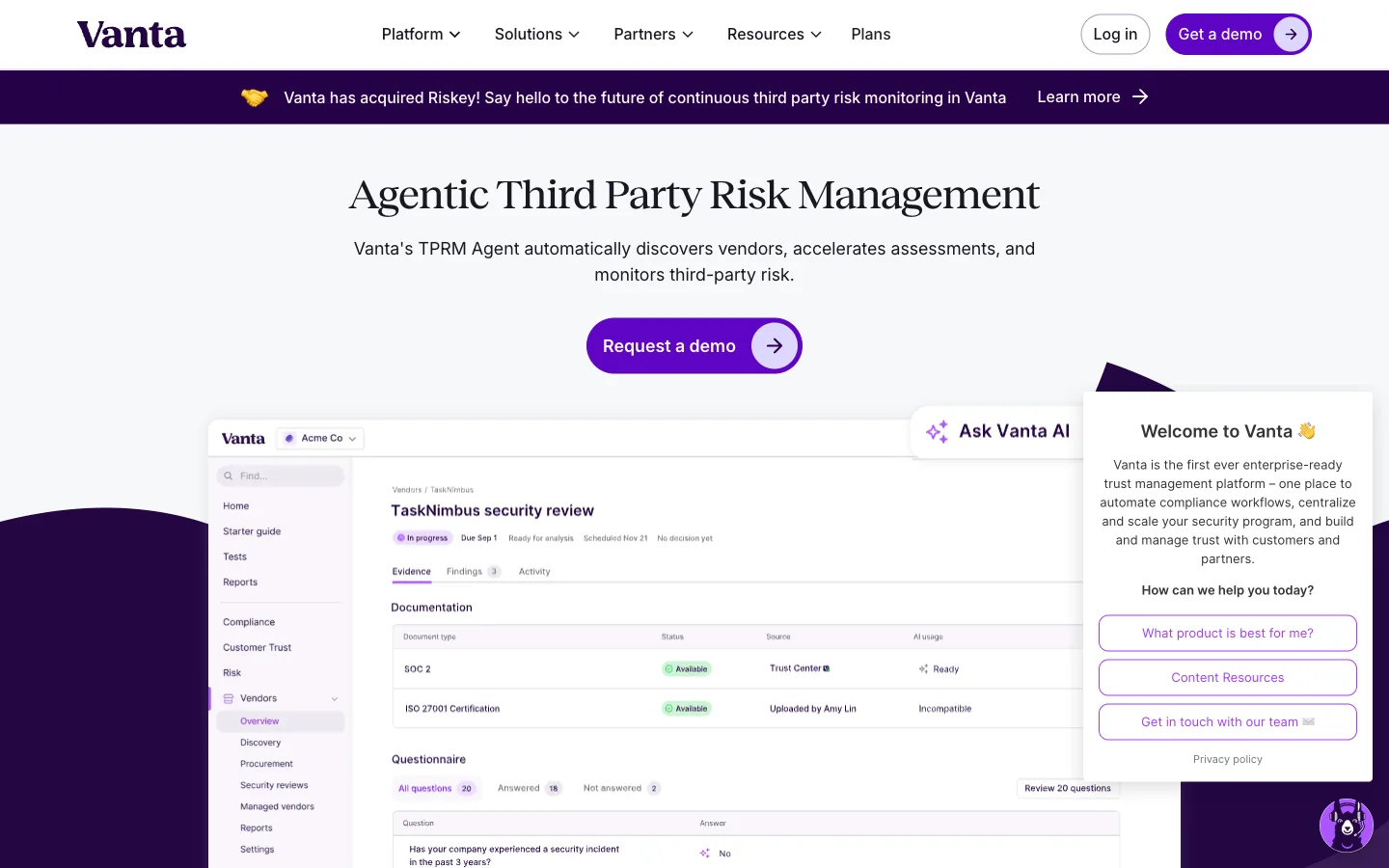
Vanta covers the most regulatory ground of the automation platforms, with dedicated product pages for both ISO 42001 and the EU AI Act. Vanta’s own EU AI Act page states that “The EU AI Act spans over 150 controls, 16 policies, and dozens of required artifacts,” and its build classifies your organization by role, provider versus deployer, since the obligations differ for each. That distinction matters in 2026, when the bulk of the Act’s remaining obligations take effect.
For ISO 42001, Vanta offers adaptive scoping and ready-made AIMS templates. Evidence reuse is the practical draw: Vanta’s framework mapping puts ISO 42001 at 50 percent overlap with the EU AI Act, against 20 percent for the NIST AI RMF. Teams already running SOC 2 or ISO 27001 inside Vanta can fold the AI frameworks into the same workspace. You can see the approach on the Vanta EU AI Act page.
Vanta also runs a tiered AI Security Assessment that scores third-party AI vendors. Those results feed Vendor Risk Management and the public Trust Center a buyer reviews during procurement. The company holds its own ISO 42001 certification, which it points to as proof the workflow holds up.
Where Vanta leads on AI regulation:
- Dedicated ISO 42001 and EU AI Act control libraries
- Evidence reuse of about 50 percent between the two frameworks
- Provider-versus-deployer classification baked into scoping
- Vendor AI risk scores wired into the Trust Center
Pros:
- Deepest coverage of EU AI Act obligations among automation tools
- Strong evidence reuse across AI and security frameworks
- Vendor AI assessments feed procurement and Trust Centers
Cons:
- Less focused on discovering shadow AI already in use
- Breadth can feel heavy for a team chasing one framework
Capterra: 4.2/5 (33 reviews), checked August 19, 2026.
Drata
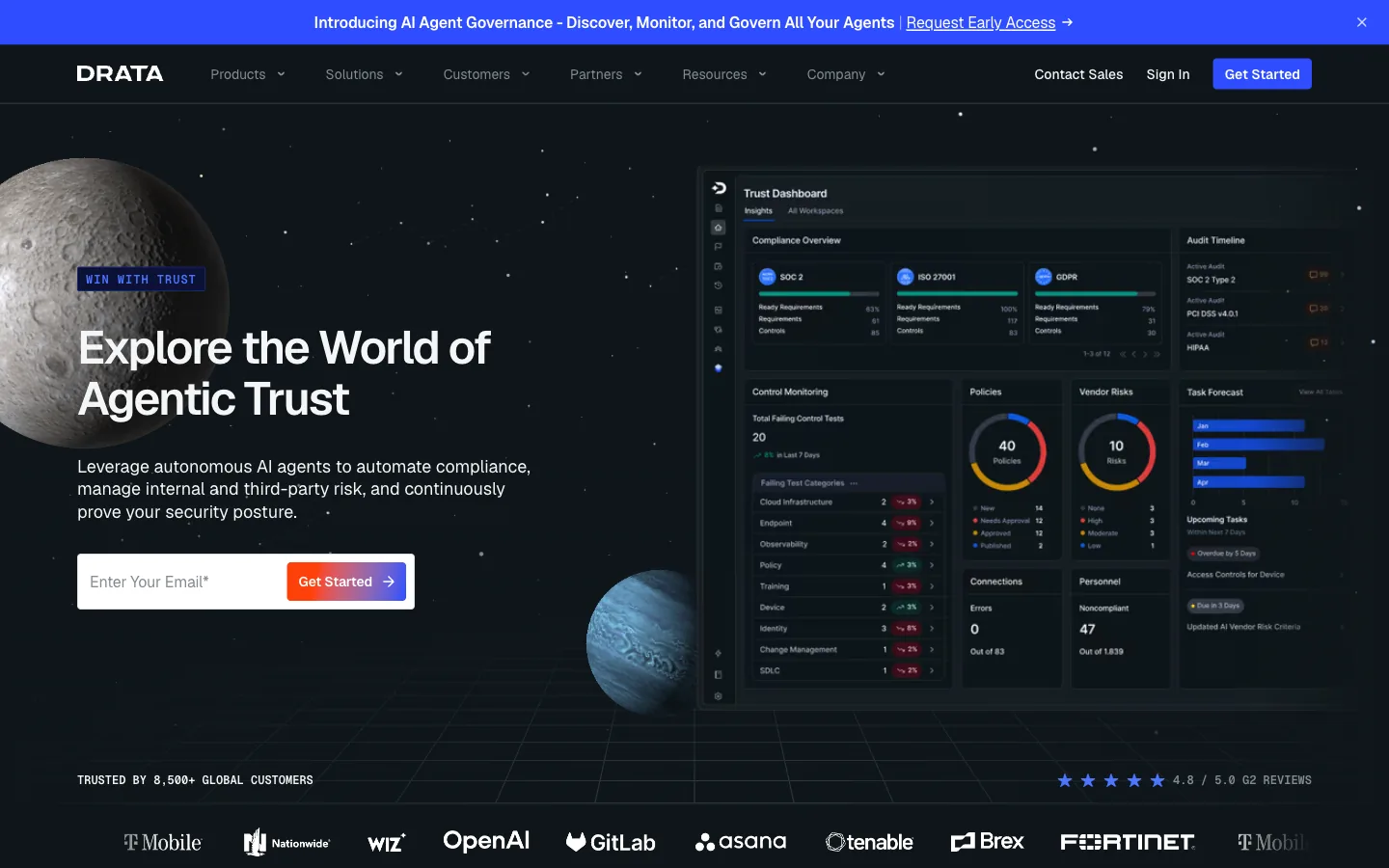
Drata’s standout for AI compliance is governance aimed at AI agents, not just AI tools. Its AI Agent Governance discovers agents running inside your stack, enforces policy before an action runs, and logs every decision for auditors. That decision-level trail answers the question SOC 2 reviewers increasingly raise in 2026, which is whether you can prove what an autonomous agent was allowed to do and what it actually did.
For framework work, Drata treats AI as a lifecycle that runs from conception to retirement. It ships more than 20 pre-built AI-specific risks across model, data, and usage, each linked straight to ISO 42001 controls, so you begin with a populated risk register instead of a blank one. The Drata ISO 42001 page lays out how those risks map.
Drata’s Agentic TPRM extends the same vendor scrutiny to third parties outside your stack. It retrieves and reviews third-party documents on its own, then drafts follow-up questions when something looks thin. A Drata MCP server connects AI assistants to the workspace with full audit logging, so even the tools doing the compliance work stay on the record.
What sets Drata apart on AI:
- Agent discovery with policy enforcement before an action fires
- Decision-level audit trails for every agent
- More than 20 AI risks pre-mapped to ISO 42001 controls
- Autonomous vendor document review through Agentic TPRM
Pros:
- Built around live AI agent control, not just documentation
- Pre-built AI risk register speeds ISO 42001 setup
- Vendor review runs with little manual effort
Cons:
- Agent governance is newer and still maturing
- Heavier lift if you only need basic AI policy tracking
Capterra: 4.8/5 (6 reviews), checked August 19, 2026.
Secureframe
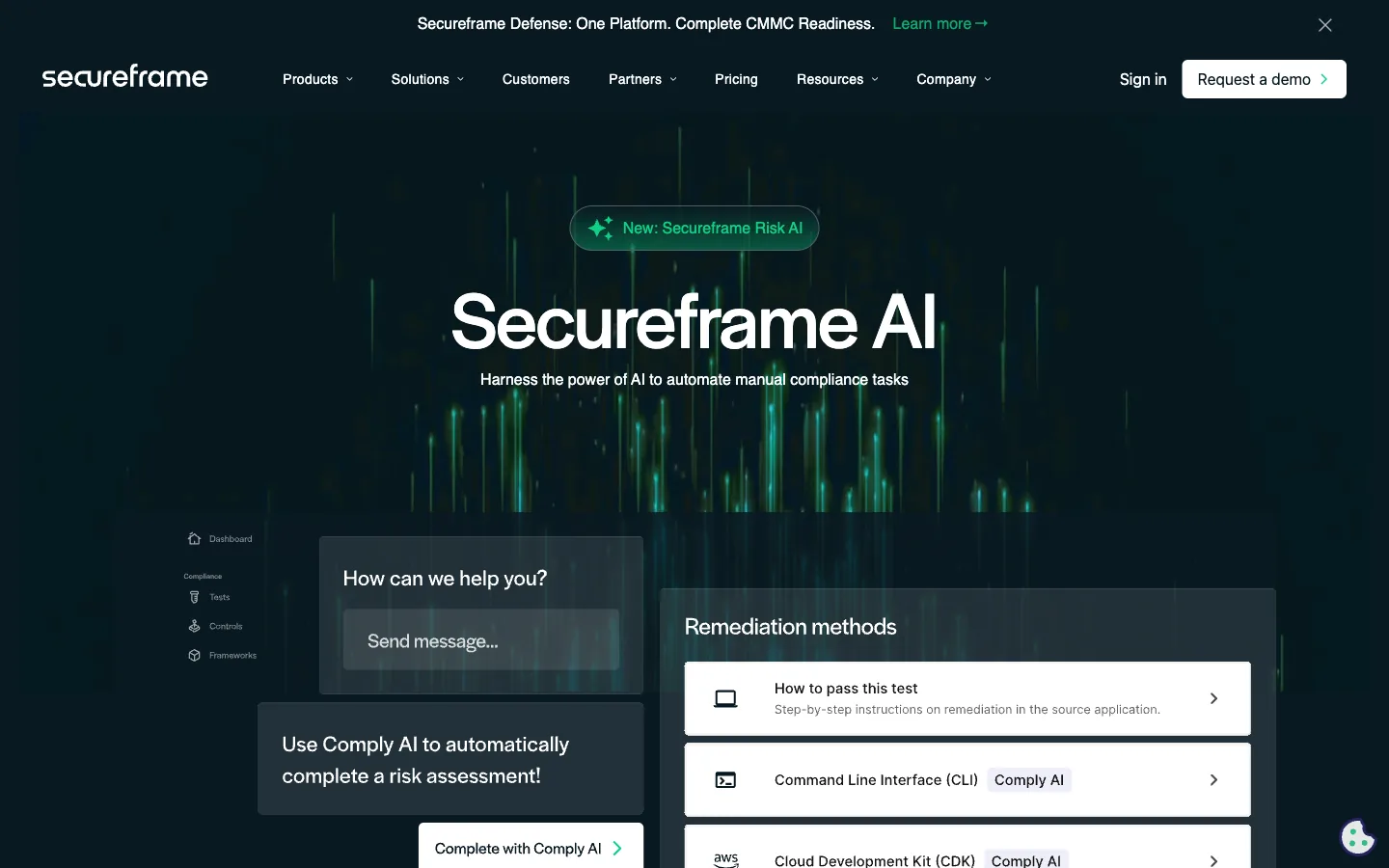
Secureframe flips the angle, using AI to do the compliance grind instead of governing your AI. The branded Comply AI suite spans remediation, risk, policy drafting, third-party risk, and control mapping. Comply AI for Remediation generates infrastructure-as-code fixes for failing cloud controls, while the policy module drafts documentation you would otherwise write by hand.
The piece that helps most at audit time is AI Evidence Validation. It scans collected evidence and flags anything missing, outdated, or mismatched against the control it is meant to support, which is where manual audits usually lose days. Secureframe supports ISO 42001 and the NIST AI RMF, which NIST says “is intended for voluntary use and to improve the ability to incorporate trustworthiness considerations into the design, development, use, and evaluation of AI products, services, and systems,” as named frameworks with pre-built tests. The Secureframe AI features page covers the full suite.
With more than 200 integrations and an MCP server for conversational queries, Secureframe suits teams that want the platform to carry the workload. The tradeoff is that its AI focus sits on running compliance faster, not on assessing the AI models your company deploys.
Where Secureframe saves audit time:
- Infrastructure-as-code auto-fixes for failing cloud controls
- Generative drafting of policies and procedures
- Evidence validation that flags gaps before an auditor does
- ISO 42001 and NIST AI RMF tests out of the box
Pros:
- AI handles the repetitive parts of an audit
- Evidence validation catches gaps early
- Broad integration library and MCP access
Cons:
- Focused on doing compliance, not testing AI models
- Newer AI features vary in depth across modules
Capterra: 4.8/5 (58 reviews), checked August 19, 2026.
Framework and testing tools assume you already know which AI is in use. Torii discovers the shadow AI tools employees adopt outside SSO by reading finance, browser, OAuth, and contract data, then scores each one on SOC 2 status, data residency, and breach history. That inventory becomes the evidence layer an ISO 42001 or EU AI Act audit depends on. See the Torii AI Management Platform.
Anecdotes
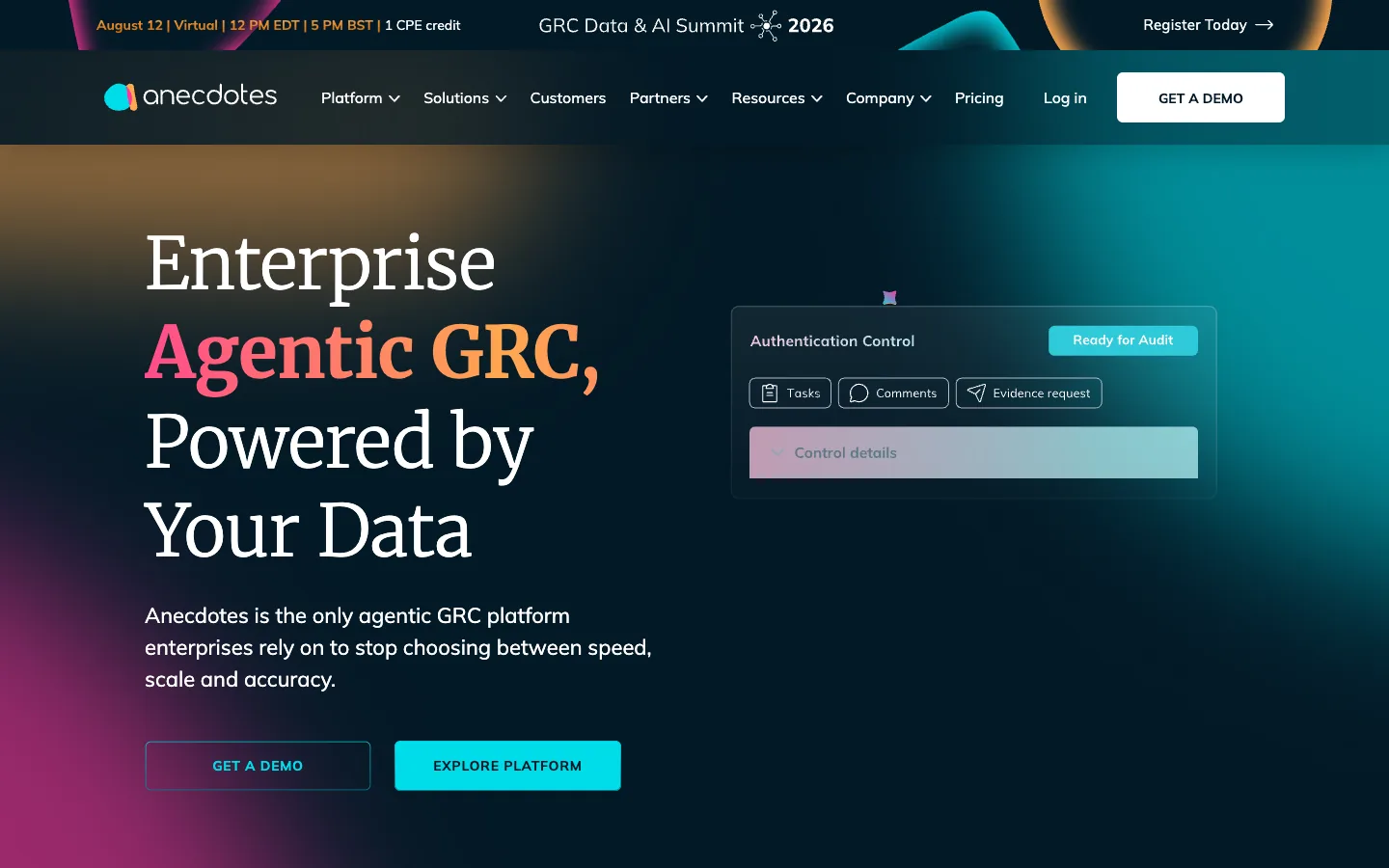
Anecdotes makes the case that AI compliance does not need a separate tool at all. It is a GRC platform, and the pitch is consolidation, letting you manage ISO 42001 and the NIST AI RMF inside the same engine you already run for SOC 2 and ISO 27001. For a security team buried in point tools, folding AI frameworks into existing GRC is the draw.
The platform maps more than 60 frameworks and keeps them in sync, so a control you satisfy once can count toward several standards at the same time. Agentic Continuous Control Monitoring watches for drift, and Agentic Policy Lifecycle Management handles policy reviews and approvals. A ChatGRC command hub lets staff query compliance status in plain language. The Anecdotes AI governance page covers how the framework mapping works.
Anecdotes also points to its own certification stack, not just its product. The company says it “became one of just 30 organizations worldwide to hold the trifecta of ISO 27001, ISO 27701, and ISO 42001 certifications” (Anecdotes). That count is Anecdotes’ own figure rather than a number published by a registrar, so treat it as a vendor claim, but the certifications themselves are real. An Agent Studio lets teams build custom GRC agents for their own processes.
Why teams pick Anecdotes for AI rules:
- ISO 42001 and NIST AI RMF inside one GRC platform
- More than 60 frameworks with shared, reusable controls
- Continuous monitoring that flags control drift
- Plain-language status queries through ChatGRC
Pros:
- Avoids buying a standalone AI compliance tool
- Strong framework reuse across SOC 2, ISO, and AI
- Holds the ISO 27001, 27701, and 42001 certifications itself
Cons:
- Less specialized than purpose-built AI governance tools
- Best value only if you adopt it as your main GRC system
Anecdotes has no Capterra listing, so there is no third-party review score to cite here (checked August 19, 2026).
Credo AI
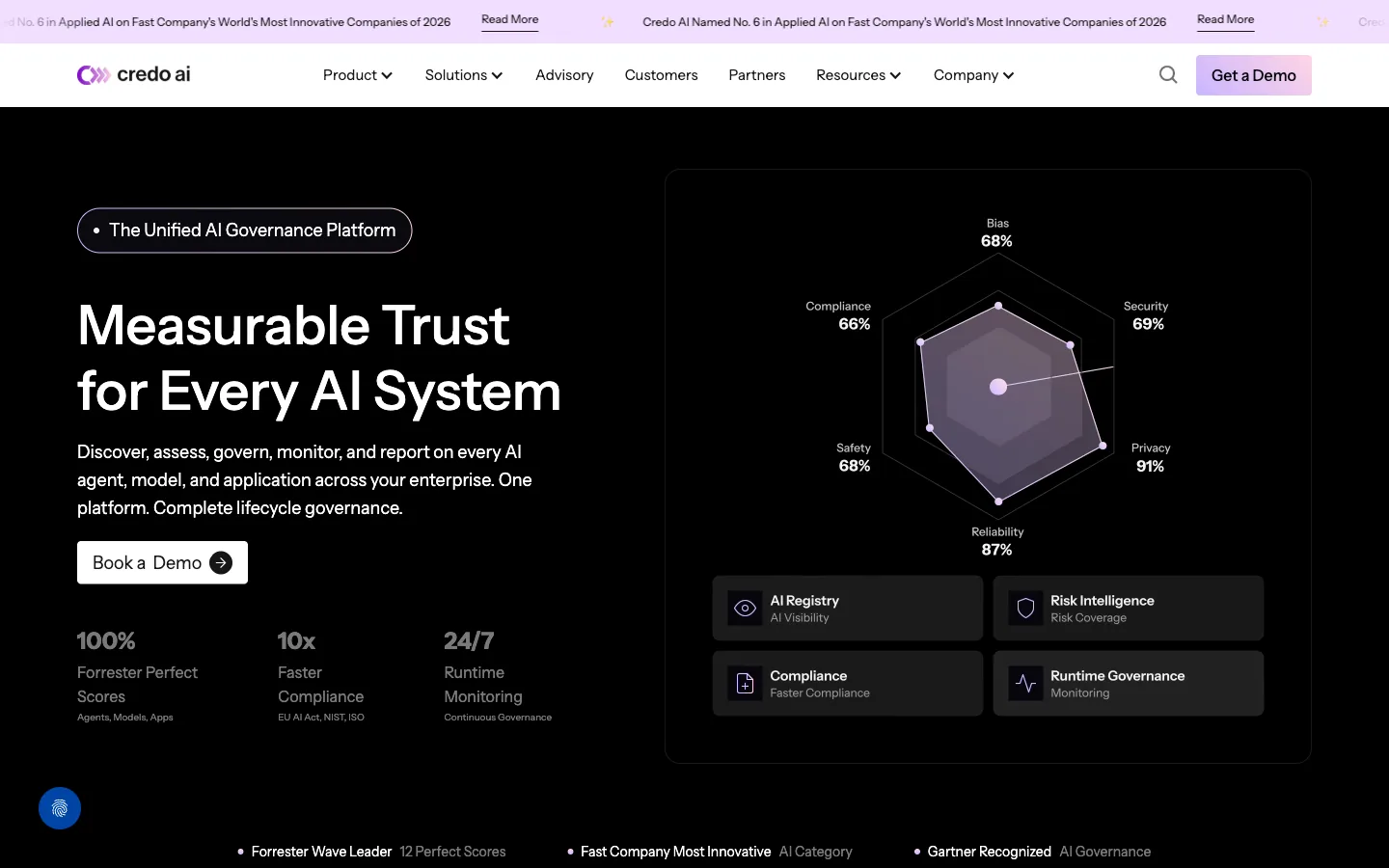
Credo AI was built for AI governance from the ground up, under the tagline “Govern AI Everywhere.” Its AI Registry auto-discovers AI and ML systems across the company, shadow AI included, and gives each one a governance record. That registry is the backbone for any audit, since you cannot govern models you have not catalogued.
Where Credo AI pulls ahead is its Policy Engine and its library of pre-built regulatory packs. Out of the box it covers the EU AI Act, NIST AI RMF, ISO 42001, SOC 2, OMB M-25, Colorado’s ADMT rule, and NAIC AI guidance, so a team facing several regimes does not start from scratch. Risk Intelligence layers automated red-teaming and drift detection on top. The Credo AI product page details the module set.
For the agent era, Credo AI keeps a separate Agent Registry that tracks each agent’s capabilities, access, and level of autonomy. Its GAIA assistant pulls evidence and suggests remediation across the program. The result is a governance layer that scales from a handful of models to a full portfolio.
What Credo AI brings to an audit:
- Auto-discovery of AI, ML, and shadow AI systems
- Pre-built policy packs for the EU AI Act, ISO 42001, and more
- Red-teaming and drift detection through Risk Intelligence
- An Agent Registry tracking access and autonomy
Pros:
- Deepest library of ready regulatory policy packs
- Purpose-built for full AI governance programs
- Tracks both models and autonomous agents
Cons:
- More than a team needs for a single framework
- Program depth takes time to set up properly
Credo AI’s Capterra listing carries no rating yet, based on 0 user reviews (checked August 19, 2026).
Holistic AI
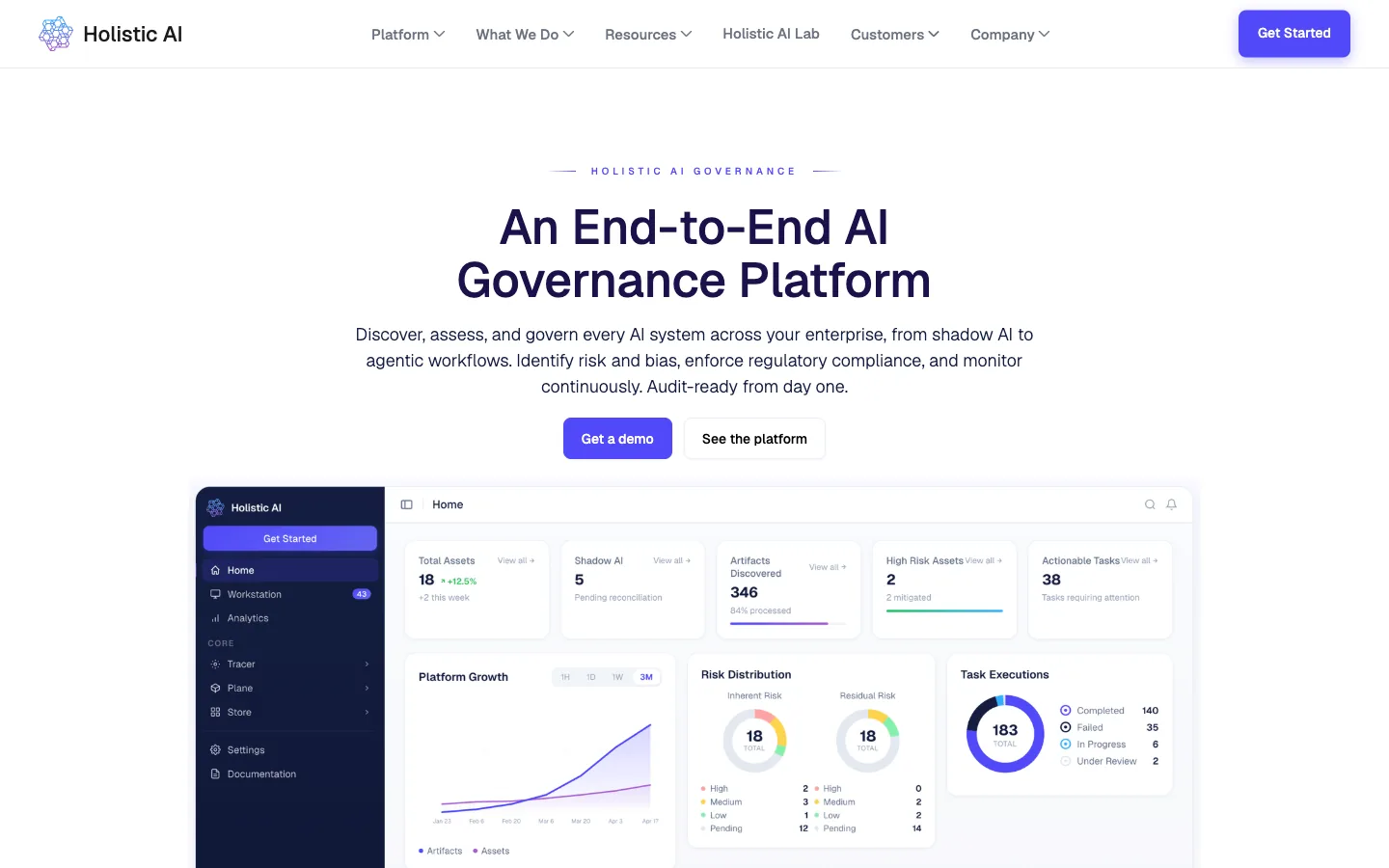
Holistic AI closes the list with the most technical testing depth of the group. Its platform runs in three stages, Identify, Protect, and Enforce. Identify discovers AI across AWS, Azure, GitHub, Databricks, and more than 20 integrations, so shadow models in your cloud get caught alongside the sanctioned ones.
Protect is where Holistic AI separates itself from tools that only track paperwork. Its site advertises “Run 40+ specialised tests covering bias, safety, security, and performance” (Holistic AI), and lists automated testing for bias, fairness, toxicity, hallucination, prompt injection, and adversarial attacks. That goes well past what most compliance platforms cover. Enforce then applies real-time policy with deployment gates and kill switches, mapped to the EU AI Act, NIST AI RMF, ISO 42001, and NYC Local Law 144. The Holistic AI platform page shows how the stages connect.
Two guardian agents, Sentinel and Operative, watch deployed models and step in when something drifts out of bounds. Holistic AI has been named by Gartner, IDC, and CB Insights, and counts Unilever, GSK, and Siemens among its customers. For teams whose risk lives in model behavior, this is the deepest option here.
Where Holistic AI goes deepest:
- Shadow-AI discovery across major cloud and code platforms
- More than 40 tests spanning bias, safety, security, and performance
- Deployment gates and kill switches tied to live policy
- Framework mapping for the EU AI Act, ISO 42001, and Local Law 144
Pros:
- Strongest technical testing of model behavior
- Real-time enforcement with deployment gates
- Proven with large enterprise customers
Cons:
- Heavier than teams without ML models in production need
- Technical depth assumes in-house AI expertise
Holistic AI has no Capterra listing, so there is no third-party review score to cite here (checked August 19, 2026).
How to Choose an AI Compliance Tool
The right tool depends on where your AI compliance gap actually sits. Holistic AI and Credo AI go deep on model testing and governance programs, Vanta and Drata lead on framework mapping and agent control, Secureframe automates the audit work, and Anecdotes folds AI into the GRC platform you already run.
This category is growing for a reason. Gartner forecasts that fragmented AI regulation will drive 1 billion dollars in compliance spend by 2030, and Gartner director analyst Lauren Kornutick says “AI governance platforms are now essential for building trust, preventing costly AI incidents, and ensuring responsible, compliant AI deployment at scale.”
Whichever you pick, each one starts from a list of AI you already know about, which is why discovery is the prerequisite rather than the finishing touch. Arun Chandrasekaran, Distinguished VP Analyst at Gartner, advises that “CIOs should define clear enterprise-wide policies for AI tool usage, conduct regular audits for shadow AI activity and incorporate GenAI risk evaluation into their SaaS assessment processes” (Gartner). Tools like Torii cover that first step by surfacing shadow AI across SSO, finance, and browser data; pair one with the framework tool that fits your stack.
Torii is the discovery and access layer, not a replacement for a GRC or model-testing platform. If your next audit will expose an incomplete AI inventory, start there; if it will expose untested models or missing control mappings, start with one of the framework or testing tools above. See the Torii AI Management Platform.
Frequently Asked Questions
The EU AI Act's Article 50 transparency obligations took effect on August 2, 2026, while the July 2026 AI Omnibus moved Annex III high-risk obligations to December 2, 2027 and product-embedded high-risk systems to August 2, 2028. Noncompliance with prohibited practices can trigger fines up to 35 million euros or 7% of global annual turnover, whichever is higher, plus increased regulatory scrutiny and mandatory remediation steps depending on your deployer/provider classification.
Shadow AI is widespread: Microsoft's 2025 Work Trend Index found that 78% of AI users bring their own AI tools to work, and a Gartner survey of 302 cybersecurity leaders run between March and May 2025 found 69% of organizations suspect or have evidence that employees are using prohibited public GenAI. That makes accurate inventories essential to satisfy SOC 2, ISO 42001 and EU AI Act requirements.
Use Torii to discover shadow AI: it aggregates SSO logs, identity providers, browser extensions, finance, OAuth grants and HRIS to build a live inventory. Torii also scores apps for SOC 2/data residency and automates approvals and access revocation during role changes.
Framework-focused platforms like Vanta, Drata and Anecdotes map ISO 42001 and EU AI Act controls and reuse evidence. Credo AI and Holistic AI prioritize model testing, red-teaming and drift detection. Secureframe automates evidence validation and remediation to speed audit readiness.
Evidence automation like Secureframe’s evidence validation, Vanta’s evidence reuse, and Torii’s access certifications cuts manual work. Drata logs agent decisions and uses MCP servers for audit trails. These features flag gaps, auto-generate policies or fixes, and provide repeatable audit records.
Prepare by building a complete AI inventory, mapping controls to ISO 42001 or SOC 2, running model tests and vendor risk assessments, automating evidence collection, enforcing access and agent policies, and remediating gaps before the auditor's first review.