

What Is an AI Management Platform? A 2026 Overview
 Chris Shuptrine
•
May 29, 2026
•
26 min read
•
Updated June 2, 2026
Chris Shuptrine
•
May 29, 2026
•
26 min read
•
Updated June 2, 2026
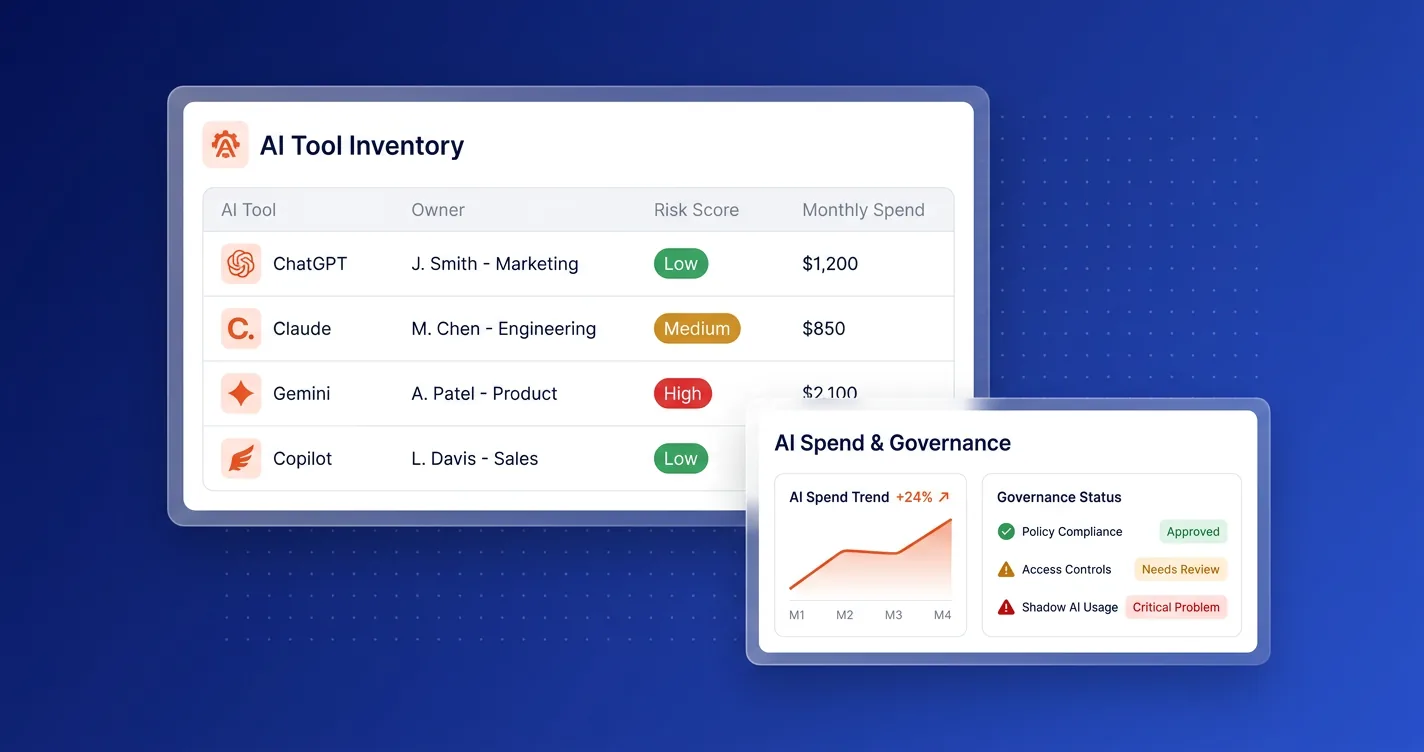
AI management platforms give IT and security teams one system to discover, govern, and control shadow AI tools, agents, and spend.
Ask about this article
Opens Claude in a new tab to answer, using this article as the source.
Most companies spent the last two years quietly turning into AI shops without ever calling it that. Employees signed up for chatbots, paid with personal cards, and pasted customer data into prompts. IT and security learned about it the way they always learn about new tech, after the fact, in a quarterly invoice or a breach report.
By 2026, the gap between AI usage and AI oversight has gotten too wide to ignore, and closing it usually starts with tools for tracking AI adoption across the company. Microsoft’s Work Trend Index reports that “75% of knowledge workers use AI at work today, and 46% of users started using it less than six months ago.” Netskope Threat Labs is blunter about where that usage lives: “GenAI is shadow IT: Most genAI use in the enterprise (72%) is shadow IT, driven by individuals using personal accounts to access genAI apps” (Cloud and Threat Report: Generative AI 2025). Spend is climbing in step, with Zylo pegging the average company’s AI-native bill at $1.2 million a year.
A new category called the AI management platform is emerging to close that gap, and this guide covers what it does and why it matters now. Teams whose AI bill is dominated by agentic coding often start with a narrower toolset. See our list of Claude Code spend management tools for that slice.
Table of Contents
- What Is an AI Management Platform?
- Why Do I Need AI Management?
- What Should an AI Management Strategy Include?
- The 4 Pillars of AI Management
- How Do AI Management Platforms Work?
- Can I DIY AI Management?
- How Does It Support EU AI Act, NIST, and ISO 42001 Compliance?
What Is an AI Management Platform?
AI management platforms give IT, security, and finance one shared system for tracking and governing every AI tool, model, and agent employees use. Instead of running separate scanners or asking each team to keep its own list, the platform pulls signals from identity providers, OAuth grants, expense data, browser activity, and network telemetry into a single inventory. The result is a working map of which AI products are in play, which employees touch them, and what data flows through each one.
That positioning matters because most companies already have a dozen overlapping point tools that each watch part of the picture. A DLP rule catches sensitive text heading toward a chatbot. CASB flags one of the bigger AI platforms. Finance sees a credit-card charge for an annual ChatGPT seat. None of those signals talk to each other, so the same shadow tool can appear in three reports and still go unmanaged.
A platform pulls those streams together and adds workflow on top, producing a connected picture no single tool can match. Common capabilities include:
- Continuous discovery across SSO, OAuth, finance, browser, and network sources
- A unified inventory of AI apps, models, and agents tied to user identities
- Risk scoring per tool and per data flow
- Policy enforcement and approval workflows for new requests
- Spend and usage analytics with license consolidation
- Audit-ready evidence for frameworks like the EU AI Act or ISO 42001
The category sits next to SaaS management the same way endpoint management once sat next to network security. The shapes are familiar, with rapid bottom-up adoption, hidden costs, and a governance vacuum that surfaces later in audits or breach reports. Buyers usually frame the outcome around three results, namely visibility into what’s in use, control over what’s allowed, and containment of AI spend that has been climbing fast every quarter.
An AI management platform is the operational system of record for every AI tool, model, agent, and OAuth grant in use across a company, tying each one back to an identity, a data flow, a cost, and a policy owner.
Why Do I Need AI Management?
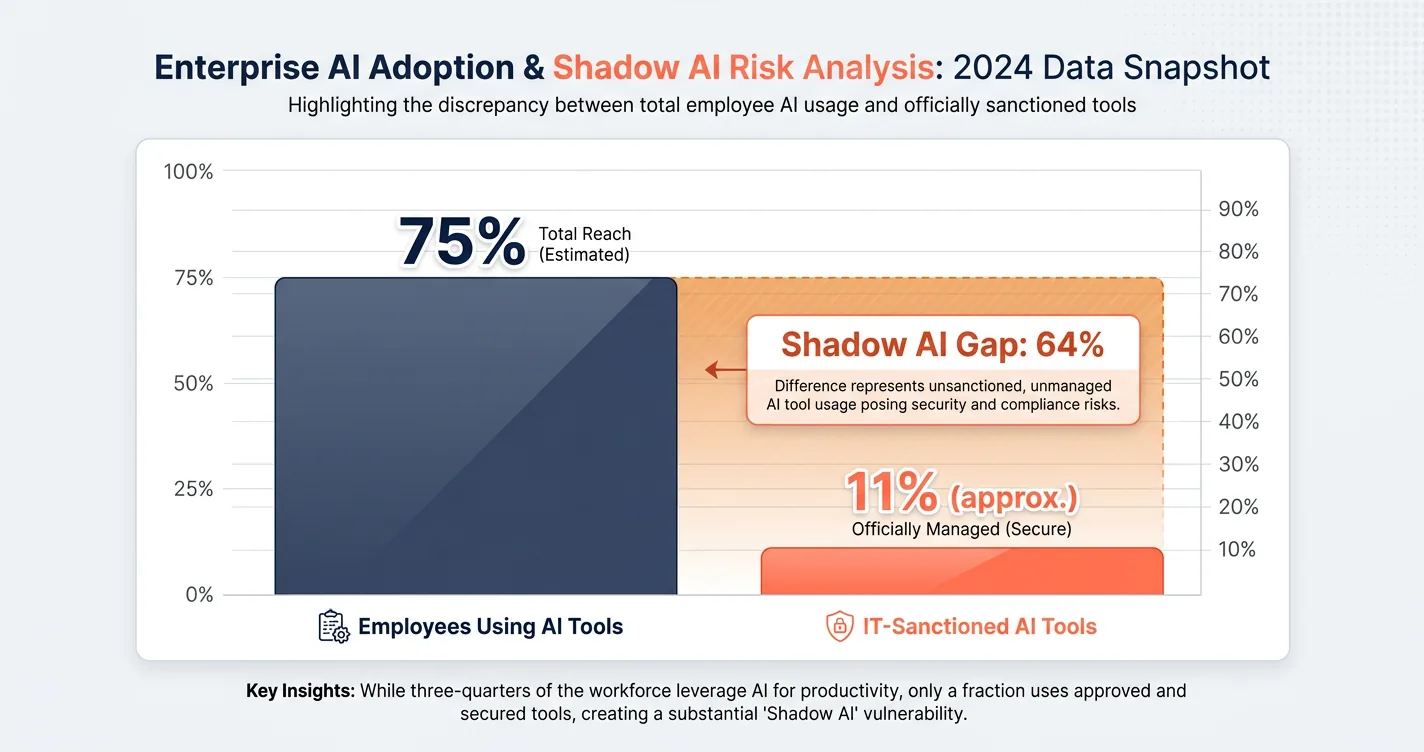
The demand case writes itself once you put the 2025 and 2026 numbers next to one another. Microsoft’s Work Trend Index reports that three out of four knowledge workers already use AI on the job. Cyberhaven Labs measured “an astonishing 61x in the last two years” of growth in workplace AI usage, and found that “a staggering 83.8% of enterprise data flowing into AI tools is going to platforms classified as critical or high risk” (2025 AI Adoption and Risk Report). Awareways puts the visibility gap in its Trendrapport 2025 at IT having actual sight of under 11 percent of AI tool usage, with unauthorized AI use among AI-using staff at 78 percent.
At those volumes, small policy gaps turn into real exposure quickly. Netskope reports that incidents of users sending sensitive data to AI apps “has doubled in the past year, with the average organization seeing 223 incidents per month” (Cloud and Threat Report: 2026). IBM’s 2025 Cost of a Data Breach research ties shadow AI to the breach rate directly: “One in five organizations reported a breach due to shadow AI, and only 37% have policies to manage AI or detect shadow AI” (IBM newsroom). Where shadow AI use ran high, IBM measured an extra $670,000 on the average breach cost. Reco’s study of the dwell-time problem found that “shadow AI persistence averages 400+ days, with some applications running unsanctioned for over a year” (Reco), which is a long time for sensitive data to keep walking out the door. See our roundup of shadow AI discovery tools for the platforms purpose-built to close that gap.
75% of knowledge workers use AI on the job (Microsoft Work Trend Index). 72% of enterprise GenAI use is shadow IT (Netskope, 2025). IT has sight of under 11% of AI tool usage (Awareways, 2025). Average enterprise AI bill: $1.2M per year. Average shadow AI dwell time before discovery: 400+ days (Reco, 2025).
Software cost is the other half of the case for buying one of the best AI management platforms. Zylo’s 2026 data has AI-native spend up 108 percent year over year, averaging $1.2 million per organization, and ChatGPT now sitting as the most-expensed software on the platform. The pattern behind those totals is consistent across sources: the number of AI tools in use keeps outrunning the number that ever reached a security review.
Boiled down, the urgency around shadow AI management comes from a handful of pressures that have landed at the same time:
- Adoption has run far ahead of procurement and security review
- Sensitive data routinely lands in prompts and is hard to recall
- AI-driven spend is the fastest-growing software line item for many finance teams (see our roundup of AI spend management tools for vendor-by-vendor coverage)
- Regulators are no longer waiting to see what shakes out
What Should an AI Management Strategy Include?
A strategy is the program around the platform, not the tool itself. Even the strongest discovery engine produces a stack of findings that nobody owns if the underlying program is missing. Most teams start by naming a single accountable owner, usually in IT or security, with finance and GRC pulled in for spend and compliance questions. From there the strategy usually grows around six pieces.
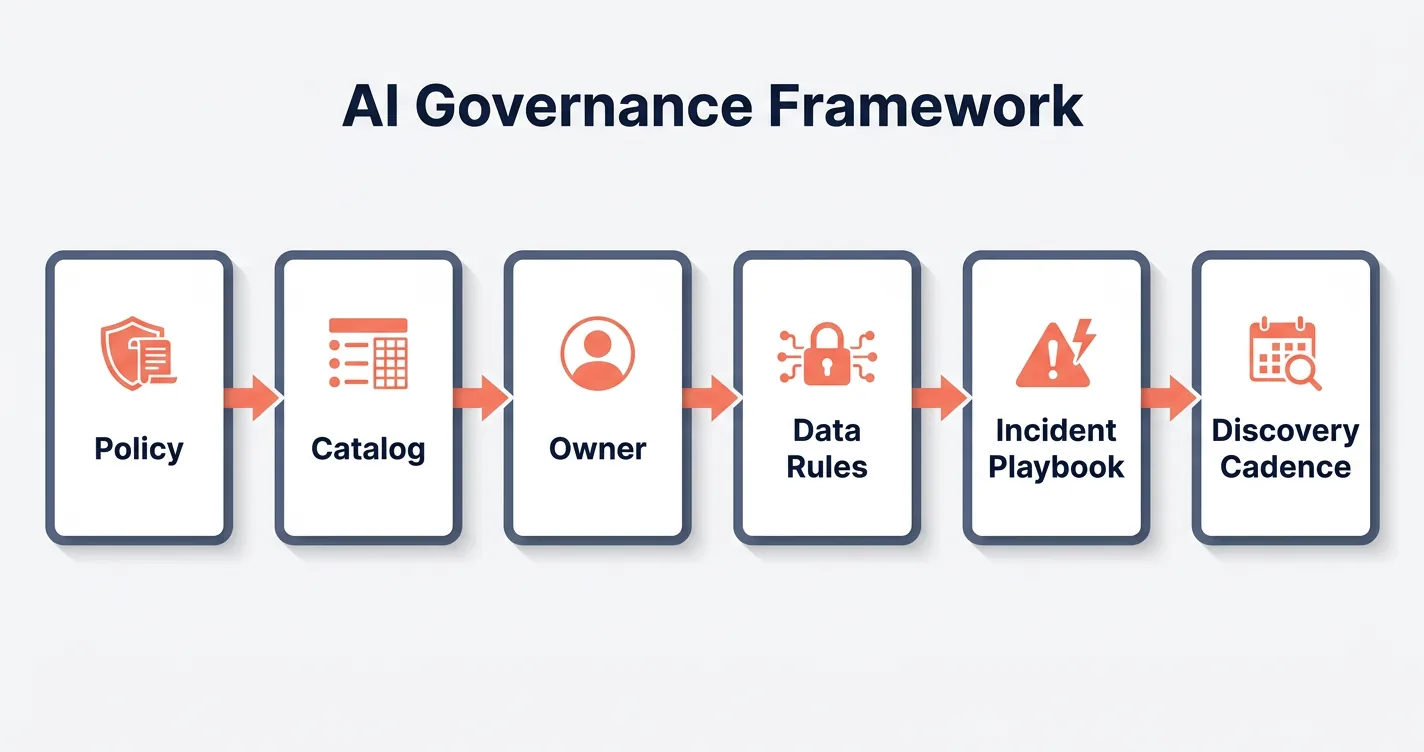
The recurring elements look like this in practice across most programs that have moved past the spreadsheet phase:
- An AI acceptable-use policy that defines who can use what, with what data, for which tasks
- A sanctioned-tool catalog that gives employees an obvious approved path
- A named owner across IT, security, and GRC who triages new tool requests
- Data classification rules describing what can and cannot go into AI tools
- An incident playbook for prompt leakage, model misuse, or rogue agents
- A discovery cadence so the inventory keeps pace with new sign-ups
A common stumbling block early on is plain vocabulary confusion between adjacent categories. AI management, AI governance, and AI TRiSM are related but distinct. AI governance, as Gartner uses the term, focuses on policies and oversight committees. Gartner positions AI TRiSM as the layer underneath it: “AI trust, risk and security management (AI TRiSM) provides the technical foundation and controls to operationalize modern AI governance” (Gartner). In practice that means model-level controls such as input filtering and output validation. AI management is the operational layer that ties tool discovery, access, spend, and compliance evidence together for IT and security teams. Keeping those labels straight helps when you brief leadership, since each one maps to a different budget owner and a different vendor shortlist.
AI governance sets the policy and committee structure. AI TRiSM secures the model layer with input/output controls. AI management is the operational system of record for tools, agents, spend, and evidence. Most programs need all three, but they buy from different shortlists.
Finally, a usable strategy has to acknowledge how fast the surface area is moving. New agentic tools, OAuth grants from existing SaaS apps, and AI features bolted onto familiar software all show up faster than quarterly reviews can catch. That’s why the cadence and ownership pieces matter as much as the policy text itself.
The 4 Pillars of AI Management
It helps to break the discipline into four pillars so teams can pick a starting point and measure progress. Each pillar has its own owner, metrics, and tooling questions, and most programs mature unevenly across them.
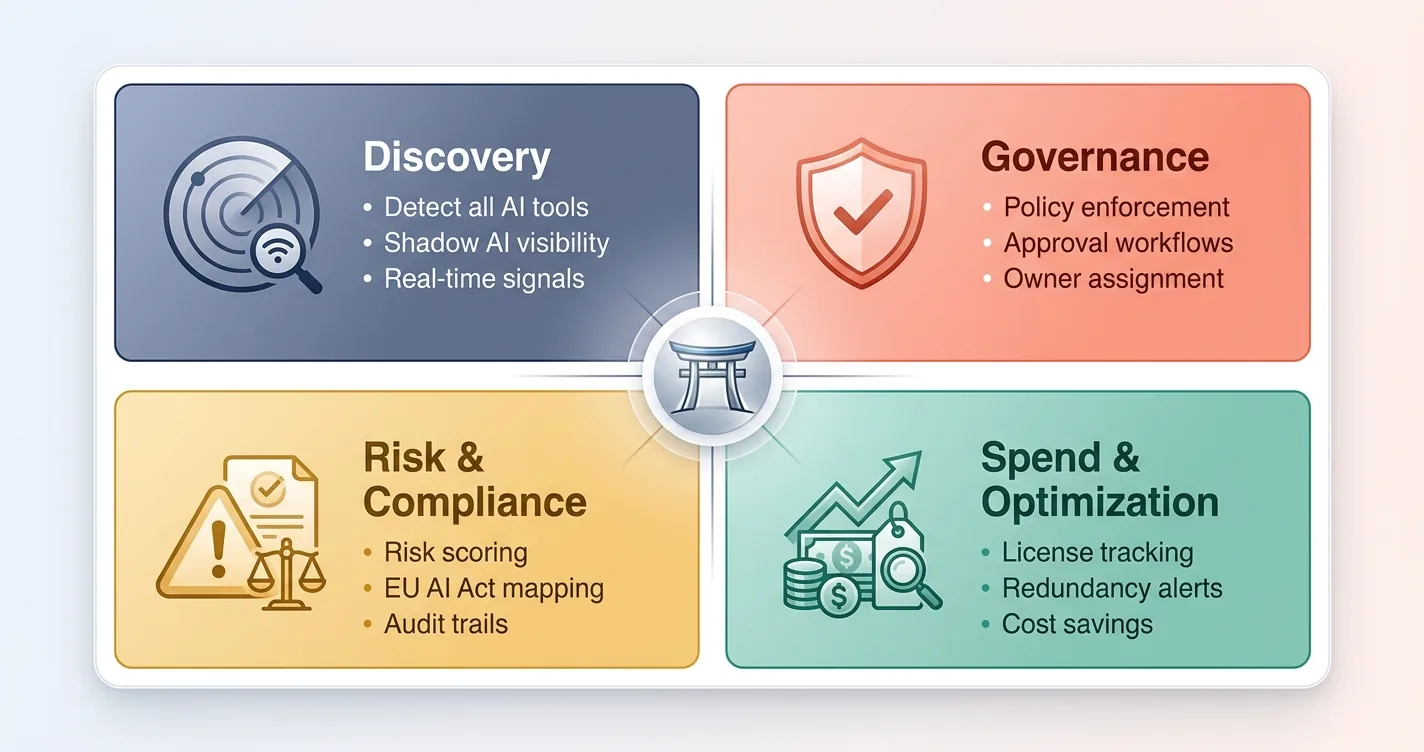
Discovery
Discovery is the foundation, since nothing else works without a current inventory. Strong discovery pulls from SSO and IdP logs, OAuth scope grants, expense and finance feeds, browser extensions, and network telemetry. The goal is to surface every AI tool, model, and agent in use, including the long tail of niche tools that one or two employees rely on.
Governance
Governance covers policy, approval workflows, access controls, and tool lifecycle. It answers who can request a new AI tool, what data it can touch, who reviews the request, and how access is revoked when the tool is retired. Good governance also handles renewals and the moment when a beta tool either graduates to sanctioned status or gets removed.
Risk and Compliance
This pillar maps each tool to a risk score and to the framework controls your organization owes evidence against. It produces the artifacts auditors look for, such as an AI inventory, risk classifications, human-oversight logs, and incident records. The right platform turns these from a quarterly fire drill into a continuous output.
Spend and Optimization
Spend has become a board-level question for AI in the past 18 months. This pillar tracks usage per user, per team, and per model, then flags duplicate seats, overlapping subscriptions, and tools nobody actually opens. It also forecasts renewals, the same discipline behind GitHub Copilot contract management, so finance is not surprised by another 100 percent year-over-year increase. Together these four pillars are how teams turn a vague AI risk discussion into an operating plan.
| Pillar | Primary Owner | Core Output | Sample Metric |
|---|---|---|---|
| Discovery | IT | Live AI inventory tied to identities | Time-to-discover a new tool |
| Governance | Security / GRC | Approval workflow and access lifecycle | % of tools with a named owner |
| Risk & Compliance | GRC / Legal | Audit-ready evidence pack | Controls mapped per framework |
| Spend & Optimization | Finance / IT | Spend per user, model, and team | Duplicate seats reclaimed |
What Are the Hidden Costs of Not Managing AI?
The costs of doing nothing show up across four buckets, and only one of them is the obvious software bill. Data leakage usually leads the list. Cyberhaven found that “34.8% of enterprise data shared with AI is now sensitive, up from just 10.7% two years ago” (2025 AI Adoption and Risk Report), a category that includes source code, customer records, and internal financials. Once that data is in a third-party model’s logs or training pipeline, getting it back is rarely possible, and prompt injection risk only widens the blast radius. IBM’s 2025 Cost of a Data Breach report attached an extra $670,000 to the average breach cost where shadow AI use ran high.
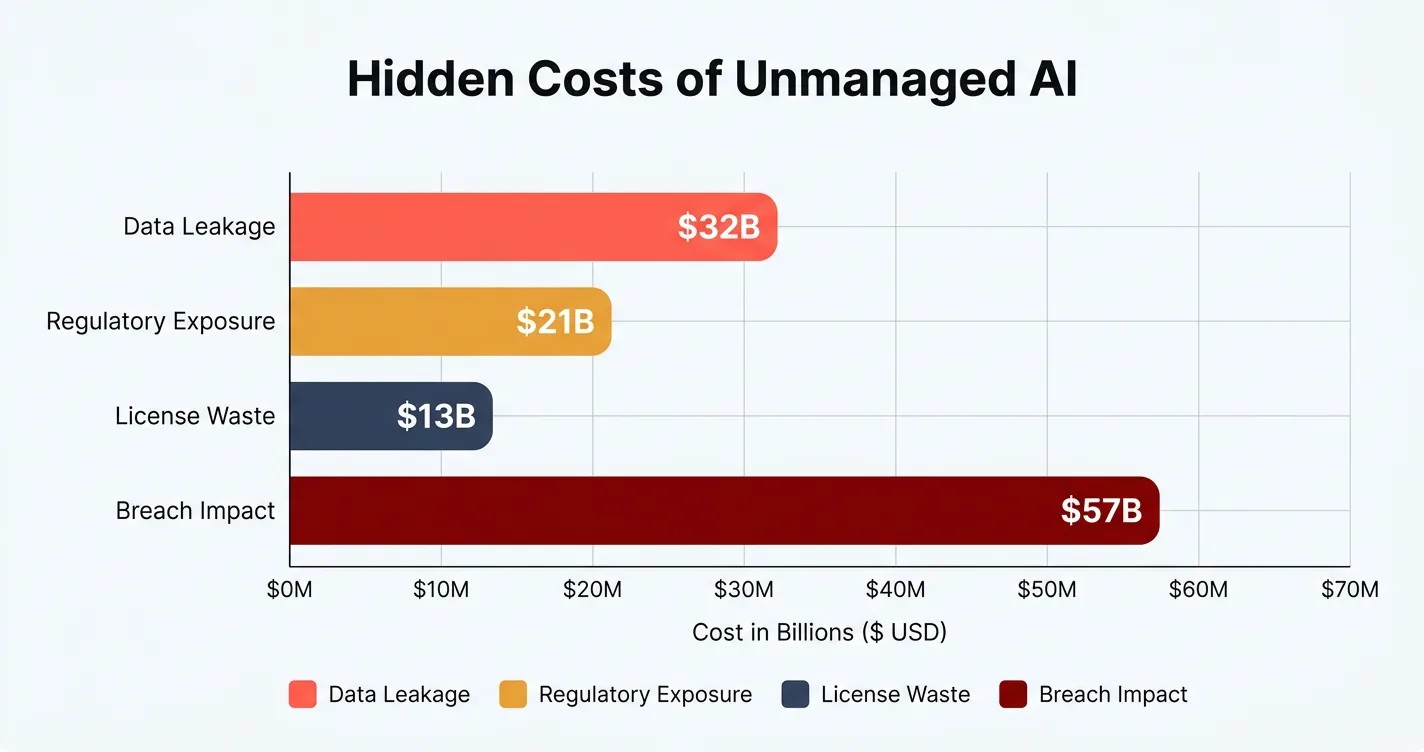
Regulatory exposure has caught up faster than many teams expected, though the deadline itself has moved. EU AI Act fines run in three tiers. The top one, reserved for the prohibited practices in Article 5, sets “administrative fines of up to 35 000 000 EUR or, if the offender is an undertaking, up to 7 % of its total worldwide annual turnover for the preceding financial year, whichever is higher” (Article 99). The lower tiers sit at €15 million or 3 percent and €7.5 million or 1 percent. The high-risk timeline, however, slipped this summer: the AI Omnibus entered into force on July 27, 2026 and, per the European Commission, “extends the timeline to 2 December 2027 for high-risk AI systems and 2 August 2028 for AI embedded in products” (Navigating the AI Act). The extra runway is real, but the inventory work it requires has not shrunk.
License waste tends to be the quiet cost that finance notices first. Zylo’s 2026 data shows fragmented AI tooling running $1,800 to $2,800 per user per year, while consolidated stacks sit around $800 to $1,400. The gap usually comes from individual ChatGPT, Claude, Cursor, Gemini, and Copilot subscriptions stacked on the same employees.
Breach impact and dwell time round out the cost picture, and the numbers here are worth keeping on hand:
- One in five organizations reported a breach due to shadow AI, and only 37 percent have policies to manage AI or detect it, per IBM’s 2025 breach research
- Average dwell time for an undiscovered shadow AI tool is 400+ days, per Reco’s shadow AI study
- Cyberhaven measured 83.8 percent of enterprise data flowing into AI tools going to platforms it classifies as critical or high risk
- ChatGPT is now the single most-expensed application on Zylo’s platform
Torii's AI Dashboard ties usage, spend, and OAuth scope data into one view so finance can spot duplicate AI subscriptions, security can see which tools hold sensitive data, and IT can act before the next 400-day dwell window starts.
The unifying point is that none of these costs sit cleanly in one department’s budget, which is part of why they keep growing unchecked. Spreading the same exposure across security, finance, and GRC makes it easy for everyone to assume someone else is watching.
How Do AI Management Platforms Work?
The mechanics start with multi-signal discovery, since one feed alone is never enough. A platform connects to your identity provider for sign-in events, your OAuth consent logs for app authorizations, and your finance system for SaaS and AI charges. Most products add a browser extension to catch the long tail of tools an employee uses on a personal account, plus network telemetry for traffic patterns that match known AI endpoints. The signals are then deduplicated and tied back to real user identities.
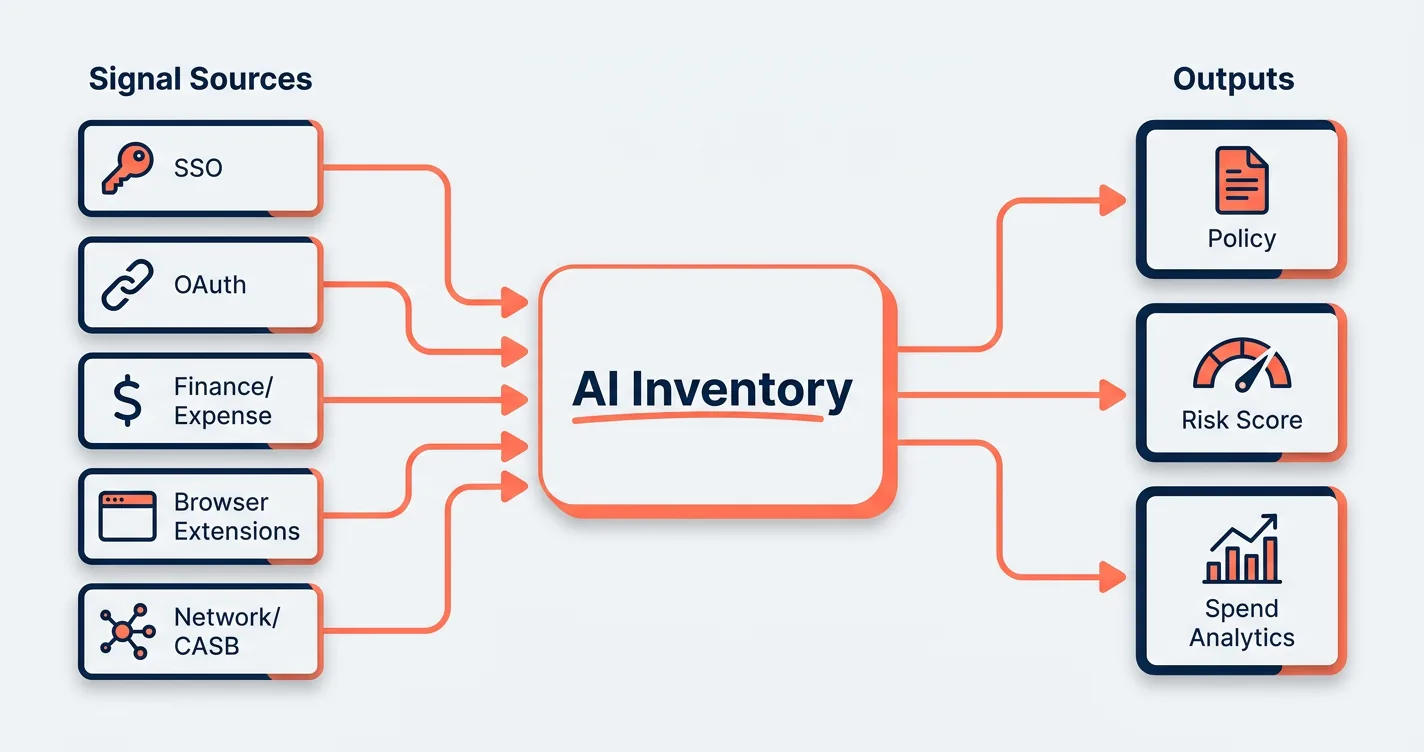
Once the inventory exists, the platform layers a few capabilities on top. Risk scoring weighs factors like data sensitivity, model provider, region, and authentication strength. Policy enforcement decides what happens when a new tool appears, ranging from automatic blocking to a human-in-the-loop approval. Usage and spend analytics roll up per user, per team, and per model so finance can spot waste and forecast renewals without pulling spreadsheets every quarter.
API integrations matter more than they used to, since the largest AI vendors now expose admin APIs for their enterprise plans. Coverage usually spans ChatGPT Enterprise, Microsoft Copilot, Claude for Work, Gemini for Workspace, and Agentforce. A modern platform plugs into those APIs directly so it sees per-user prompt counts, model selections, and data-loss policy hits without relying on guesswork from network logs. A typical admin API pull for ChatGPT Enterprise looks like this:
curl https://api.openai.com/v1/organization/usage/completions \
  -H "Authorization: Bearer $ADMIN_KEY" \
  -G --data-urlencode "start_time=1735689600" \
     --data-urlencode "group_by=user_id,model"
A few capabilities show up consistently in almost every serious AI management platform on the market today:
- Agent-level discovery that catches OAuth grants behaving like autonomous agents
- Continuous tracking, not point-in-time scans
- Compliance evidence packs that map to NIST AI RMF, ISO 42001, and EU AI Act controls
- Workflow handoffs into ticketing tools so requests move through approval automatically
- HRIS-driven lifecycle hooks that revoke AI access when employees leave, often paired with one of the AI tool onboarding and provisioning platforms
The newer wrinkle in this whole picture is agent discovery and management. Browser-based agents, ChatGPT custom GPTs, and tools built on the OpenAI Assistants API can grant themselves persistent OAuth scopes against your SaaS stack. Treating those agents as first-class inventory items, not just sessions, is becoming the differentiator between AI management platforms and older shadow IT scanners.
Can I DIY AI Management?
DIY is the default starting point for almost every company, and it usually carries a team further than expected. Most programs begin with three or four spreadsheets, an OAuth consent review in the IdP, an expense scan from finance, and a couple of CASB rules. For a 50-person company on a single Google or Microsoft tenant, that combination can reasonably cover the basics for a while.
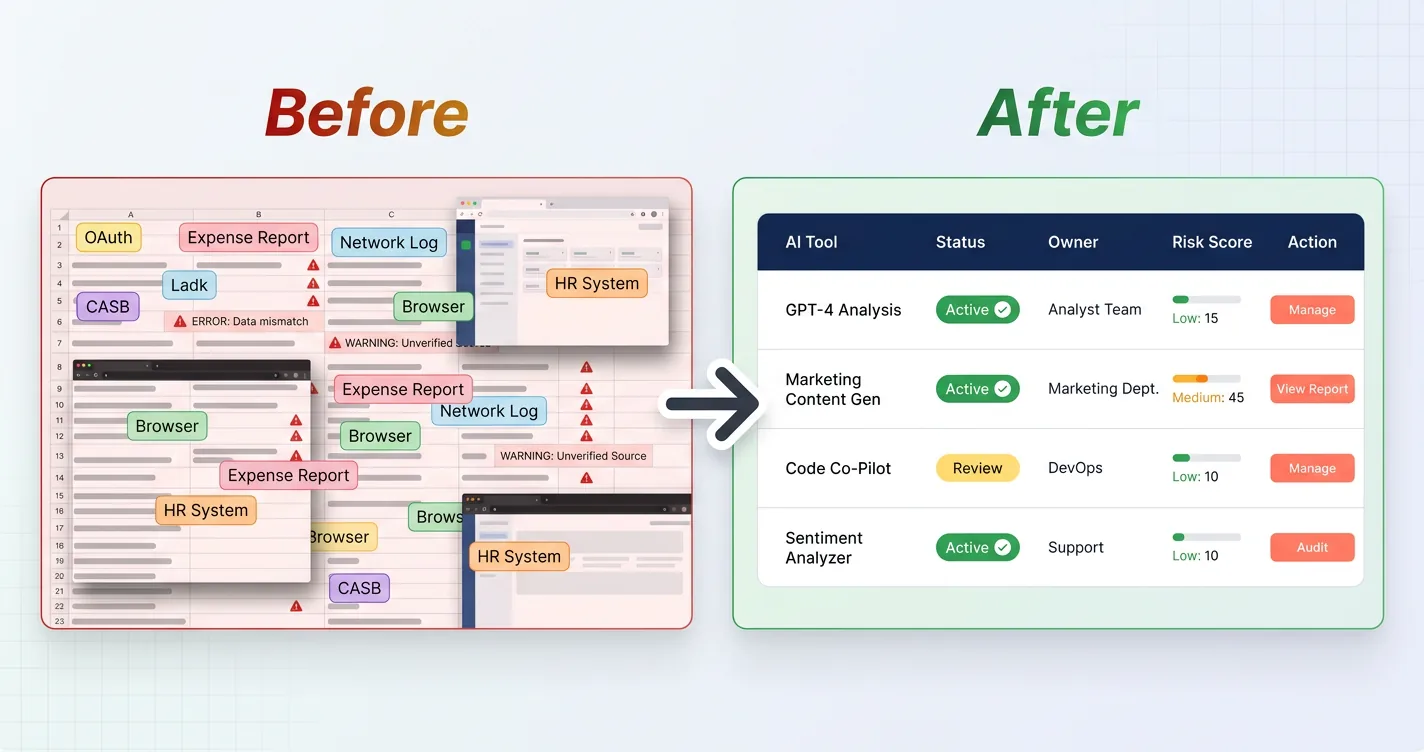
The wheels come off as scale and tool sprawl pick up. The signals stay siloed because no one tool pulls expense, OAuth, browser, and network data together. Manual reviews catch the obvious ChatGPT charges but miss free-tier accounts, personal-card subscriptions, and AI features turned on inside existing SaaS apps. Without continuous coverage, the inventory drifts within weeks of the last audit, and Reco’s 400-plus-day average dwell time is a direct symptom.
DIY approaches tend to break in a few predictable spots as the AI management program scales up:
- No single owner sees both AI spend and AI risk
- Agent and OAuth grants are invisible without specialized tooling
- Audit evidence has to be rebuilt by hand each cycle
- The discovery cadence cannot keep up with how fast employees adopt new tools
- Personal-account usage stays off the books entirely
There are still places where DIY is enough for now. Very small organizations with a tightly controlled SSO catalog, low regulatory exposure, and a culture of approval-first tool adoption can run the program from a few well-maintained sheets. The trigger to consider a platform usually shows up around the time finance flags surprise AI spend, legal asks for an AI inventory for an upcoming audit, or security finds an AI tool with broad OAuth scopes that nobody can recall approving. Teams that have already invested in detecting shadow AI at the network layer tend to hit that tipping point first.
If your inventory is more than a quarter out of date, takes more than a day to refresh, or cannot answer "which agents hold OAuth scopes against our SaaS stack today," DIY is no longer carrying the program. That's the buy signal, not the headcount on the IT team.
Knowing when DIY has stopped working is more useful than insisting it never works. The honest answer is that the model holds for a smaller slice of companies each year as AI usage grows.
How Does It Support EU AI Act, NIST, and ISO 42001 Compliance?
Three frameworks dominate conversations with legal and compliance teams right now. Each one has a different purpose, and a good AI management platform produces evidence for all three out of the same inventory and policy data.
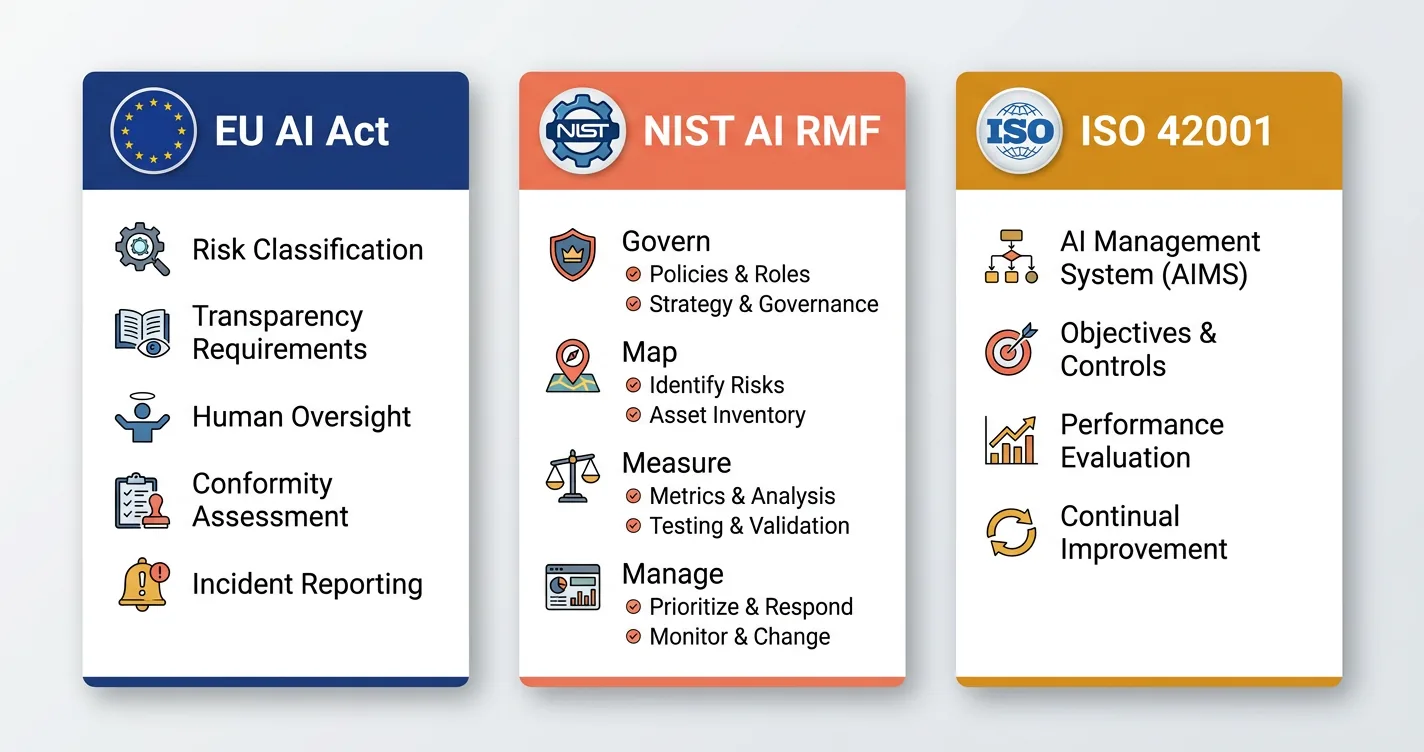
The EU AI Act is the most concrete because it carries penalties. Prohibited practices have been banned since February 2025. High-risk system obligations were originally set for August 2, 2026, but the AI Omnibus pushed Annex III use-based high-risk systems to December 2, 2027 and high-risk AI embedded in regulated products to August 2, 2028. The substance did not change: risk management, data governance, technical documentation, human oversight, and post-market monitoring. Fines top out at €35 million or 7 percent of global annual turnover for Article 5 prohibited practices, with lower tiers of €15 million or 3 percent and €7.5 million or 1 percent for other breaches. Either way the burden of proof falls on companies to show they know what AI is operating, what data flows through it, and who is watching it.
NIST’s AI Risk Management Framework is voluntary in the United States but increasingly cited in vendor questionnaires and federal contracting. It organizes work into four functions: Govern, Map, Measure, and Manage. A platform supports the Map and Measure pieces directly by maintaining an AI inventory, scoring each tool, and tracking incidents over time.
ISO/IEC 42001 is the certifiable standard in this trio, and it’s gaining traction quickly. It defines an AI management system in the same shape as ISO 27001’s information-security management system, with policies, roles, controls, and audits. Certification is becoming a procurement requirement at larger enterprises, and the platform contributes the operational evidence behind most of the controls.
| Framework | Status | What the Platform Produces |
|---|---|---|
| EU AI Act | Mandatory; high-risk obligations from Dec 2, 2027 (Annex III) and Aug 2, 2028 (embedded in products), per the July 2026 AI Omnibus | Inventory, risk classification, human-oversight logs, post-market monitoring evidence |
| NIST AI RMF | Voluntary, widely referenced | Map and Measure outputs: AI inventory, tool risk scores, incident records |
| ISO/IEC 42001 | Certifiable standard | Policies, roles, controls, and audit trails for an AI management system |
The common evidence outputs a platform should be able to produce on demand for auditors include:
- Current AI inventory with risk classification
- Human oversight records tied to specific tools and use cases
- Incident logs covering prompt leakage, hallucination escalations, and agent failures
- Policy attestations from owners and users
- Audit-ready exports mapped to specific framework controls
The mechanics differ by framework, but the underlying source of truth is the same inventory and policy data. That overlap is why teams reach for a platform rather than maintaining three parallel binders.
How Should I Choose an AI Management Platform?
The buying process tends to go best when teams start with discovery and add governance later, rather than the other way around. You cannot govern what you cannot see, so the first six weeks of a deployment should answer a basic question about what AI is actually running inside the company today, and how much of it the existing stack already covers.
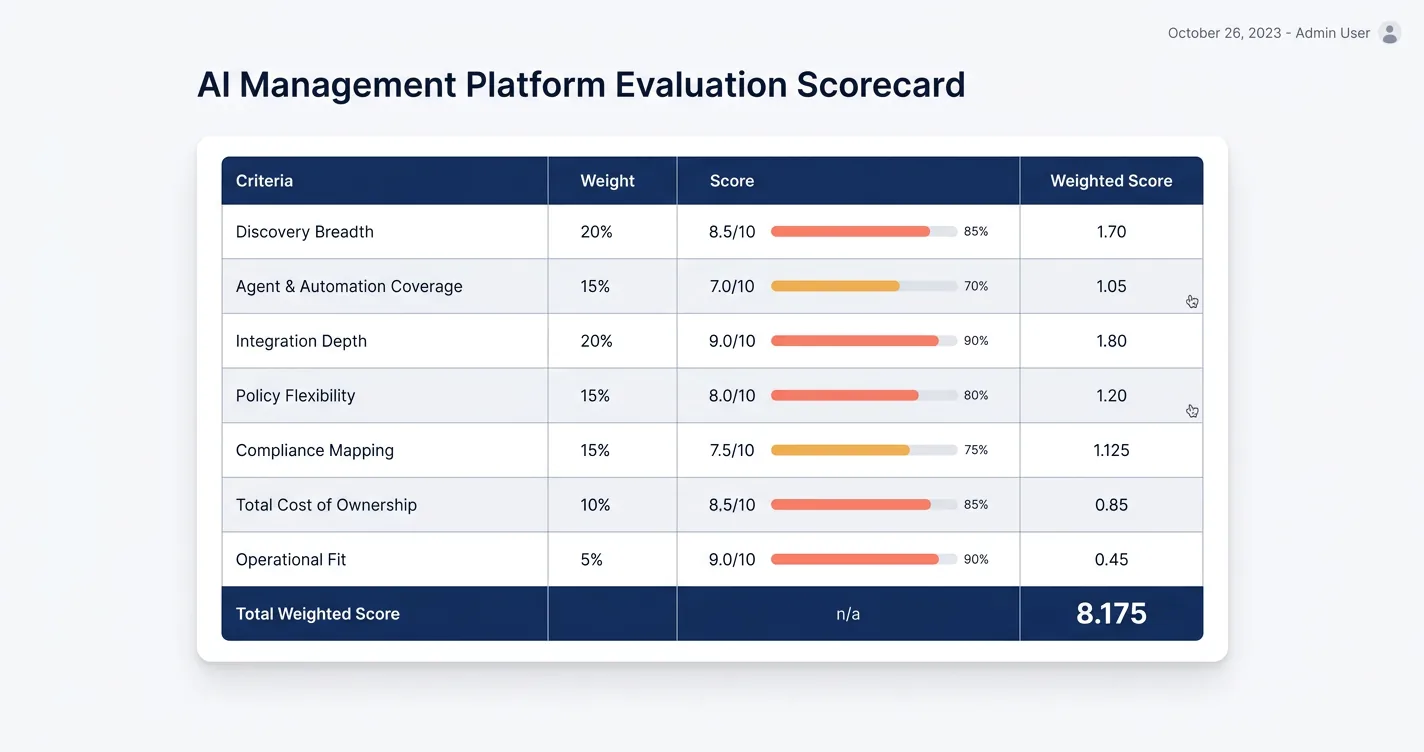
A useful evaluation checklist for AI management software buyers breaks down into seven key areas to consider:
- Discovery breadth across browser, API, SSO, OAuth, and finance signals
- Agent and OAuth coverage, including non-human identities
- Integration depth with your HRIS, IdP, finance, and ticketing stack
- Policy and risk-scoring flexibility for your industry’s data sensitivities
- Compliance framework mapping for EU AI Act, NIST, and ISO 42001
- Total cost of ownership and clear data-ownership terms
- Operational fit, since IT, security, and GRC each shop the category differently
Beyond the checklist, watch how the platform handles edge cases during a proof of value. The two questions that tend to separate strong from weak products are how they discover free-tier accounts created with personal email addresses, and how they treat AI features turned on inside existing SaaS apps. Those are exactly the cases where DIY breaks first, and where a real platform should earn its keep.
A handful of sample RFP prompts that consistently surface useful detail during vendor evaluations:
- Ask the vendor to show an AI tool in use at your company that your SSO and CASB miss today.
- Ask how the inventory represents an agent that holds OAuth scopes versus a user-driven tool.
- Ask for a walkthrough of the audit export they’d produce for an EU AI Act high-risk system review.
Finally, watch out for vendors who package AI management as a feature inside a broader product without a dedicated AI inventory model. Bolt-on coverage is fine for a six-month bridge but tends to age poorly as agentic tools and admin APIs evolve. Buying the function as a core product is the better long-run shape. The same shortlist work pairs well with a structured set of AI tool risk questions sent ahead of any proof of value.
- Discovery breadth Pulls from SSO, OAuth, finance, browser, and network signals, not just one feed.
- Agent and OAuth coverage Treats non-human identities and persistent scopes as first-class inventory items.
- Framework mapping Produces evidence packs for EU AI Act, NIST AI RMF, and ISO 42001 out of the same inventory.
- Lifecycle automation Hooks into HRIS so AI access leaves with the employee, not 400 days later.
Who Provides AI Management, and Why Torii?
The market is still forming, but a few vendor archetypes have settled out. CASB and DSPM vendors are extending their products with AI-specific modules, focused on data-flow and prompt-content controls. AI governance specialists like Credo AI, Trustible, and OneTrust handle the policy and committee side. SaaS management platforms with strong identity and OAuth coverage are extending into AI tools, agents, and spend management. Each archetype is real, and the right fit depends on which problems already hurt the most.
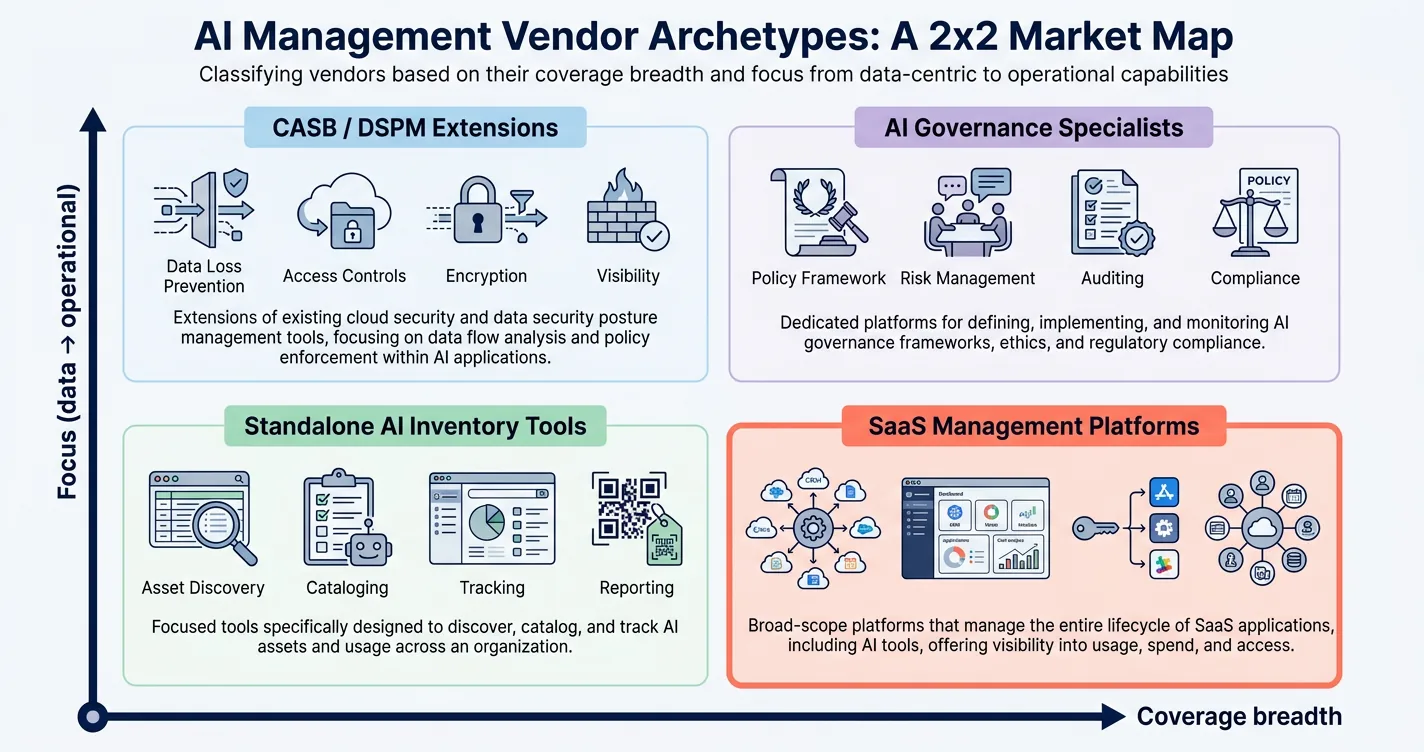
Torii sits in that third group, where the AI management layer is built on top of a mature SaaS management foundation. That matters because shadow AI behaves the way shadow SaaS did a decade ago, only faster. The same discovery sources that catch unsanctioned SaaS catch unsanctioned AI tools, and the same lifecycle automations that revoke a departing employee’s Slack access can revoke their ChatGPT, Claude, and Gemini access in the same workflow.
A few capabilities Torii customers most often point to when describing what the platform does for them:
- Unified discovery across SaaS, AI, and desktop, pulling from SSO, OAuth, finance, browser, and network signals
- An AI dashboard that tracks spend by user, model, and token alongside overlap detection and renewal forecasting
- Lifecycle automation that treats AI accounts and OAuth grants as first-class objects, not afterthoughts
- Policy and compliance workflows mapped to EU AI Act, NIST AI RMF, and ISO 42001 controls
- Coverage of the long tail of AI features inside existing SaaS apps, not just standalone AI products
Torii’s 2026 Benchmark Report adds useful context for sizing the problem in your own stack. It found that more than 50 percent of the top shadow apps inside the average enterprise are now AI-native, with 61.3 percent of the typical 830-app stack sitting outside IT’s direct oversight. Those numbers explain why teams already running a SaaS management program are using the same platform to manage AI rather than buying a separate tool.
A broader vendor comparison is coming in a future article, since each buyer’s shortlist depends on the rest of their stack.
Pick a CASB or DSPM extension if the active pain is prompt content and data-flow control. Pick an AI governance specialist if the active pain is policy committees and model risk. Pick a SaaS management platform like Torii if the active pain is unmanaged tools, agents, and spend across the broader stack, since the AI layer rides on the same discovery and lifecycle plumbing.
Conclusion
AI inside the company has gone from a curiosity to a core operating layer in three years. The supporting controls have not kept up. Visibility is patchy, spend is climbing, and regulators are no longer waiting for the dust to settle. The companies that handle it well are treating AI the way they treated SaaS in the 2010s, with a real owner, a real inventory, and real automation behind the policy.
An AI management platform is how that program gets built and kept current. It turns scattered signals into one inventory, ties usage and spend to identities, and produces the compliance evidence the next audit will ask for. Torii’s approach makes it the same workflow your SaaS program already runs on.
Frequently Asked Questions
An AI management platform is a single operational system of record that tracks and governs every AI tool, model, and agent. It aggregates signals from SSO, OAuth, finance, browser, and network telemetry into a unified inventory with risk, policy, and spend context.
You need AI management because adoption outpaced procurement and security, leaving sensitive prompts, shadow tools, and rising AI spend exposed. Platforms reduce data leakage, shorten dwell time, produce audit evidence, and help avoid regulatory fines and breach costs.
A practical AI management strategy names a single owner and combines an acceptable-use policy, a sanctioned-tool catalog, data classification rules, approval workflows, an incident playbook, and a discovery cadence so inventory, ownership, and controls stay current across IT, security, finance, and GRC.
The four pillars are Discovery, Governance, Risk & Compliance, and Spend & Optimization. Discovery builds a live inventory; Governance enforces policies and lifecycles; Risk & Compliance maps tools to controls and audit evidence; Spend optimizes licenses, usage, and renewal forecasting.
Platforms ingest multi-signal telemetry from IdPs, OAuth logs, finance, browser extensions, and network feeds, deduplicate events, tie items to identities, score risk, enforce policies, and surface spend analytics. Modern products also integrate vendor admin APIs and discover agentic OAuth scopes.
DIY works for very small, tightly controlled environments, but buy a platform when your inventory is more than a quarter out of date, refresh takes over a day, finance flags surprise AI spend, or you cannot identify agents with OAuth scopes for audits and remediation.