

8 Tools for Cursor Contract Management in 2026
 Chris Shuptrine
•
Jun 18, 2026
•
13 min read
Chris Shuptrine
•
Jun 18, 2026
•
13 min read

Compare 8 tools for Cursor contract management in 2026, from seat-based billing and renewals to Business plan oversight.
Ask about this article
Opens Claude in a new tab to answer, using this article as the source.
Cursor crossed $2 billion in annual recurring revenue by February 2026, with 64% of the Fortune 500 running it somewhere in engineering. Most of those seats got bought quickly and tracked slowly. The invoice is usually where the gap shows up, which is why the contract problem starts with managing Cursor Business and Enterprise plans at the seat level.
The contract math changed in 2025 when Cursor swapped fixed request limits for usage-based credit pools, and Teams plans followed that August. On-demand overage stays on by default, so a handful of heavy agentic users can push a credit-card bill past budget before anyone notices. Seat true-ups, mid-cycle credits instead of refunds, and Enterprise-only deprovisioning add more places for cost to hide.
These eight tools each handle part of Cursor contract management in 2026, from reading renewal clauses to reclaiming idle seats and forecasting credit burn. Several reach past Cursor into broader AI spend management across the whole stack.
Cursor's on-demand overage stays on by default, so usage-based credit spend lands variable while seats stay fixed. Cursor's docs confirm that "on-demand usage allows you to continue using models after included usage is consumed, billed in arrears." A few heavy agentic users can push a Business invoice past budget before a renewal review ever happens.
★ = low · ★★ = medium · ★★★ = high
| Tool | Seat Tracking | Renewal Alerts | Billing Visibility | AI-Tool Discovery |
|---|---|---|---|---|
| Torii | ★★★ | ★★★ | ★★ | ★★★ |
| Zylo | ★★ | ★★ | ★★★ | ★ |
| CloudEagle | ★★★ | ★★★ | ★ | ★ |
| Cledara | ★ | ★★ | ★★★ | ★★ |
| Sastrify | ★ | ★★ | ★★ | ★★ |
| Spendflo | ★★ | ★★★ | ★★ | ★ |
| Tropic | ★ | ★★★ | ★★ | ★ |
| Vendr | ★ | ★★★ | ★★ | ★ |
Table of Contents
Torii
Torii sits a layer beneath Cursor itself, at the accounts, seats, and dollars that feed every license. It discovers each app a company runs, AI coding tools like Cursor and Claude Code included, through SSO, integrations, and expense data. Then it maps active versus inactive seat assignments so finance can see which Cursor seats earn their keep.
Its May 2026 AI Management Dashboard breaks Cursor spend down by user, model, and time window. The dashboard projects token burn rates in real time, which catches usage-based overages before the credit-pool invoice lands. A contract repository uses AI ingestion to parse renewal dates, cancellation deadlines, and auto-renew clauses, then alerts months ahead through a renewal calendar.
Always-on automation reclaims or downgrades unused seats straight from live usage, which directly answers Cursor Teams’ missing seat reclamation. You can also ask Eko, Torii’s AI co-pilot, a plain question like which renewals need right-sizing. See how the Torii platform handles AI spend.
Where Torii fits Cursor cost control:
- Discovers Cursor seats and accounts through SSO, integrations, and expense signals
- Splits spend dashboards by user, model, and date range
- Parses renewal and cancellation dates from contract PDFs
- Reclaims or downgrades idle seats from real usage
Pros:
- Ties every Cursor seat back to a named employee
- Forecasts credit-pool burn before the overage bills
- Reclaims idle and orphaned seats automatically
- Covers the whole SaaS estate, not just developer tools
Cons:
- Built for enterprise breadth, so it isn’t the cheapest option
- Focused on SaaS and shadow IT, without on-premise deployment
| G2: 4.5/5 (303 reviews) | Capterra: 4.9/5 (26 reviews) |
Zylo
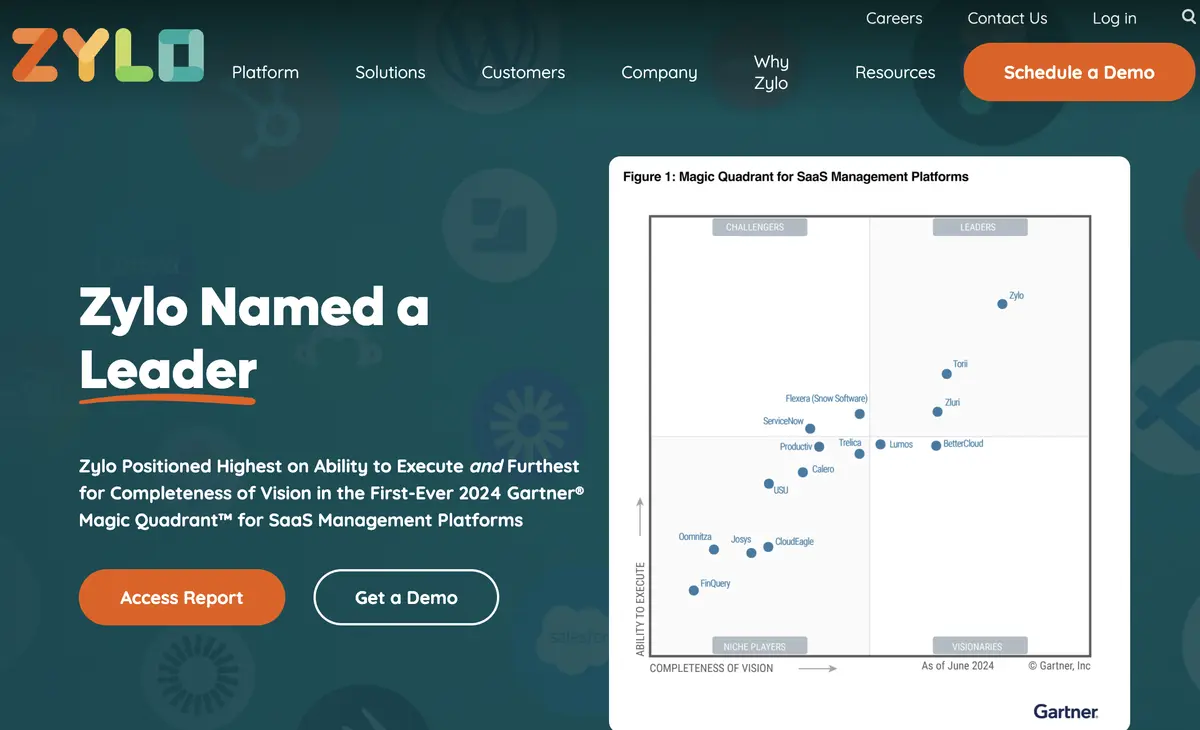
Zylo runs as an enterprise system of record, carrying one of the deepest SaaS benchmarking datasets in the category. Its April 2026 Consumption Cost Management release connects straight to OpenAI, Anthropic, and similar providers to track tokens, API calls, and compute next to seat licenses. That puts Cursor’s variable credit spend in the same view as its fixed per-seat cost.
The Contract Center centralizes agreements with 30, 60, 90, and 120-day renewal windows for procurement teams. It flags burn at 80% of a commitment, so teams can forecast a Cursor overage against contract terms before the true-up. Zylo’s 2026 index also lists Cursor among the top 50 most-expensed enterprise apps, which tells you peers are watching the same line item.
Benchmark depth is the draw here, since pricing leverage usually comes from knowing what comparable companies pay. Pricing and renewal detail live on the Zylo platform.
Where Zylo leads:
- Direct connections to AI providers for token and compute data
- Consumption-cost forecasting against contract commitments
- A contract center with staggered renewal windows
- Benchmark data drawn from a large expensed-app index
Pros:
- Benchmark data grounds both audits and renewal talks
- Forecasts variable Cursor credit spend before true-up
- Staggered renewal windows give procurement real lead time
Cons:
- The enterprise focus can feel heavy for small teams
- Deeper value needs broad SaaS data to draw on
G2: 4.4/5
CloudEagle

CloudEagle.ai pairs more than 500 integrations across SSO, finance, and CLM systems with contract-reading AI. It syncs both ways with Ironclad, Coupa, and Zip, then pulls renewal dates, notice periods, opt-out clauses, SKUs, and license counts straight from Cursor contract PDFs. That extraction depth is the part rival tools rarely match.
Multi-stage renewal alerts fire at 30, 60, and 90 days across Slack, Teams, and email. The platform auto-flags auto-renewal clauses and minimum-spend commitments as risks, so a Cursor Enterprise agreement never renews unseen. Feature-level usage tracking then assigns users to the right tier and reclaims seats after a configurable inactivity window.
CloudEagle also extends natively into AI governance and token tracking, which keeps Cursor spend inside policy as usage scales. You can walk through the workflow on the CloudEagle site.
Where CloudEagle digs in:
- Contract-metadata extraction from Cursor PDFs
- Renewal alerts at 30, 60, and 90 days across channels
- Auto-flagging of auto-renewal and minimum-spend risks
- Seat reclamation on configurable inactivity windows
Pros:
- Deepest contract-metadata extraction in this list
- Two-way sync with major CLM systems
- Native AI governance keeps token spend in policy
Cons:
- Heavy integration setup rewards larger stacks
- Best value assumes CLM tools already in place
| G2: 4.7/5 | Capterra: 4.9/5 |
Cledara
Cledara takes a finance-first angle, controlling SaaS spend at the payment layer itself. Approved tools get provisioned through virtual cards, so an unsanctioned Cursor Pro subscription can’t quietly land on a shared corporate card. That closes a gap most discovery tools only catch after the charge clears.
It keeps a real-time directory of every subscription with cost, renewal date, and usage attached. Alerts fire ahead of a Cursor renewal, and the platform flags vendor overcharges and mid-cycle price changes. Cledara Engage surfaces unknown subscriptions and duplicate tools, which matters when Cledara’s 2025 Software Spend Report found mid-size companies waste roughly a third of their software budget.
Native Xero, QuickBooks, and NetSuite reconciliation then bridges SaaS and expense management in one place for finance teams. The Cledara platform centers on that payment-control model.
Where Cledara helps most:
- Virtual cards that gate new Cursor subscriptions
- A real-time directory with cost, renewal, and usage
- Overcharge and price-change alerts before renewal
- Accounting reconciliation across Xero, QuickBooks, and NetSuite
Pros:
- Stops shadow Cursor charges at the card level
- Renewal and price-change alerts protect the budget
- Tight accounting reconciliation for finance teams
Cons:
- Payment-layer control suits finance more than IT
- Lighter on deep usage and seat telemetry
| G2: 4.6/5 | Capterra: 4.5/5 |
Most tools here manage contracts you already know about. Torii works the other end, discovering Cursor accounts through SSO, integrations, and expense data, tracking real per-seat usage, then reclaiming the idle ones before the next renewal. See how Torii cuts AI license waste.
Sastrify
Sastrify blends self-serve SaaS management with a human-backed Procurement-as-a-Service team. That pairing fits mid-market orgs running Cursor without a dedicated procurement function. The service handles the negotiation legwork smaller teams rarely have time for.
Its unified contract hub auto-generates renewal alerts and groups tools by function and owner to expose redundancy. Discovery runs across identity providers, browser extensions, and ERP data, claiming 90% spend coverage within seven days. Negotiation playbooks backed by more than $6 billion in managed spend sit inside the renewal workflow itself.
Sastrify, acquired by Deel in May 2026, also supports DORA, NIS2, and EU AI Act audit-readiness, which keeps a Cursor rollout compliant as rules tighten. The Sastrify platform combines the software and the service.
Where Sastrify helps most:
- Human procurement specialists inside the renewal flow
- A contract hub with automatic renewal alerts
- Discovery across IDPs, browsers, and ERP data
- Audit-readiness for DORA, NIS2, and the EU AI Act
Pros:
- Experts handle Cursor negotiation for lean teams
- Fast discovery surfaces off-procurement subscriptions
- Compliance coverage built into the workflow
Cons:
- The service layer adds cost over pure software
- Roadmap is less certain after the Deel acquisition
G2: 4.6/5
Spendflo
Spendflo runs as a procure-to-pay platform with an AI buying assistant called Flo AI. It covers intake, approvals, contracts, and AP automation in one flow, so a Cursor purchase moves start to finish without leaving the tool. The whole pipeline stays visible to finance and procurement at once.
Renewal management runs a six-stage pipeline with a Google Calendar-integrated renewal calendar and automated stakeholder escalation. It detects auto-renew clauses around 60 days out, giving teams time to right-size a Cursor commitment. Usage analytics tie real adoption to spend and recommend whether to renew, downgrade, or cancel each seat block.
Offboarding then triggers automatic license deprovisioning, and Spendflo backs the whole process with a guarantee of up to 30% in renewal savings. The Spendflo platform ties buying and renewal into one pipeline.
Where Spendflo helps most:
- A six-stage renewal pipeline with calendar sync
- Auto-renew detection roughly 60 days ahead
- Renew, downgrade, or cancel guidance from usage
- Automatic deprovisioning on offboarding
Pros:
- One pipeline from intake through AP automation
- A savings guarantee puts money behind renewals
- Usage-tied advice sharpens the renew decision
Cons:
- Full procure-to-pay can overshoot small teams
- Heavier setup than a single-purpose tracker
G2: 4.6/5
Tropic
Tropic positions itself as a procurement-intelligence platform built around its 2026 Purchase Prep AI. The feature identifies which contracts actually warrant negotiation, so teams spend energy where Cursor pricing has room to move. It benchmarks against a spend database north of $15 billion.
Purchase Prep AI scans for auto-renewal traps and surveys stakeholders on real Cursor adoption before a renewal. Its CLM module tracks renewal and opt-out dates with DocuSign integration, while Variance Analysis compares actual spend against contracted amounts. Tropic’s own data shows that “organizations that kick off the process at least 6 months before the renewal date realize a 39% savings improvement on average.”
Tropic’s H1 2025 newsroom reports the company “negotiated $362 million in customer spend, delivering $56 million in verified savings, a nearly 15.5% average savings rate.” The Tropic platform leads with that negotiation intelligence.
Where Tropic digs in:
- Purchase Prep AI that scores negotiation potential
- Benchmarking against a $15B+ spend database
- CLM tracking of renewal and opt-out dates
- Variance analysis of actual versus contracted spend
Pros:
- Tells you which Cursor contracts to negotiate
- Deep benchmarking sharpens pricing leverage
- Variance analysis catches overspend early
Cons:
- Procurement focus, lighter on seat reclamation
- Best returns need early renewal engagement
G2: 4.7/5
Vendr
Vendr closes the list as the negotiation-first option, backed by more than 130,000 verified negotiations across 4,500-plus suppliers. It is the only tool here with an automated negotiation agent that runs supplier email outreach on a buyer’s behalf. That agent reports an 87% success rate and 18.4% average savings.
Its pricing agent benchmarks per-seat Cursor costs against that transaction history. A searchable contract repository, renewal calendar, and Overlapping Spend report then flag duplicate SaaS and shadow Cursor accounts. Contract Analysis surfaces hidden terms, price increases, and renewal traps before they cost anything.
Vendr leans on real deal data rather than list prices, which is where most Cursor negotiating leverage hides. The Vendr renewals product lays out the approach.
Where Vendr digs in:
- An automated agent that negotiates by email
- Per-seat benchmarking from 130,000+ negotiations
- Overlapping Spend reporting for duplicate accounts
- Contract Analysis for hidden terms and price hikes
Pros:
- The only option with an autonomous negotiation agent
- A huge transaction dataset behind every benchmark
- Overlap reports surface shadow Cursor spend
Cons:
- Procurement focus, light on seat telemetry
- Most value lands at renewal, not day to day
G2: 4.5/5
How to Choose a Cursor Contract Management Tool
The right tool depends on where your Cursor spend leaks. Teams fighting variable credit bills lean on Zylo’s consumption forecasting and tools that track Cursor usage and spend, while Vendr and Tropic own the negotiation side. CloudEagle and Spendflo automate the renewal pipeline, and Cledara guards the corporate card against shadow signups.
Confirm you can answer four questions — Who holds each active seat? Which seats went idle this cycle? How fast is credit burn trending against the commitment? When does the auto-renew clause lock? A tool that leaves any of these blank is the gap to close first.
All of that assumes you can already see every Cursor seat in play. Torii starts there, discovering AI tools across the company, tying each seat to an owner, and reclaiming idle licenses before they renew. For Cursor contract management, that visibility is where the savings begin.
Frequently Asked Questions
Cursor switched to usage-based credit pools in 2025, with on-demand overage enabled by default. Heavy agentic users can consume credits quickly, making variable spend outpace fixed seat budgets and produce surprise invoices before renewals or visibility catches up.
Discovery-focused platforms like Torii and CloudEagle combine SSO, integrations, and expense data to find Cursor accounts, map active versus inactive seats, and automatically reclaim or downgrade idle licenses before the next renewal.
Contract-reading AI and CLM integrations in CloudEagle, Zylo, and others extract renewal dates, notice periods, and auto-renew clauses from PDFs. Multi-stage alerts across email, Slack, and calendars warn procurement months ahead to prevent unwanted renewals.
Zylo, Torii, and CloudEagle provide consumption forecasting by tracking tokens, API calls, models, and real-time token burn rates. They compare variable credit usage to commitments, flagging burn at thresholds so teams can forecast overages before true-ups.
Vendr and Tropic focus on negotiation intelligence: Vendr uses an automated negotiation agent and a massive transaction dataset, while Tropic’s Purchase Prep AI scores negotiation potential and benchmarks against a $15B+ spend database to maximize renewal savings.
Before renewing Cursor, confirm owner of each seat, identify idle seats, compare credit-burn trends to commitments, and locate auto-renew clauses. Tools that leave any of these blind spots are the first to replace.