

8 Best AI Management Platforms in 2026
 Chris Shuptrine
•
Jun 12, 2026
•
14 min read
•
Updated August 19, 2026
Chris Shuptrine
•
Jun 12, 2026
•
14 min read
•
Updated August 19, 2026

Compare the top AI management platforms in 2026 to discover, govern, and control AI tools and shadow AI across your org.
Ask about this article
Opens Claude in a new tab to answer, using this article as the source.
AI tools spread faster than any software category IT has tried to track before. McKinsey’s global survey found that “78 percent of respondents say their organizations use AI in at least one business function, up from 72 percent in early 2024 and 55 percent a year earlier”. Adoption is not the hard part. Knowing which tools are in play is: Zluri’s 2025 workplace AI study, drawn from usage data across 160-plus organizations and 400,000-plus users, reports that 80 percent of enterprise AI tools operate unmanaged, with IT and security teams holding control over fewer than 20 percent.
Shadow AI exposure shows up clearly on the risk ledger. A Gartner survey of 302 cybersecurity leaders run between March and May 2025 found that 69 percent of organizations suspect or have evidence that employees are using prohibited public GenAI. IBM’s 2025 Cost of a Data Breach Report puts a number on the downside: a high level of shadow AI added roughly $670,000 to the average breach cost, and 63 percent of the organizations studied had no AI governance policies in place at all.
An AI management platform closes that gap by discovering AI tools, scoring their risk, and governing how people and applications use them. The eight platforms below tackle the job from different angles, from SaaS discovery to compliance automation to runtime API control.
Zluri's 2025 study puts 80 percent of enterprise AI tools outside IT's control, and IBM found 63 percent of organizations have no AI governance policy at all. Breaches involving a high level of shadow AI ran about $670,000 above the average incident. Discovery and governance can no longer live in separate tools.
Sources: Zluri, State of AI in the Workplace 2025; IBM Cost of a Data Breach 2025.
★ = low · ★★ = medium · ★★★ = high
| Platform | Discovery | Governance | AI Capabilities | Reviews |
|---|---|---|---|---|
| Torii | ★★★ | ★★★ | ★★★ | ★★ |
| Zylo | ★★ | ★★ | ★★ | ★★ |
| Zluri | ★★★ | ★★★ | ★ | ★ |
| CloudEagle.ai | ★★★ | ★★★ | ★ | ★ |
| Nudge Security | ★★★ | ★★ | ★★ | ★ |
| Credo AI | ★ | ★★★ | ★★★ | ★ |
| Holistic AI | ★ | ★★★ | ★★★ | ★ |
| Portkey | ★ | ★★★ | ★★★ | ★ |
Table of Contents
Torii
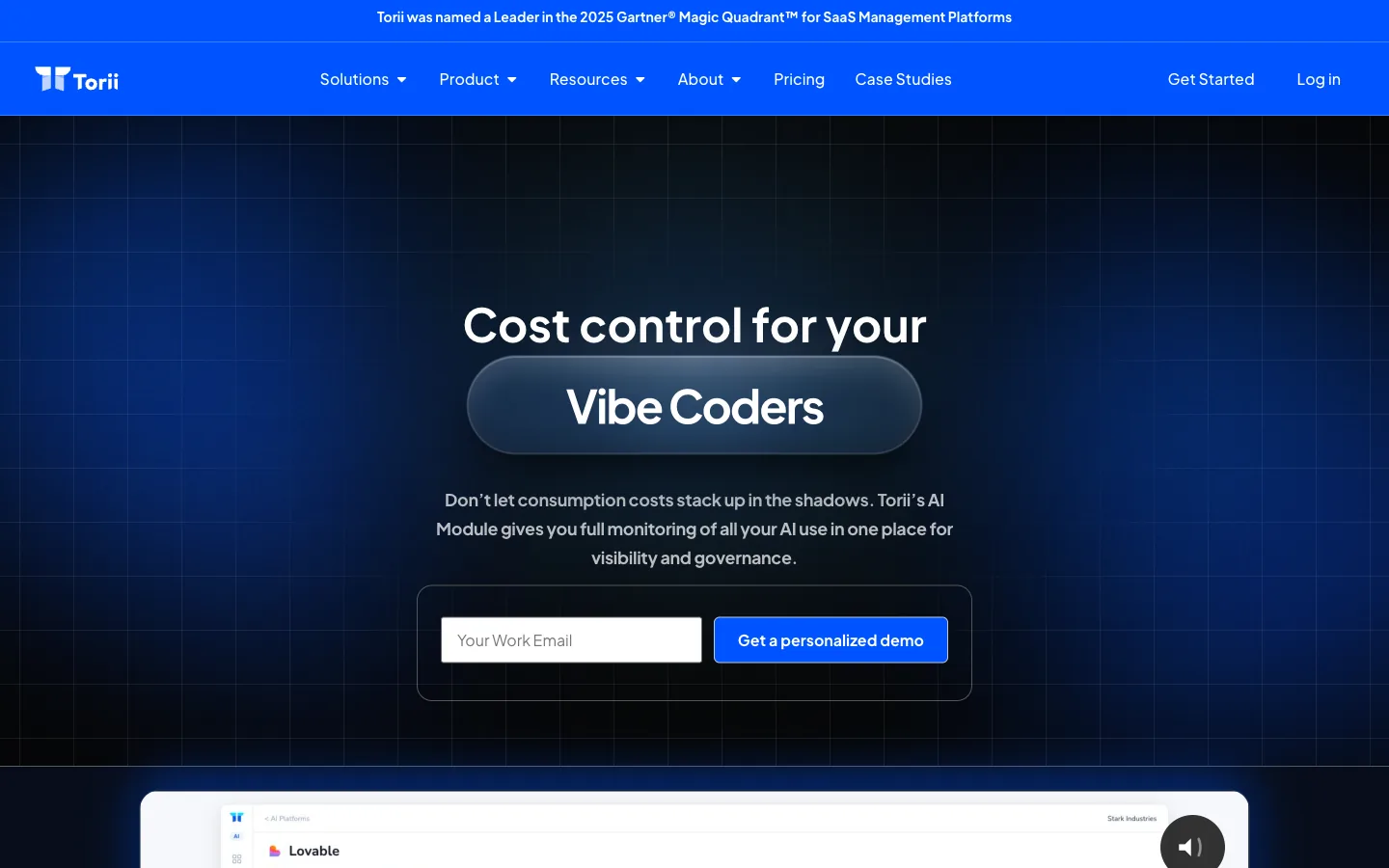
Torii is an AI management platform that treats AI governance as a named, first-class pillar rather than an afterthought. It continuously discovers the AI tools employees actually use, from ChatGPT and Claude to Cursor, Midjourney, and raw OpenAI or Gemini API keys, then flags redundant subscriptions across the estate. Nothing earns a separate intake process just because it has “AI” in the name.
The AI Dashboard tracks spend by user, model, and time period, and it watches token usage, API keys, and agent activity as it happens. Torii forecasts where spend lands before the billing cycle closes, so finance catches overruns early instead of at invoice time. You can walk through the full setup on the Torii AI management platform page.
What sets Torii apart is where the governance actually runs. AI tools flow through the same access requests, provisioning, access reviews, and offboarding steps that already cover every other app. A few things it surfaces that point tools tend to miss:
- Shadow AI accounts opened on personal email
- Overlapping AI subscriptions billed to different teams
- Token and agent spend mapped to specific people and projects
Pros:
- Discovery ties every AI tool back to a real person and budget owner
- Governance runs inside existing access and offboarding workflows
- Real-time token, key, and agent monitoring with spend forecasting
- One view covers AI alongside the entire SaaS portfolio
Cons:
- Pricing reflects enterprise coverage, not entry-level point pricing
- Built for SaaS and shadow IT; no on-premise deployment
Zylo
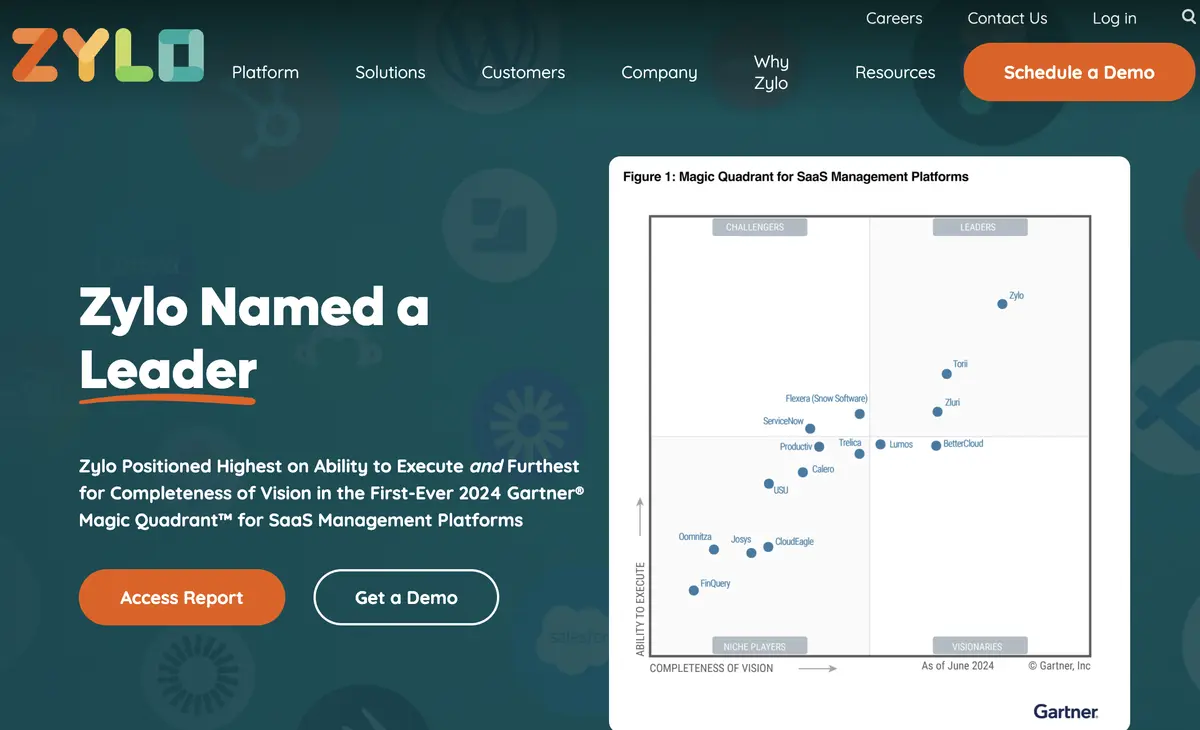
Zylo comes at AI management from the finance and procurement side of the house. Its own site describes the platform as “Powered by $75B+ in SaaS and Cloud spend data”, and it surfaces shadow AI through spend signals rather than network traffic. That makes it strong on the AI purchases that land as line items before anyone files a ticket.
The AI Consumption Cost Management product is where Zylo earns its keep for large AI buyers. It monitors consumption-based spend against negotiated commitments with OpenAI, Anthropic, Databricks, Snowflake, and Google Vertex, then fires burn-rate and overage alerts before a commitment blows past its cap. Teams managing Claude Enterprise or Team subscriptions directly can also pair Zylo with dedicated tools for managing Claude Enterprise and Team plans, including seat provisioning and license reclamation. Zylo Clarity AI reads that same spend data and generates savings recommendations. The AI consumption cost management product page covers the commitment tracking.
Zylo lands best when large AI vendor agreements are in play:
- Consumption commitments with model providers and data platforms
- Expense-report AI signups that skip procurement entirely
- Renewal timing on negotiated, multi-year AI contracts
Pros:
- Spend-based discovery catches AI tools that never touch SSO
- Commitment tracking against OpenAI and Anthropic burn rates
- Savings recommendations generated from real invoice data
Cons:
- Lighter on real-time enforcement than security-led tools
- Discovery depth depends on finance system integration coverage
Zluri
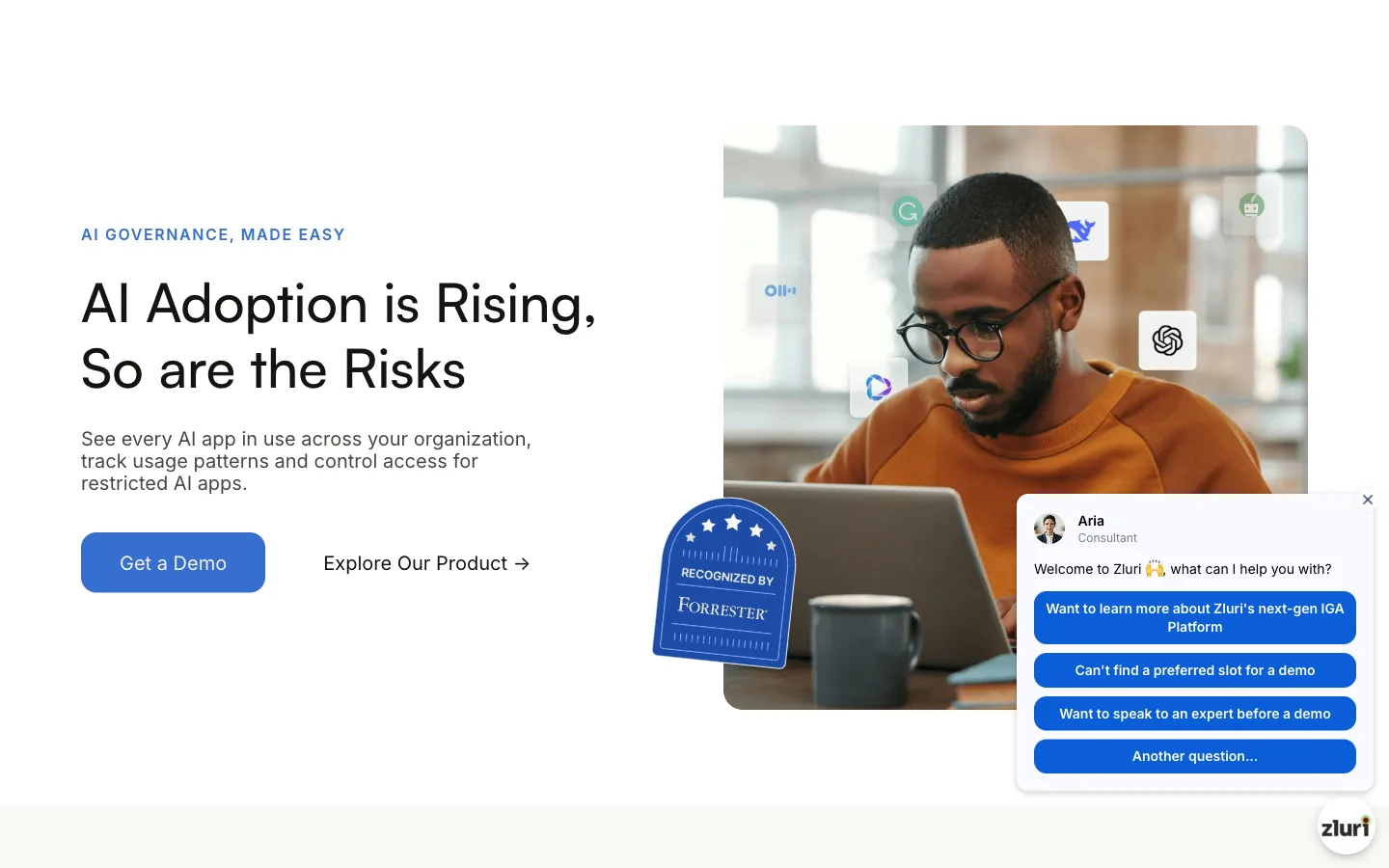
Zluri builds AI management on top of an identity-centric view of the app estate. Its “Monitor AI Apps” use case runs on a patented multi-pathway discovery engine that pulls from API, SSO, browser, and finance signals, then auto-classifies apps into 37-plus categories and tags each one Managed, Unmanaged, or Restricted.
Automated access governance is where Zluri pulls ahead of discovery-only tools. It sends real-time alerts when someone reaches for a restricted AI tool, auto-rejects requests that break policy, and deprovisions access through Slack or Jira. It also governs non-human identities like service accounts, API tokens, and AI agents through its IVIP product, which matters as more agents start holding their own credentials.
Zluri’s own research pegs 80 percent of enterprise AI tools as unmanaged, which frames where it concentrates. The platform leans toward control over passive visibility. You can see the approach on its monitor AI apps page, which covers the classification and remediation flow:
- Auto-classification of new AI apps as they appear
- Policy-based rejection and deprovisioning without manual tickets
- Governance for AI agents and the tokens they hold
Pros:
- Multi-pathway discovery classifies AI apps the moment they appear
- Automated rejection and deprovisioning cut manual ticket work
- Non-human identity governance covers tokens and AI agents
Cons:
- Broad platform can be more than small teams need
- Identity-first setup means a longer initial configuration
CloudEagle.ai
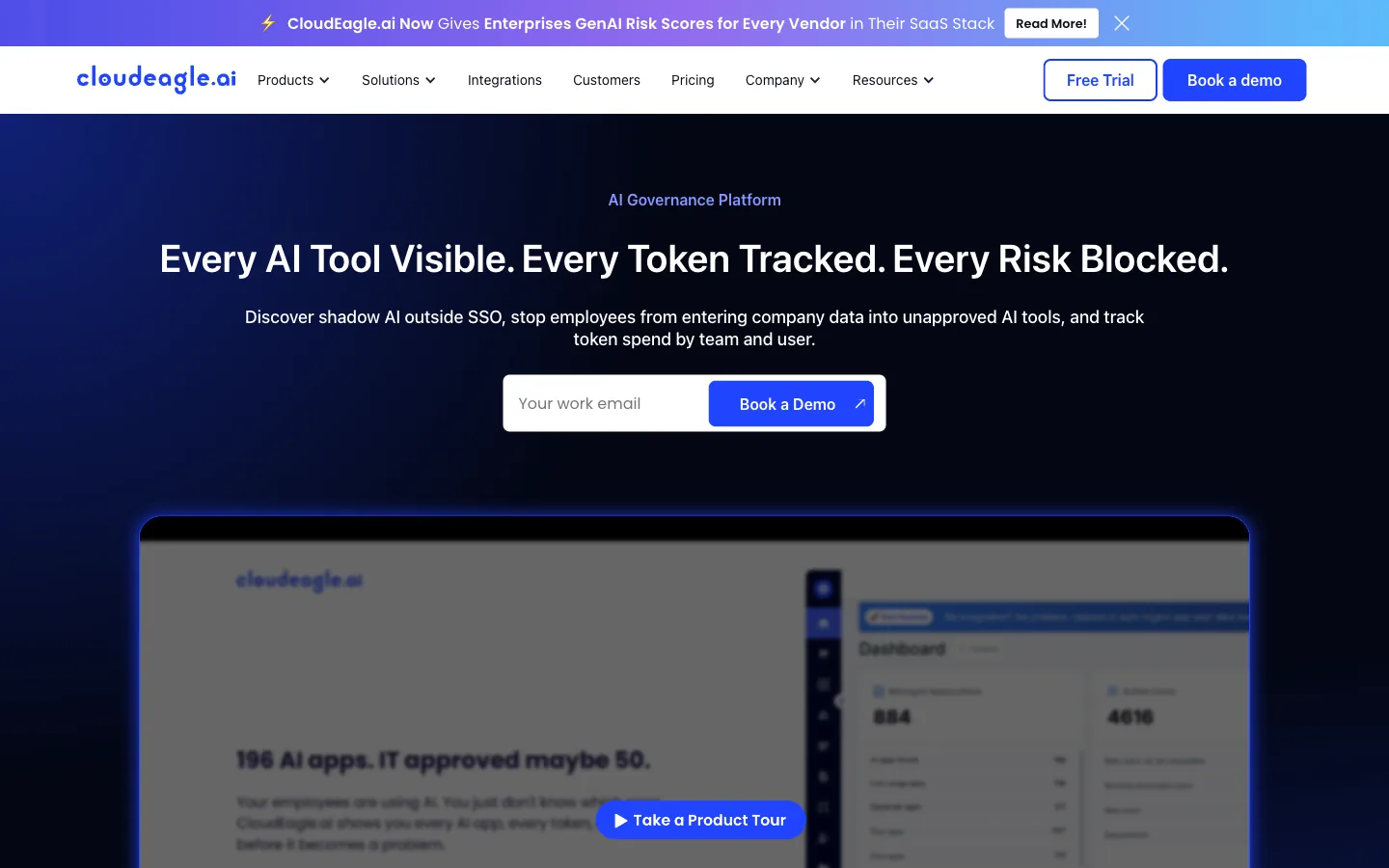
CloudEagle.ai takes the most security-first stance on the list with a purpose-built AI Governance module. It discovers AI through browser logs, finance, SSO, and CASB or EDR integrations like Netskope and CrowdStrike, and it uniquely catches generative AI features quietly switching on inside SaaS tools companies already own.
Real-time enforcement is where CloudEagle.ai separates from tools that stop at detection. It auto-assigns a risk score to each AI vendor based on data residency, training use, and certifications, then enforces policy through a browser extension that intercepts data entry as it happens. Hard blocks route through Palo Alto. Its AI governance module also adds emerging MCP server governance for teams orchestrating AI agents.
Security-led programs tend to reach for CloudEagle when alerts alone fall short:
- Real-time interception of data typed into unsanctioned AI tools
- Risk scoring tied to training-data and residency policies
- Detection of GenAI features activating inside existing SaaS
Pros:
- Browser-level enforcement blocks risky data entry as it happens
- Per-vendor risk scoring grounded in residency and training use
- Detects hidden GenAI features inside existing SaaS apps
Cons:
- Enforcement depth assumes security owns the rollout
- Newer AI module than its core SaaS management features
Nudge Security
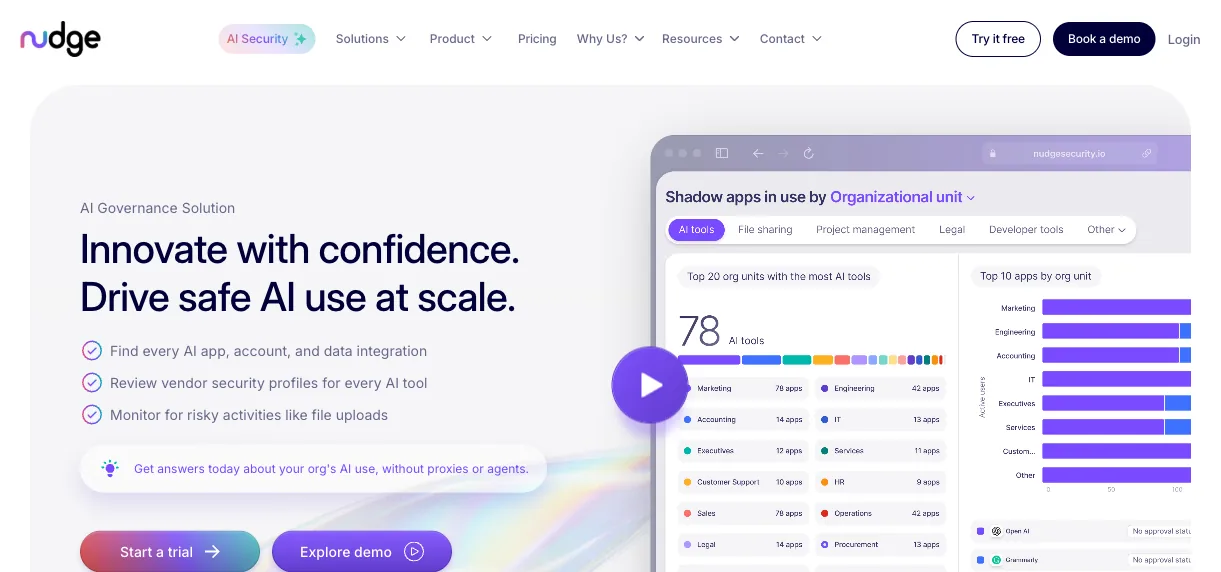
Nudge Security specializes in agentless discovery that works from day one. It detects AI apps and agents from email and network signals with no proxies or endpoint agents, so a fresh deployment surfaces shadow AI within hours instead of weeks of rollout.
Beyond finding apps, it governs the AI agents teams build themselves. Nudge surfaces agents created in Salesforce Agentforce and Microsoft Copilot Studio, showing who built each one, what it connects to, and which permissions it holds. A browser extension adds conversation monitoring for file uploads, copy-paste, and exposed API keys, and it ships a security profile for every AI vendor it finds.
Nudge reports the average organization runs about 35 unique AI apps, which shapes where it helps most. The AI security use case page walks through the discovery flow:
- Fast, frictionless discovery with no agents to deploy
- Visibility into homegrown agents and their permissions
- Per-vendor security profiles for quick risk triage
Pros:
- Agentless setup surfaces shadow AI on the first day
- Governs agents built in Agentforce and Copilot Studio
- Vendor security profiles speed up risk decisions
Cons:
- Lighter on hard blocking than enforcement-first platforms
- Email-signal discovery leans on broad inbox access
Torii finds every AI tool across your SaaS estate, ties each one to a person and a budget owner, and runs governance through the same access-request and offboarding workflows you already use. Token, key, and agent spend rolls into one forecastable view. See the Torii AI management platform.
Credo AI
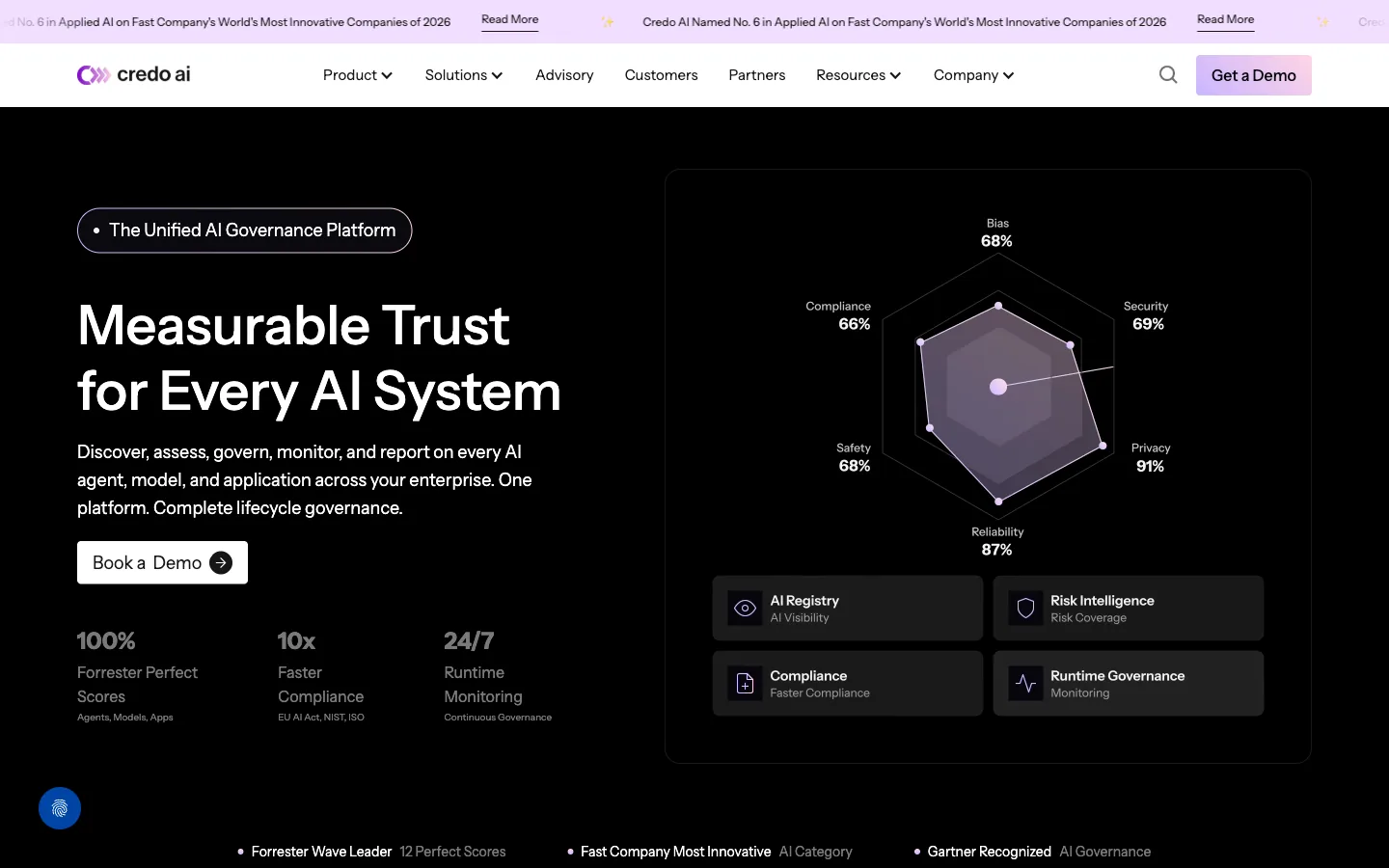
Credo AI shifts the list from SaaS discovery toward purpose-built AI governance and compliance. Its tagline, “Govern AI Everywhere,” captures the scope. An AI Registry auto-discovers and catalogs models, agents, and applications, shadow AI included, with a risk classification attached to each entry.
Regulated teams typically adopt Credo AI for the Policy Engine more than anything else. It ships pre-built packs for the EU AI Act, NIST AI RMF, ISO 42001, SOC 2, and GDPR, then generates audit-ready evidence automatically as conditions change. Its GAIA layer governs across the model, agent, application, and network levels. The Credo AI product overview walks through the registry and policy packs.
A Forrester Wave Leader, Credo AI counts Mastercard and Principal among its customers. The fit is clearest for regulated industries that want regulatory mapping handled rather than tracked by hand:
- Pre-built policy packs for the EU AI Act and ISO 42001
- Automated, audit-ready evidence as use cases evolve
- A central registry covering models, agents, and shadow AI
Pros:
- Pre-built regulatory packs cut compliance mapping time
- Audit-ready evidence generated automatically per framework
- Registry catalogs models, agents, and applications in one place
Cons:
- Governance focus means lighter employee-app discovery
- Built for regulated programs, heavier than small teams need
Holistic AI
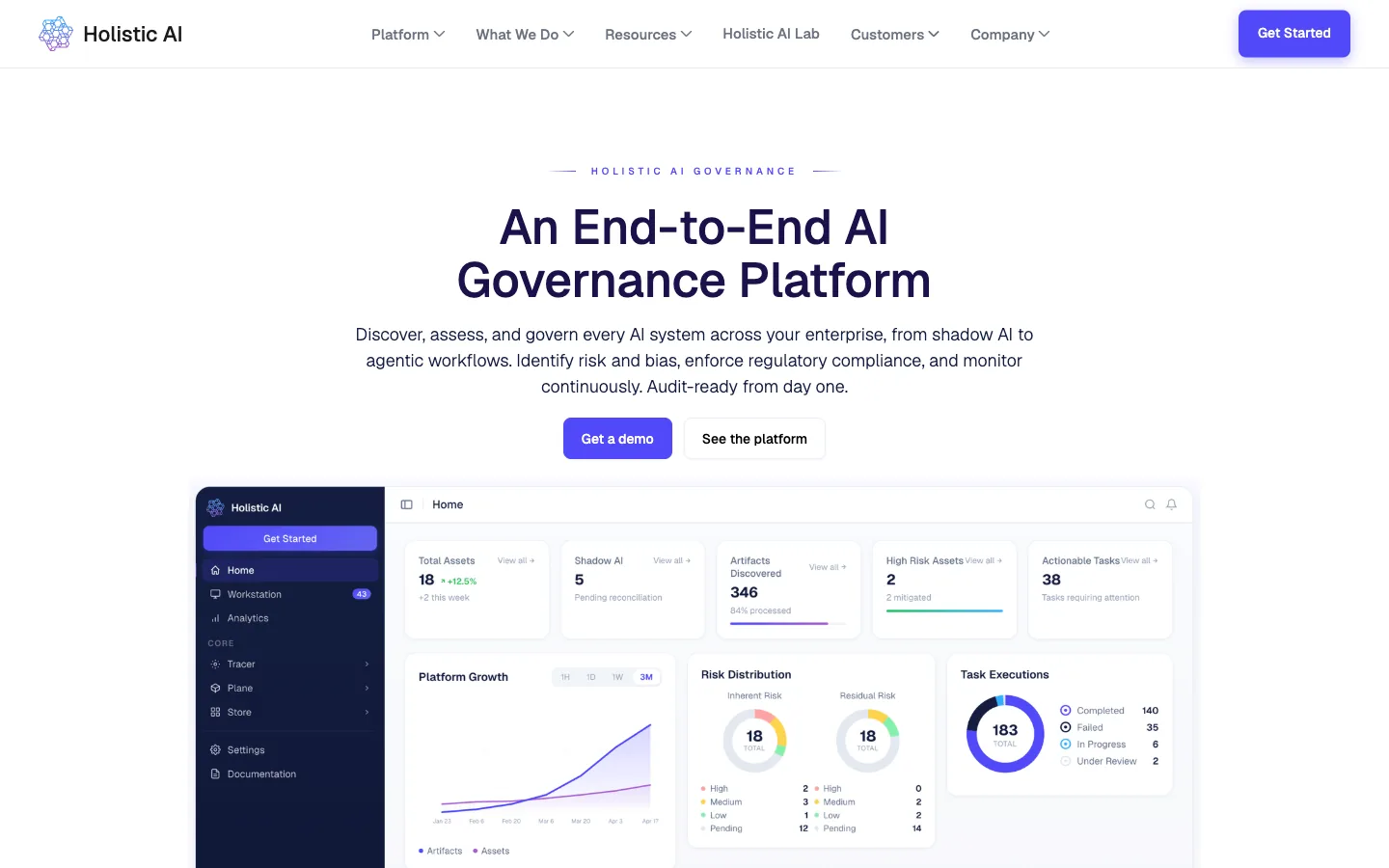
Holistic AI pairs governance with deep model auditing across three pillars: Identify, Protect, and Enforce. It builds an AI inventory by scanning cloud accounts on AWS and Azure, code repositories on GitHub, and connected SaaS, so the catalog reflects what teams are actually running rather than what they reported.
The platform’s testing depth is what sets it apart from governance tools that stop at policy. It runs more than 40 tests for bias, safety, security, prompt injection, and hallucination, with continuous drift monitoring as models change over time. Its Guardian Agents add autonomous oversight, where Sentinel agents watch and Operative agents step in with kill switches and request blocking. The AI governance platform covers the full test suite.
Compliance mapping spans the EU AI Act, NIST, ISO 42001, and NYC Local Law 144. That suits teams that want technical testing alongside enforcement:
- More than 40 tests for bias, safety, and prompt injection
- Continuous drift monitoring as models update
- Autonomous agents that can intervene in real time
Pros:
- Deep model testing for bias, safety, and prompt injection
- Guardian Agents enforce policy without constant human input
Cons:
- Technical depth assumes data science involvement
- Less focused on shadow-app discovery than SMP tools
Portkey
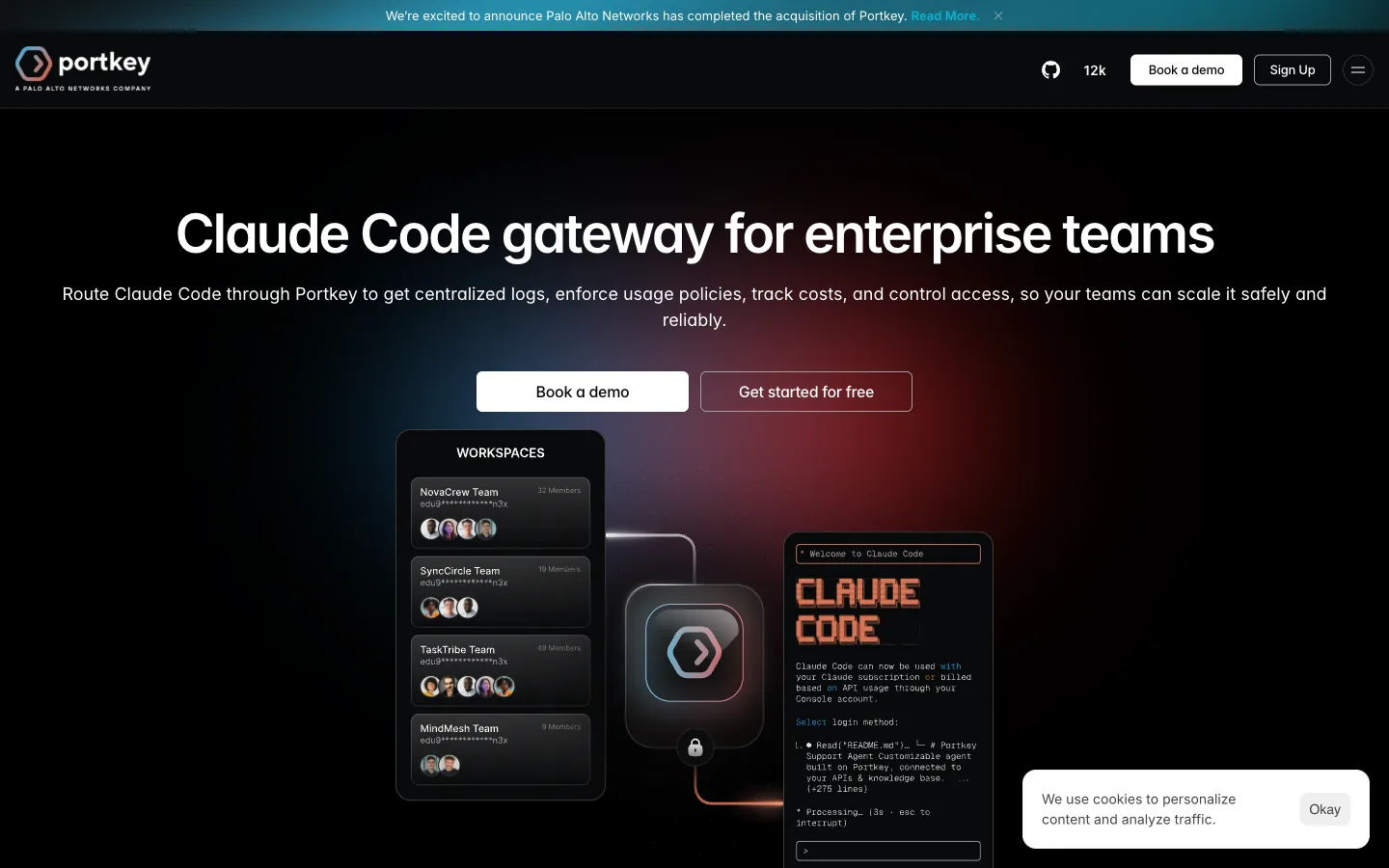
Portkey works at the infrastructure layer as an AI gateway between applications and more than 1,600 LLMs. Rather than discovering shadow apps, it governs the sanctioned LLM API calls developers make, routing every request through one control point for visibility and policy enforcement.
Centralized control over every LLM call is the core value Portkey delivers. It logs full request and response data, tracks 40-plus metrics, and applies 60-plus guardrails like PII redaction, prompt-injection blocking, and hallucination detection. A virtual key vault lets teams rotate, revoke, and monitor credentials, while real-time budget limits attribute cost per use case and per team. Its guardrails page details the policy controls.
Engineering and platform teams reach for Portkey to govern how LLM APIs get consumed across the org:
- Org-wide policy enforcement on every model call
- Virtual keys with rotation, revocation, and budgets
- Conditional routing across models under one envelope
Pros:
- Every LLM call routes through one governed control point
- 60-plus guardrails cover PII, injection, and hallucination
- Virtual key vault manages credentials and budgets centrally
Cons:
- Governs sanctioned API use, not shadow AI discovery
- Adds a gateway hop teams need to monitor for latency
How to Choose an AI Management Platform
The right AI management platform depends on where your risk actually sits today. Security-led teams gravitate to CloudEagle.ai or Holistic AI for enforcement, regulated programs lean on Credo AI for compliance automation, and engineering teams pick Portkey to govern LLM API traffic. Discovery-first teams usually start with a SaaS management layer that ties AI back to people and budgets.
Most organizations in 2026 need both discovery and governance, and the split in this list runs along that seam. Discovery-led platforms (Torii, Zylo, Zluri, CloudEagle.ai, Nudge Security) answer what AI is in use and who owns it; governance-led platforms (Credo AI, Holistic AI, Portkey) answer whether a given model or agent is behaving inside policy. Buying only the second while the first is unsolved is the common mistake, because a policy engine can only govern the tools it has been told about.
Before you commit to a platform, confirm it can: discover AI tools without an agent or proxy, tie each tool back to a person and a budget owner, enforce policy at the moment of risk rather than after the fact, govern the AI agents your teams build, and map evidence to the frameworks you answer to. The fewer separate tools you need to cover that list, the easier AI stays to manage.
Frequently Asked Questions
Shadow AI refers to unsanctioned AI tools employees use without IT oversight. It increases data exposure, prolongs breach detection, and raises incident costs because tools bypass security reviews, governance, and asset owners, creating uncontrolled data flows and audit gaps.
They discover unsanctioned tools, map each to users and budgets, score vendor and model risk, enforce policies at use time, and centralize monitoring. This closes gaps between discovery and governance, speeding detection and reducing exposure and unexpected spend.
Platforms combine signals from finance, SSO, browser logs, API keys, network and email telemetry, and cloud repos to surface AI apps and agents. Some rely on invoice data for spend-based discovery while others use multi-pathway engines or agentless email/network detection.
Discovery-first tools emphasize finding tools tied to people and budgets, often via SaaS management. Governance-first solutions prioritize runtime enforcement, compliance mapping, model testing, and blocking risky data entry. Many organizations need both capabilities for complete coverage.
Regulated teams favor compliance-focused platforms that offer policy packs, audit evidence, and registries of models and agents. Engineering teams prefer gateway solutions that centralize LLM calls, apply guardrails, manage keys, and enforce per-call budgets and routing.
Confirm the platform can discover AI without proxies, tie tools to people and budgets, enforce policies in real time, govern AI agents, and map evidence to regulatory frameworks. Fewer separate tools means simpler ongoing AI risk management.