

6 Best AI Spend Management Software Tools for 2026
 Chris Shuptrine
•
Jun 1, 2026
•
14 min read
Chris Shuptrine
•
Jun 1, 2026
•
14 min read

Compare the 6 best AI spend management software tools for 2026 to control AI SaaS costs, per-token usage, shadow AI, and renewals.
Ask about this article
Opens Claude in a new tab to answer, using this article as the source.
AI spend stopped behaving like SaaS spend the moment 2026 began. Every vendor meters differently. Microsoft 365 Copilot lists at $30 per user per month paid yearly as an enterprise add-on on top of a qualifying base license, Claude charges by token, and Salesforce Agentforce now sells Flex Credits at $500 per 100,000 credits plus a $5 per-user license, with its per-conversation tier quoted only on request. Gartner forecasts that worldwide spending on AI will total $2.52 trillion in 2026, a 44 percent increase year over year, and Zylo’s 2026 index shows AI-native spend up 393 percent inside enterprises over 10,000 employees.
Most finance teams are flying blind through that growth curve, and Gartner’s own framing is that money is not the constraint. “AI adoption is fundamentally shaped by the readiness of both human capital and organizational processes, not merely by financial investment,” said John-David Lovelock, Distinguished VP Analyst at Gartner, adding that organizations “are increasingly prioritizing proven outcomes over speculative potential” (Gartner, January 2026). Two structural problems get in the way of proving those outcomes. Pricing keeps moving, since a 2025 ICONIQ Capital survey cited in BCG’s pricing research found that 68 percent of vendors charge separately for AI enhancements or include these features exclusively within premium tiers. And much of the spend is invisible until the statement closes, which is the discovery gap our breakdown of how to detect shadow AI covers in depth.
This article compares six AI spend management platforms purpose-built for that mess. Coverage ranges from the broader best AI management platforms that meter tokens and seats together to procurement engines that renegotiate AI contracts at renewal. For teams whose AI bill is mostly one vendor, our deeper look at Claude Code spend management tools covers gateway and observability options as well, while GitHub Copilot contract management suits teams managing committed Copilot seats and AI Credits billing.
Gartner forecasts $2.52 trillion in worldwide AI spend in 2026, up 44 percent year over year (Gartner, January 2026). A 2025 ICONIQ Capital survey cited by BCG found 68 percent of vendors charge separately for AI features or gate them behind premium tiers. Cledara's own transaction data put AI spend growth at 446 percent in a 12-month window against 36 percent for SaaS overall. The tools below address different slices of that problem.
★ = low · ★★ = medium · ★★★ = high
| Tool | Ease | Cost | AI Capabilities | Reviews |
|---|---|---|---|---|
| Torii | ★★★ | ★★ | ★★★ | ★★★ |
| Cledara | ★★★ | ★★ | ★ | ★★ |
| Productiv | ★★ | ★ | ★★★ | ★★ |
| Spendflo | ★★ | ★★ | ★★ | ★★ |
| Vendr | ★★ | ★★ | ★★ | ★★ |
| Zylo | ★★ | ★ | ★★★ | ★★ |
Table of Contents
Torii
Torii released its AI Management Platform in May 2026, with spend control wired into every layer of the product. The AI Dashboard slices usage by employee, model, and time window, surfacing exactly who is burning credits on Cursor, Claude Code, ChatGPT, and the OpenAI API. That same view is what underpins managing Cursor Business and Enterprise plans, where idle seats get downgraded before renewal. Real-time forecasts overlay that data so finance catches a runaway month before the invoice arrives.
Project-level ROI attribution maps which internal builds and vibe-coded apps are draining tokens against the output they actually produce. Shadow AI discovery runs through Torii’s browser extension and SSO connectors, and the company’s 2025 dataset found that 26 of the top 50 unsanctioned tools were pure-play AI products, the same signal mix our roundup of tools for tracking AI adoption covers in more depth. Overlapping-tool detection flags when teams pay for Copilot, Claude, and Gemini simultaneously, with the dollar cost attached to each duplicate.
Beyond AI specifically, Torii manages the full SaaS stack within the same platform, so spend, license cleanup, and shadow IT live in one place. See the AI Management Platform overview for the full feature breakdown, or the AI tool onboarding and provisioning platforms comparison for the lifecycle side. The AI Dashboard walkthrough shows the per-model forecasts and shadow-AI overlap in detail. Torii was named a Leader in the Gartner Magic Quadrant for SaaS Management Platforms.
Pros:
- Spend dashboards segment AI usage by employee, model, and time window with overage forecasting
- Project-level ROI attribution ties token consumption to specific internal builds and vibe-coded apps
- Discovery catches shadow AI through browser extension and SSO signals, with overlap alerts on paid tools
- Named a Leader in the Gartner Magic Quadrant for SaaS Management Platforms
Cons:
- Pricing reflects enterprise-grade coverage, not entry-level point pricing
- Built for SaaS and Shadow-IT environments; no on-premise deployment
| G2: 4.5/5 (302 reviews) | Capterra: 4.9/5 (26 reviews) |
Cledara
Cledara controls AI spend at the payment layer, issuing a virtual card per subscription so every AI tool gets its own metered budget. Hard caps can be applied to consumption-based services like the OpenAI API or Midjourney, blocking the next charge once a team hits its monthly limit instead of fighting an overage after the fact. When an employee tries to expense ChatGPT Plus, Cledara can flag that the company already pays for an enterprise license and route them there instead.
The analytics layer pulls duplicate AI subscriptions, overlapping tools, and unused seats into a single dashboard finance can act on. Cledara’s reporting suite tracks burn per category, which matters when AI line items can outgrow a team’s full SaaS budget inside a quarter. Its 2025 Software Spend Report, built on “over 1 million transactions with more than 5 thousand vendors” across more than 200 tech companies, found that “AI spending grew by a staggering 446% in the last 12 months, compared to 36% growth in overall SaaS spending.”
The product targets finance teams at SMB and mid-market companies that want preventive controls instead of after-the-fact spend reports, a strategy that pairs well with the broader playbook to reduce SaaS costs. Cledara is less of a fit for IT-led governance programs that need policy enforcement on AI features inside existing SaaS contracts, but for a finance team that just needs the bleeding to stop, the virtual card model does the job cleanly.
Pros:
- Virtual cards put a hard cap on consumption tools like OpenAI API and Midjourney before overages hit
- Duplicate subscription detection catches overlapping AI tools and unused seats in real time
- Approval routing and accounting sync fit naturally into finance workflows
Cons:
- SMB and mid-market focus means enterprise procurement teams may find the workflow tooling thin
- Discovery relies on payment data, so tools paid through expense reports can still slip through
| G2: 4.8/5 (139 reviews) | Capterra: 4.9/5 (60 reviews) |
Productiv
Productiv approaches AI spend from a different angle, tracking which AI features have lit up inside the SaaS apps the company already pays for. AI Visibility scans contracts and app portfolios to flag new AI capabilities vendors quietly added, including data-training clauses and retention terms that quietly inflate compliance risk. That coverage matters because the pricing shift is near-universal. Per the 2025 ICONIQ Capital survey cited in BCG’s B2B software pricing research, 68 percent of vendors now charge separately for AI enhancements or reserve them for premium tiers, often without notifying the buyer. That raises the kind of AI tool risk questions security and finance teams should be asking before renewal.
The AI Compliance Agent automates policy enforcement at scale, firing a review workflow whenever a sanctioned app rolls out a new AI feature. The right team gets notified automatically, and executive reporting then shows which applications train on company data, which are approved, and what audit evidence exists for completed reviews. The AI Visibility page details the connector list and the agent workflow end to end.
Organizations whose AI spend problem is feature creep inside trusted vendors will find Productiv covers ground the other platforms here largely ignore.
Pros:
- Spots AI features added inside existing SaaS contracts before they create compliance exposure
- AI Compliance Agent automates the review when a sanctioned vendor ships a new AI capability
- Executive reporting maps which apps train on company data and which carry approved status
Cons:
- Less helpful for direct token spend monitoring on tools like the OpenAI API or Anthropic API
- Enterprise pricing only, so smaller teams may find the scope larger than they need
G2: 4.6/5 (84 reviews)
Torii's AI Dashboard breaks token and seat spend down by employee and model, forecasts overages before the invoice arrives, and flags overlapping AI subscriptions across Copilot, Claude, and Gemini in real time. See it live on the AI Management Platform page.
Spendflo
Spendflo runs AI spend through a procurement workflow, with intake-to-pay automation handling every new request before it lands on a card or expense report. The Flo AI agents (Flo Procure, Flo Contracts, Flo AP) handle approvals, budget checks, and auto-renew clause detection 60 days ahead of renewal for any SaaS or AI purchase.
Spendflo routes every new AI purchase request through a structured workflow instead of letting it surface as an expense-report shadow purchase. When a sales rep requests ChatGPT Enterprise or a developer asks for a Copilot seat, the intake flow captures it before the card hits. The Contract Analyst agent pulls renewal timelines and non-standard clauses out of AI contracts automatically, and pricing benchmarks attach at renewal so the negotiation team knows what peers actually pay. Spendflo publishes outcome figures of 11 percent average savings on SaaS spend and 70 percent faster intake-to-procure cycles.
For finance and procurement teams whose AI spend headache is unmanaged intake and surprise renewals, Spendflo closes the gap before purchases hit production.
Pros:
- Intake workflow stops AI tools from being bought through expense reports without approval
- Flo Contracts agent extracts renewal dates and auto-renew clauses from AI agreements
- Pricing benchmarks at renewal give procurement leverage on opaque AI contracts
Cons:
- Less visibility into per-token consumption once an AI tool is in production
- Managed-service model can feel heavier than self-serve buyers prefer
- Smaller benchmark dataset than Vendr in the AI category specifically
G2: 4.7/5 (368 reviews)
Vendr
Vendr’s pitch on AI spend is negotiation intelligence at scale, built on what the company describes as 130,000+ real negotiations across 4,500+ suppliers. That corpus tells procurement what peers actually pay for Copilot, ChatGPT Enterprise, or Claude Enterprise before the renewal hits the table. That gives buyers concrete leverage on AI tools where list prices are mostly fiction.
Autonomous negotiation agents handle outreach, counter-offers, and deal management over email, cutting out the call cycle entirely. That matters when AI vendors push opaque pricing through aggressive sales motions. Vertice acquired Vendr on June 1, 2026, and the combined entity reports more than $75 billion in indirect spend across 32,000 vendors and 250,000 negotiated contracts. The Vendr platform overview covers the agent workflow and benchmark coverage in more detail.
Companies whose AI cost management pain centers on renewal hikes or list-price gouging will find Vendr brings real peer data to the negotiation table.
Pros:
- Benchmark data covers AI contracts specifically, with peer pricing on Copilot, ChatGPT Enterprise, and Claude Enterprise
- Autonomous negotiation agents handle vendor email without scheduling calls
- Vertice combination expands coverage to $75 billion in indirect spend across 32,000 vendors
Cons:
- Focused on procurement and negotiation rather than ongoing per-token usage monitoring across vendors
- Best suited to mid-market and enterprise buyers, since smaller teams have less leverage to use
G2: 4.7/5 (113 reviews)
Zylo
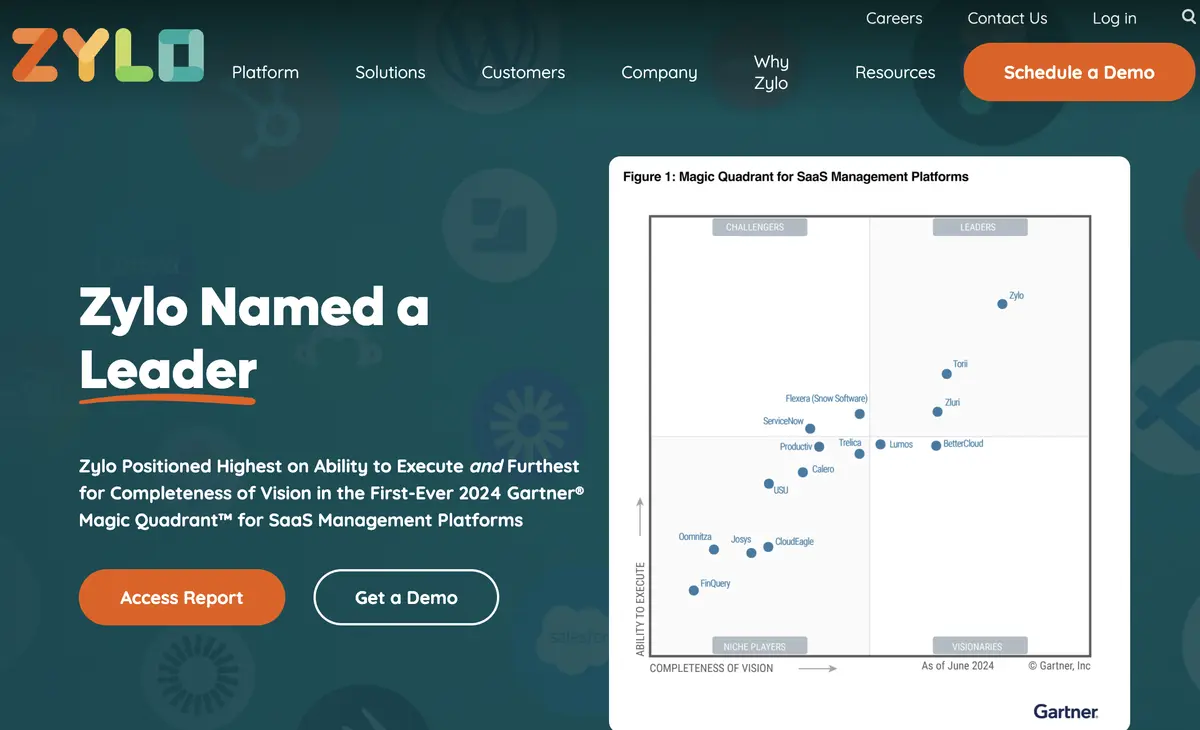
Zylo serves as a single system of record for both SaaS subscriptions and AI tool spend tracking, covering token-based, hybrid, and seat-based pricing models in one place. The AI Cost Management module monitors consumption-based spend in real time, forecasts exposure on variable pricing, and allocates AI costs across business units so finance is not guessing whether engineering or marketing ate the OpenAI bill.
License tracking handles the full range from Copilot at $30 a user to OpenAI API at fractions of a cent per token without pushing finance into spreadsheets. The Zylo 2026 SaaS Management Index shows AI-native spend up 108 percent overall and 393 percent inside enterprises over 10,000 employees, with ChatGPT now the most-expensed app across customers. The Zylo platform overview walks through the AI Cost Management workflow and the Clarity AI assistant.
Clarity AI is trained on $75 billion in SaaS spend and recommends specific cost actions instead of just plotting trend lines. That matters when the AI portfolio outgrows the IT team’s ability to monitor it manually.
Pros:
- Handles token-based, hybrid, and seat-based licensing models in one place
- Real-time forecasting for consumption-based AI tools with cost allocation by business unit
- Clarity AI assistant surfaces specific savings actions, not just dashboards
Cons:
- Enterprise-grade pricing positions Zylo above SMB-friendly platforms
- Implementation can take longer than lightweight competitors for full deployment
G2: 4.8/5 (151 reviews)
How to Choose an AI Spend Management Tool
AI spend management splits into two questions in 2026: who is buying what, and what does each tool actually consume. Procurement-led platforms like Vendr and Spendflo answer the first by controlling intake and renewals, while consumption-focused tools like Zylo and Torii answer the second by metering tokens, seats, and shadow AI usage across the stack.
The practical test is which question your next invoice will raise. If it is “who bought this,” a procurement-led platform pays for itself at the intake gate. If it is “why did this line item double,” you need consumption metering that reports per user and per model, not a monthly total. Teams facing both questions at once usually run one of each, or pick a platform that meters tokens and seats in the same inventory.
List every active AI subscription (seat-based and consumption-based), tag which spend is approved versus shadow, flag any renewal hitting in the next 90 days, and assign an internal owner per tool. The right platform from this list is the one that closes your biggest visibility gap, not the one with the broadest feature set.
Frequently Asked Questions
Shadow AI refers to unsanctioned AI tools and subscriptions purchased outside IT oversight, often on company cards or expense reports. It creates cost surprises, data exposure, compliance gaps, and prolonged discovery windows, since tools can run unnoticed for months before finance or security detect them.
Consumption-based AI charges are metered by tokens, API calls, or agent resolutions, producing variable invoices tied to usage. Seat-based SaaS charges are flat per-user subscriptions. Consumption creates unpredictable spikes and overages that traditional SaaS budgeting and license management tools may not catch.
Use a mix of preventive controls and consumption monitoring: virtual cards and approval workflows block unsanctioned purchases, SSO and browser discovery reveal shadow tools, and real-time token metering plus forecasting flags overages before invoices arrive for proactive budget action.
Prioritize token and seat metering, shadow AI discovery via SSO and browser signals, per-model and project-level forecasting, cost allocation across business units, duplicate subscription detection, and procurement features like virtual cards and renewal negotiation benchmarks.
Use procurement-first tools when uncontrolled intake, opaque vendor pricing, or surprise renewals cause most of your AI spend pain. They enforce intake workflows, extract renewal terms, and supply benchmarked negotiation intelligence to reduce list-price gouging and improve procurement outcomes.
They meter consumption by model, employee, and project, offering real-time dashboards, overage forecasting, and cost allocation. Torii adds project ROI attribution and shadow-AI overlap alerts; Zylo pairs real-time forecasts with an AI assistant that recommends specific savings actions.