

5 Shadow AI Discovery Tools for 2026
 Chris Shuptrine
•
Jun 2, 2026
•
13 min read
Chris Shuptrine
•
Jun 2, 2026
•
13 min read

Compare 5 shadow AI discovery tools for 2026 that uncover unsanctioned AI SaaS, score risk, and govern GenAI usage at scale.
Ask about this article
Opens Claude in a new tab to answer, using this article as the source.
Shadow AI in 2026 looks nothing like the shadow IT problem that came before it, and the downstream AI vendor risk management problem only gets harder when discovery is incomplete. Unsanctioned ChatGPT, Claude, Cursor, and Copilot accounts now ingest data that lands in training sets or vendor logs. LayerX put a number on the blind spot in its Enterprise GenAI Security Report 2025: “Despite organizational security policies, organizations have no visibility into 89% of AI usage in the organization.”
The numbers behind that visibility gap keep getting worse every quarter. Gartner predicts that by 2030, more than 40 percent of global organizations will suffer security and compliance incidents from the use of unauthorized AI tools. IBM attaches a price tag to the same problem. Writing up its 2025 Cost of a Data Breach Report, IBM’s X-Force team noted that “having a high level of shadow AI, where workers download or use unapproved internet-based AI tools, added an extra USD 670,000 to the global average breach cost” (IBM X-Force). The same research found that one in five organizations reported a breach due to shadow AI, with only 37 percent holding policies to manage AI or detect it. Closing that gap starts with knowing the real tool count, which is why teams layer in AI adoption tracking across the workforce alongside one of the best AI management platforms.
Discovery is the precondition for every framework now in force, from the EU AI Act through NIST AI RMF and ISO 42001 inventory requirements. The AI Act deadline moved this summer: the AI Omnibus entered into force on July 27, 2026 and, per the European Commission, “extends the timeline to 2 December 2027 for high-risk AI systems and 2 August 2028 for AI embedded in products” (Navigating the AI Act). The inventory work did not get easier, only later. This article compares five shadow AI discovery platforms built for that mandate. Teams whose biggest line item is agentic coding usually pair discovery with the Claude Code spend management stack and tools to govern Claude Code extensions directly.
LayerX found organizations have no visibility into 89 percent of AI usage (Enterprise GenAI Security Report 2025). Gartner expects more than 40 percent of organizations to suffer an unauthorized-AI incident by 2030. IBM's 2025 Cost of a Data Breach Report adds $670,000 to the average breach where shadow AI ran high. The five platforms below close that visibility gap from different angles: identity, prompt, email, and full SaaS signal.
★ = low · ★★ = medium · ★★★ = high
| Tool | Ease | Cost | AI Capabilities | Reviews |
|---|---|---|---|---|
| Torii | ★★★ | ★★ | ★★★ | ★★★ |
| Grip Security | ★★ | ★★ | ★★ | ★★ |
| Harmonic Security | ★★ | ★★ | ★★★ | ★ |
| Nudge Security | ★★★ | ★★ | ★★ | ★ |
| Reco | ★★ | ★★ | ★★★ | ★ |
Table of Contents
Torii
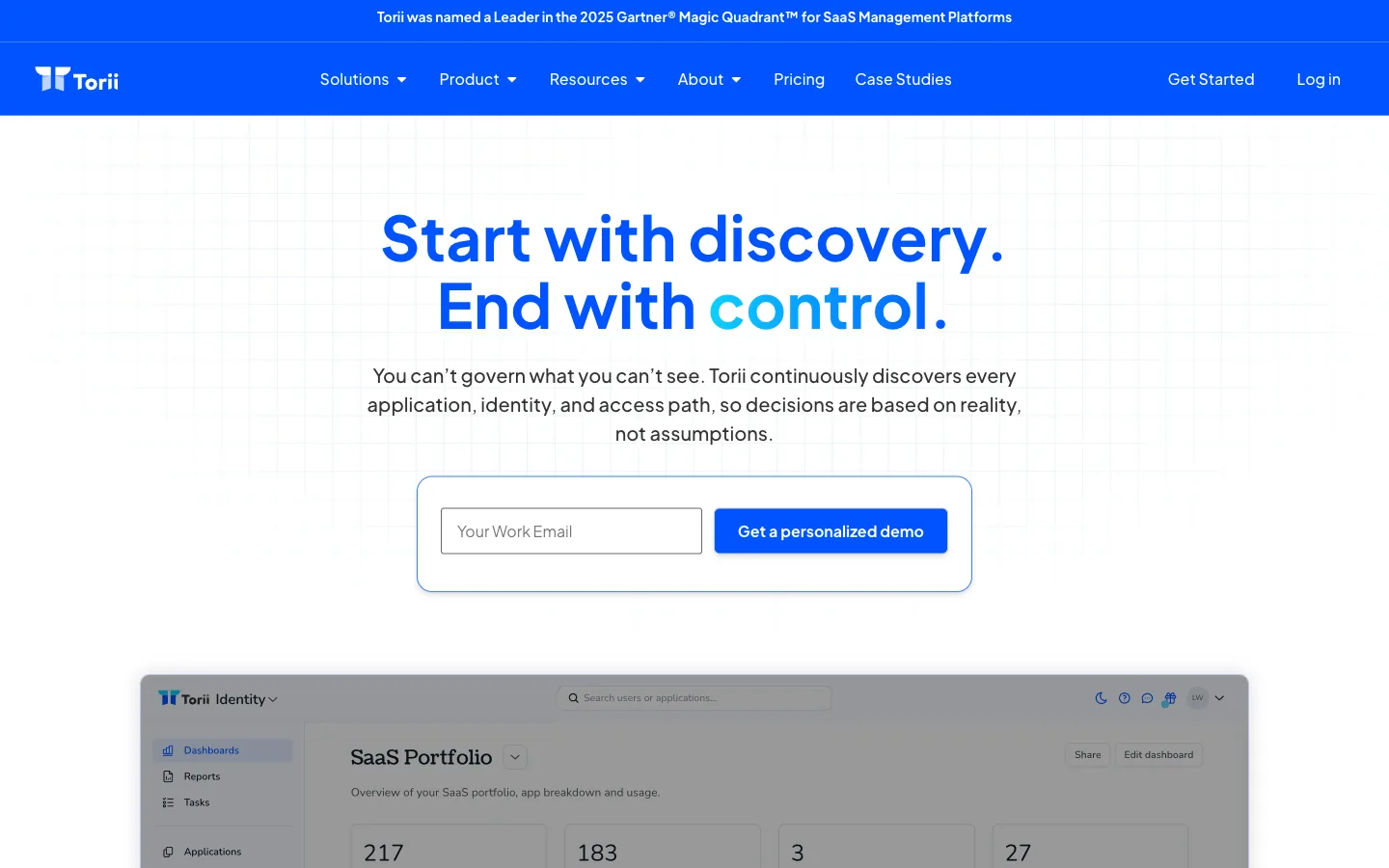
Torii treats shadow AI as a SaaS governance problem rather than a separate detection bolt-on. The platform pulls signals from SSO logs, finance and expense feeds, browser activity, OAuth grants, network telemetry, and direct app integrations, so an AI tool expensed on a corporate card but never federated still surfaces inside the same inventory. That cross-source approach matters in 2026 because Torii’s shadow IT data shows AI products now sit inside the top 50 unsanctioned tools list at most enterprises.
Every discovered AI app receives a risk score that factors in SOC 2 and ISO posture, breach history, data residency, and whether a signed DPA exists, the same scoring used across Torii’s broader AI management platform. Continuous monitoring fires alerts the moment a new AI tool appears, and the Eko AI co-pilot answers natural-language questions like what unsanctioned AI apps have high risk? without forcing analysts into raw SQL.
Workflows route new app approvals through Slack and email, hand off to AI tool onboarding and provisioning for sanctioned tools, and a dedicated AI spend view highlights overlapping AI subscriptions, API keys, and agent tokens, and teams managing Claude seat tiers can pair it with tools purpose-built for managing Claude Enterprise and Team plans.
Pros:
- Multi-source discovery catches AI tools that bypass SSO, including expensed or browser-only signups
- Risk scoring covers SOC 2, ISO, breach history, residency, and DPA status per app
- Eko AI co-pilot answers shadow AI questions in plain English
- Continuous monitoring with automated approval workflows through Slack and email
Cons:
- Pricing reflects enterprise-grade coverage, not entry-level point pricing
- Built for SaaS and Shadow-IT environments; no on-premise deployment
| G2: 4.5/5 (302 reviews) | Capterra: 4.9/5 (26 reviews) |
Grip Security
Grip Security leans on a single signal that most peers underuse: authentication events flowing through the identity provider, an approach that complements the broader playbook to detect shadow AI across an enterprise. Instead of asking customers to roll out browser extensions or endpoint agents, Grip watches SSO and IdP traffic to surface apps operating outside federation, a pattern the company calls unfederated shadow access. GenAI tools that employees signed into directly with personal credentials show up here even when no other system has logged them.
Each AI app then receives a posture score covering data sensitivity, SAML support, and MFA status. Grip’s 2025 SaaS Security Risks Report frames the size of that gap in two figures drawn from more than 29 million SaaS user accounts: “91% of AI tools within organizations remain unmanaged,” and “42% of popular AI applications have SAML capabilities, but 80% of these apps are not managed and federated with the SAML protocol.” The second number is the one that stings, because those apps could have been federated and simply were not.
Two newer modules push the platform into territory most SaaS security tools don’t reach. AI-SPM applies posture management at the model level, and Agent Control governs SaaS-to-SaaS and AI-agent connections that no human ever clicks through, capability sets that overlap with the broader AI governance and policy enforcement market.
Pros:
- Identity-led discovery requires no agents, extensions, or proxies on endpoints
- Surfaces unfederated shadow AI that SSO inventories miss
- AI-SPM and Agent Control extend posture to models and autonomous agents
Cons:
- Coverage depends on IdP signal; tools accessed without any auth event can slip through
- Less granular on prompt-level data inspection than dedicated GenAI gateways
| G2: 4.6/5 (52 reviews) | Capterra: not listed |
Harmonic Security
Harmonic Security works one layer below the app inventory, governing the actual prompts and data employees send into AI tools. A browser agent for Chrome, Edge, Firefox, and Safari, paired with device-level encrypted traffic inspection, catches what most SASE and CASB stacks miss: native desktop apps like ChatGPT Desktop, Claude Desktop, and Cursor, plus more than 1,000 embedded AI surfaces inside tools like Canva, Grammarly, and Google AI Mode.
Purpose-built Small Language Models classify prompt intent in under 200 milliseconds. The classifier separates personal accounts from corporate ones and flags IP, PII, or proprietary code being pasted into a chat window, the kind of exposure our list of AI tool risk questions covers in depth. Rather than hard-blocking the user, Harmonic uses a coach, don’t block model that nudges or redirects, so security stays out of the way of legitimate work.
The classification engine is grounded in real traffic rather than synthetic test data. Harmonic’s January 2026 write-up describes its dataset as “22,458,240 enterprise GenAI prompts from January 1 - December 31, 2025” (What 22 Million Enterprise AI Prompts Reveal About Shadow AI in 2025). In that set, 671 GenAI tools appeared and ChatGPT alone accounted for 71.2 percent of potential data exposures.
Pros:
- Catches native desktop AI apps and embedded AI inside sanctioned SaaS
- Sub-200ms prompt classification distinguishes personal accounts from corporate ones
- Coach-don’t-block model reduces user friction compared with hard blocking
- Backed by training data drawn from 22 million enterprise prompts
Cons:
- Browser and device coverage means unmanaged BYOD devices need an enrollment path
- Inventory and procurement workflows are thinner than at full SMP platforms
| G2: 4.8/5 (12 reviews) | Capterra: not listed |
Torii pulls SSO, finance, browser, OAuth, and network signals into a single inventory, scores each AI app on SOC 2, ISO, breach, and DPA status, and routes new approvals through Slack the moment something new appears. Try the AI Dashboard walkthrough to see it live.
Nudge Security
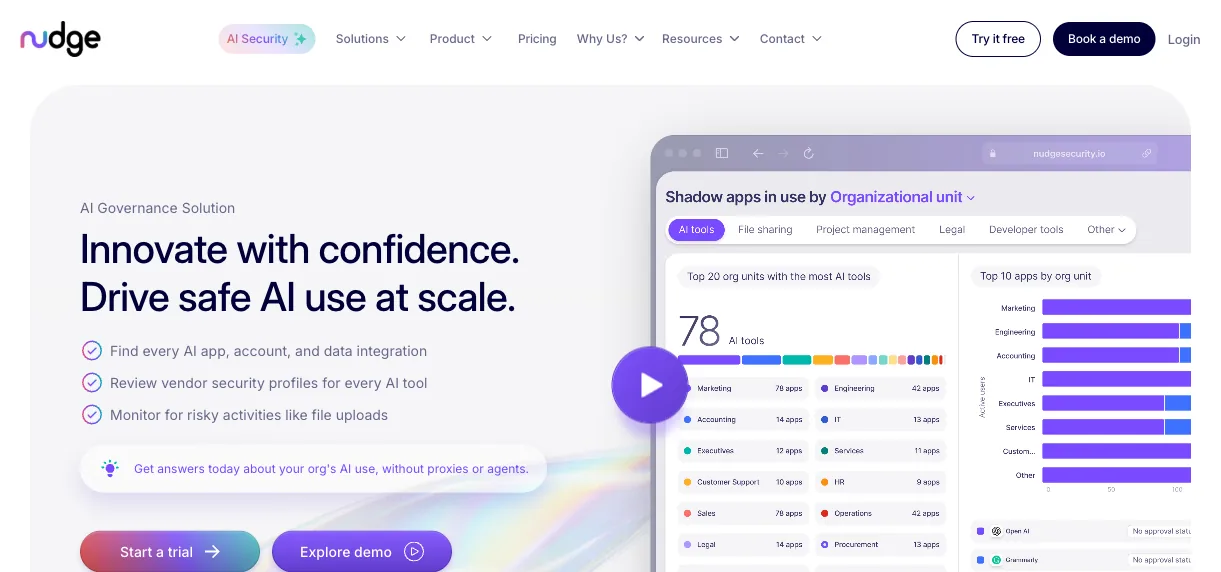
Nudge Security built its discovery on a patented email-metadata approach that needs no agents, no proxies, and no behavior change. After a read-only connect to Google Workspace or Microsoft 365, the platform scans welcome emails, billing notifications, MFA messages, and password resets to surface every AI tool any employee has ever signed up for, including signups that predate the deployment by years.
Where Nudge separates itself from basic inventory tools is in the follow-through. When a new AI app appears, the affected employee gets an automated Slack, Teams, or email nudge asking for justification or acknowledging policy. That removes the IT ticket bottleneck that usually buries shadow AI cleanup.
The 2026 roadmap pushes into the next frontier of GenAI governance. Nudge’s AI security page details AI Agent Discovery for Copilot Studio, Agentforce, and n8n agents, plus browser-based discovery for tools that lack any public API surface.
Pros:
- Patented email-metadata scan recovers years of historical AI signups
- Read-only Workspace and 365 connect deploys in minutes with no endpoint changes
- Automated employee nudges replace manual IT outreach for policy acknowledgment
Cons:
- Email-only signal will miss tools that never trigger an account-related email
- Pricing for full automation tiers can climb at large employee counts
| G2: 4.8/5 (98 reviews) | Capterra: 5.0/5 (15 reviews) |
Reco
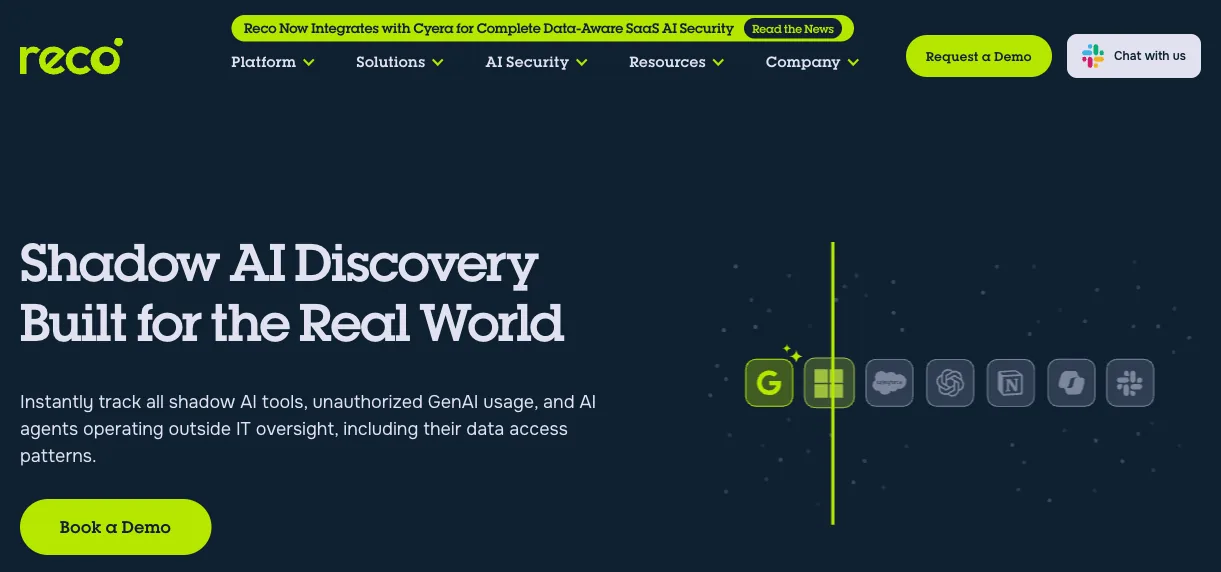
Reco frames shadow AI as an identity problem and builds the rest of its platform on top of that thesis. The core is a unified identity graph that ties humans and non-human identities together. Estimates of that ratio vary widely by who is counting: Entro Security’s H1 2025 report claims NHIs now outnumber human users 144 to 1, while CyberArk’s 2025 Identity Security Landscape report, a survey of 2,600 security decision-makers across 20 countries, puts it closer to 82 to 1. Either way the machine side dominates. Detection cross-references OAuth scopes, email metadata, app-to-app connections into Salesforce, Workday, and Slack, browser signals, and IdP baselines, so a shadow agent connected through a service token surfaces with the same weight as a human signup.
Reco now advertises a catalog of 260+ SaaS apps and 270+ agents and apps, with an internal App Factory adding new ones in three to five days. Check that page for the live count, since it has moved with each report edition.
Recent product launches extend Reco’s reach into autonomous agent territory that most identity tools don’t cover yet. Shadow Agent Discovery and Offboarding governs agents living inside Slack, Workspace, and Salesforce, and Agentic Security Posture Management extends the same treatment to autonomous agents. Reco’s own 2025 State of Shadow AI Report found that 71 percent of office workers admit to using AI tools without IT approval, and that OpenAI accounts for 53 percent of tracked shadow AI usage, more than the next nine platforms combined. That is the kind of exposure detailed in our breakdown of LLM shadow AI risk. Teams that need to go further and certify who should retain Claude access can pair Reco’s identity graph with one of the dedicated Claude access review tools.
Pros:
- Identity graph covers both human and non-human identities in one model
- 260+ app catalog with three to five day onboarding for newly requested tools
- Shadow Agent Discovery extends governance to autonomous SaaS agents
Cons:
- Identity-graph model requires solid OAuth and IdP plumbing to reach full value
- Less direct visibility into prompt content than dedicated GenAI inspection tools
| G2: 4.7/5 (44 reviews) | Capterra: not listed |
How to Choose a Shadow AI Discovery Tool
Shadow AI discovery splits along the signal each platform trusts most. Identity-led tools like Grip and Reco trace the authentication path, prompt-layer tools like Harmonic inspect the data going into AI, and SaaS-management platforms like Torii and Nudge build inventories from broader SaaS feeds.
Most enterprises in 2026 actually need more than one signal working together, because each signal has a blind spot the others cover. An IdP feed misses tools nobody authenticated into. An email scan misses tools that never sent a welcome message. A prompt inspector sees what leaves the browser but not what finance already paid for. Grip’s own data makes the point: 42 percent of popular AI apps support SAML and 80 percent of those still are not federated, so an SSO-only inventory is structurally incomplete before anyone misconfigures anything.
Pick by the gap that hurts most. Multi-source SaaS inventory: Torii. Identity-led discovery: Grip, Reco. Prompt and data inspection: Harmonic. Email-metadata history: Nudge. Most enterprises end up combining two signals, typically a SaaS inventory layer with either an identity or prompt layer on top.
Frequently Asked Questions
Shadow AI often involves unsanctioned generative AI accounts and agentic tools that ingest corporate data into vendor logs or training sets. Unlike classic shadow IT, visibility gaps come from federated and unfederated access, agents, and prompt-level data leakage across many SaaS surfaces.
Discovery creates an inventory that enables compliance with frameworks like the EU AI Act, NIST AI RMF, and ISO 42001. Without discovery, organizations can't assess risk, apply controls, or demonstrate training-data and vendor-posture requirements during audits or breach investigations.
Platforms use identity and IdP events, OAuth grants, SSO logs, browser telemetry, expense and finance feeds, email metadata, network telemetry, and prompt-level inspection. Combining signals increases coverage because different tools and agents surface via different telemetry sources.
Torii is designed for multi-source SaaS discovery, ingesting SSO, finance, browser, OAuth, and network signals to build a single inventory. It also scores apps for SOC 2, ISO, breach history, residency, and DPA status and supports approval workflows.
They analyze authentication and OAuth signals from identity providers to surface unfederated sign-ins, service tokens, and non-human agents. By building identity graphs and posture scores, these platforms reveal unmanaged apps and agentic connections without relying on endpoint agents.
Combine signals when single-source coverage misses critical exposures. Most enterprises pair a SaaS inventory with either an identity-led or prompt-inspection layer to capture expensed apps, unfederated logins, embedded AI, and prompt-level exfiltration across BYOD and managed devices.