

6 Tools for AI Governance and Policy Enforcement in 2026
 Chris Shuptrine
•
Jun 4, 2026
•
12 min read
Chris Shuptrine
•
Jun 4, 2026
•
12 min read
Compare the 6 best AI governance and policy enforcement tools for 2026, with features, strengths, and ideal use cases.
Ask about this article
Opens Claude in a new tab to answer, using this article as the source.
AI governance in 2026 is no longer a policy document problem. It is an enforcement problem. A Kiteworks survey found that “only 17% of organizations have technical controls that actually block access to public AI tools combined with DLP scanning” (Kiteworks AI Data Security and Compliance Survey). Meanwhile the EU AI Act’s Article 50 transparency obligations took effect on August 2, 2026, though the AI Omnibus that entered into force on July 27, 2026 moved the Annex III high-risk rules back: “High-risk AI systems in Annex III: Rules apply starting 2 December 2027” (European Commission). Its steepest penalty tier, 35 million euros or 7 percent of worldwide annual turnover, applies to the prohibited practices in Article 5, with lower tiers of 15 million euros or 3 percent covering most other obligations (Article 99, Regulation (EU) 2024/1689).
The pressure is showing up clearly in actual breach and incident data. IBM’s 2025 Cost of a Data Breach research reported that “13% of organizations reported breaches of AI models or applications”, and of those compromised, “97% report not having AI access controls in place”. IBM also found that organizations with high levels of shadow AI “observed an average of $670,000 in higher breach costs than those with a low level or no shadow AI” (IBM, July 30, 2025). Closing that gap is increasingly a job for one of the best AI management platforms, which fold governance into a single system of record.
This guide compares six AI governance and policy enforcement tools built for the 2026 reality. Each one closes a different layer of the problem, from discovery and adoption tracking to runtime enforcement to agent and coding-extension oversight. Most enterprises end up pairing two of them.
Only 17 percent of organizations have technical controls that block access to public AI tools combined with DLP scanning (Kiteworks AI Data Security and Compliance Survey, 2025) · 13 percent of organizations reported a breach of AI models or applications, and 97 percent of those lacked AI access controls (IBM, July 2025) · high levels of shadow AI added an average of $670,000 in breach costs (IBM, July 2025). The six platforms below close that gap from different layers: inventory, prompt, network, and agent.
★ = low · ★★ = medium · ★★★ = high
| Tool | AI Discovery | Runtime Enforcement | Agent Governance | Ease of Deployment |
|---|---|---|---|---|
| Torii | ★★★ | ★★★ | ★★ | ★★★ |
| Credo AI | ★★ | ★ | ★★ | ★★ |
| Harmonic Security | ★★ | ★★★ | ★ | ★★ |
| Prompt Security | ★★ | ★★★ | ★★ | ★★ |
| WitnessAI | ★★ | ★★★ | ★★ | ★ |
| Zenity | ★★ | ★★ | ★★★ | ★ |
Table of Contents
Torii
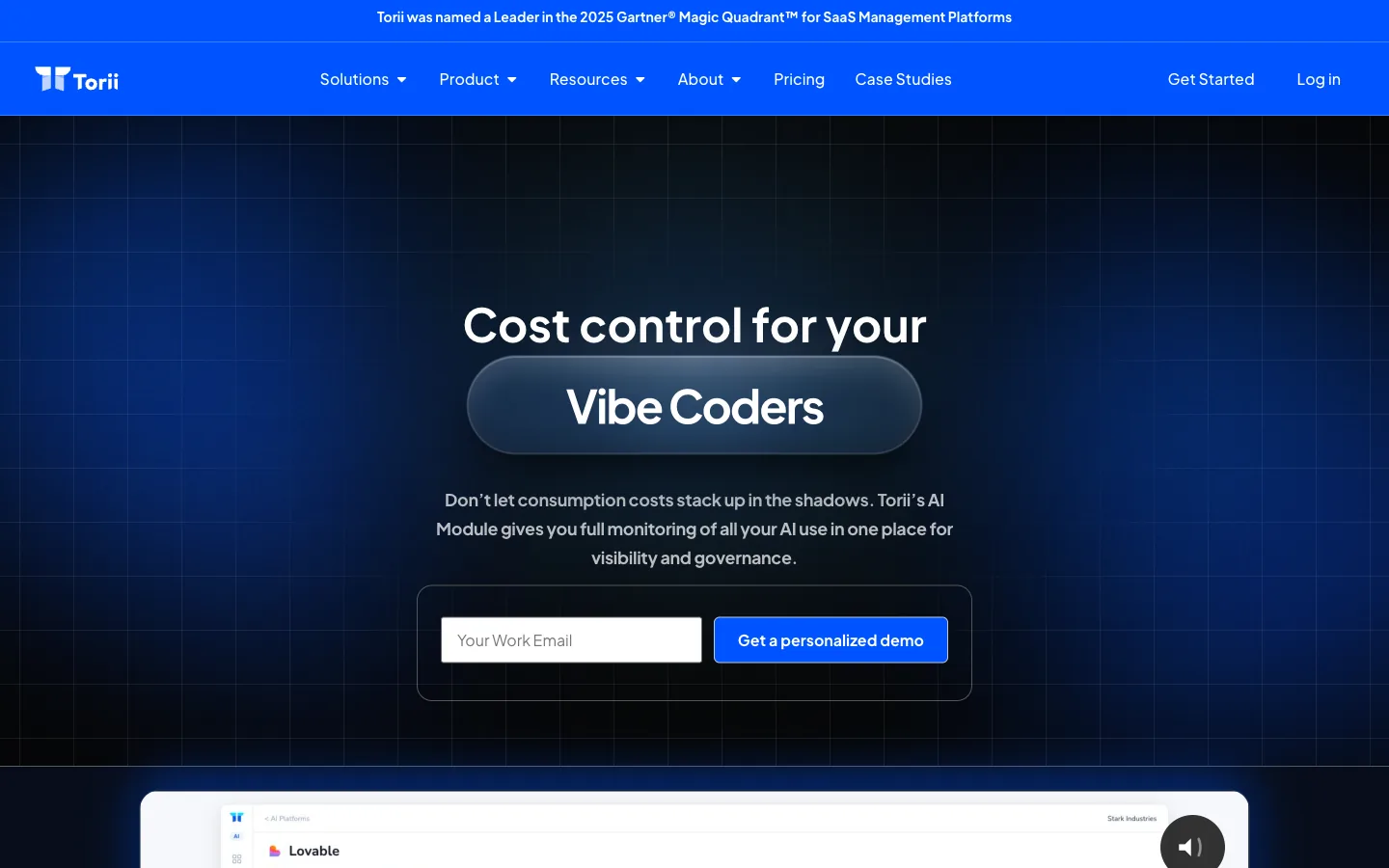
Torii treats AI governance as the natural extension of AI management, because you can’t enforce policy on what you can’t see. Its discovery engine pulls signals from SSO, IdP logs, browser extensions, finance and expense data, OAuth grants, and HRIS to surface unsanctioned AI tools that bypass procurement. A browser-level extension can flag or block AI usage at the point of access, stopping data exposure before it reaches a public model. Once an app surfaces, Torii maps entitlement-level access for both human users and non-human AI service accounts.
Torii’s 2026 SaaS Benchmark Report found that only 15.5 percent of applications are formally sanctioned, and AI-first tools now sit as the dominant ungoverned category at most enterprises, the same pattern the broader shadow AI discovery market is racing to address. The platform applies risk scoring across SOC 2 status, data residency, breach history, and DPA coverage (the kind of checks our list of AI tool risk questions walks through), then routes new app approvals through Slack so policy keeps pace with employee signups. Joiner-mover-leaver workflows revoke AI access automatically when employees change roles, an area covered in more depth in our AI tool onboarding and provisioning comparison, and teams that need to periodically certify who retains access to Claude can use this alongside the purpose-built Claude access review tools. Get a walkthrough on the Torii AI Dashboard.
Pros:
- Multi-source discovery catches AI tools that bypass SSO, including expensed or browser-only signups
- Entitlement and lifecycle workflows govern both humans and AI service accounts
- Risk scoring covers SOC 2, ISO, residency, breach history, and DPA status per app
- Eko AI co-pilot answers governance questions in plain English
Cons:
- Pricing reflects enterprise-grade coverage, not entry-level point pricing
- Built for SaaS and Shadow-IT environments; no on-premise deployment
| G2: 4.5/5 (302 reviews) | Capterra: 4.9/5 (26 reviews) |
Credo AI
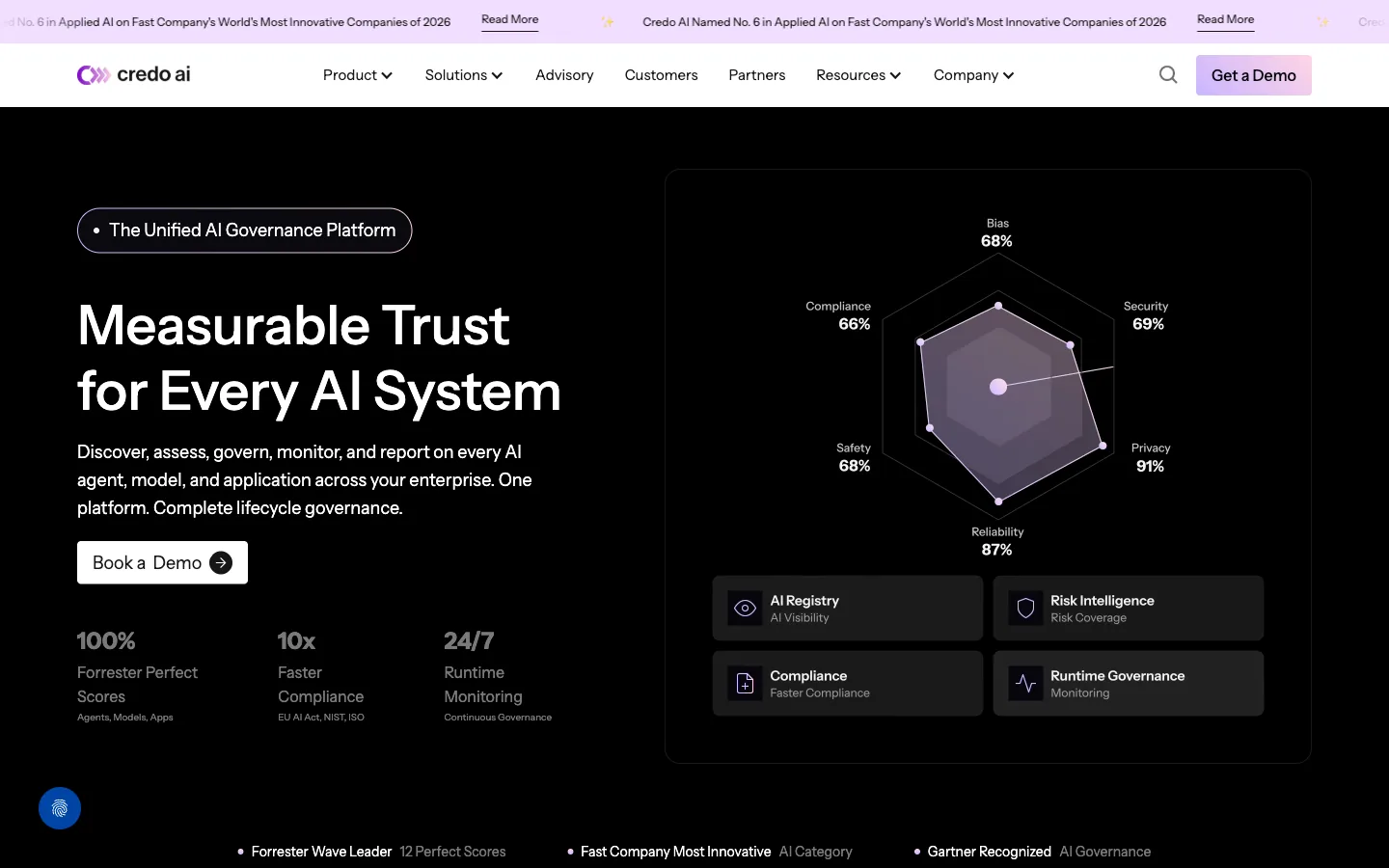
Credo AI sits at the GRC end of the AI governance spectrum, built around regulatory mapping rather than runtime traffic. The platform combines four products: an AI Registry that inventories every model, agent, and application; Risk Intelligence for continuous bias, security, and privacy monitoring; a Policy Engine for codified rules; and GAIA, a governance assistant that answers compliance questions in plain language. Pre-built policy packs cover the EU AI Act, NIST AI RMF, ISO 42001, and SOC 2.
Each control links back to live model configurations through what Credo calls its Governance Knowledge Graph. Recent agent extensions push that mapping across multi-agent dependencies, so a network of agents calling each other still rolls up to a single risk posture. Credo AI was named a Leader in The Forrester Wave: AI Governance Solutions, Q3 2025. See the full feature set on the Credo AI product page.
Pros:
- Deep regulatory mapping with policy packs for EU AI Act, NIST RMF, ISO 42001, and SOC 2
- Governance Knowledge Graph links controls to live AI configurations
- Forrester Wave Leader Q3 2025 in AI Governance Solutions
Cons:
- GRC-first design means thinner real-time DLP and runtime traffic inspection
- Best paired with a runtime tool for prompt-layer enforcement
| G2: 4.6/5 (16 reviews) | Capterra: not listed |
Harmonic Security
Harmonic Security plants itself at the browser, the layer most other vendors skip in favor of network proxies or API gateways. A lightweight Chrome and Edge extension plus a desktop client intercepts employee prompts before they leave the endpoint. Harmonic says coverage spans ChatGPT, Claude, Copilot, Gemini, and roughly 1,000 other AI surfaces, including AI features embedded inside sanctioned tools like Canva and Grammarly. The classifier runs on purpose-built Small Language Models; Harmonic says its “models are exceptionally fast, making accurate assessments within 200 milliseconds” (Harmonic Security) and that its “inline controls prevent leaks of source code, M&A data, and PII with 96% greater accuracy than legacy DLP” (Harmonic Security). Both figures are the vendor’s own benchmarks.
Where most DLP tooling drops a hard block, Harmonic uses a coach-don’t-block approach with real-time nudges or business justification prompts. Personal versus corporate account separation blocks free-tier ChatGPT and Claude uploads, and the platform flags which downstream tools train on submitted data. Harmonic’s browser GenAI security page walks through the full deployment.
Pros:
- Native desktop and embedded-AI coverage that network-layer tools tend to miss
- Sub-200ms prompt classification distinguishes personal from corporate accounts
- Coach-don’t-block enforcement keeps legitimate AI work flowing
- Flags which downstream tools train on submitted data
Cons:
- Browser-and-device coverage means unmanaged BYOD needs an enrollment path
- Lighter on inventory and procurement workflows than full SaaS-management platforms
| G2: 4.8/5 (12 reviews) | Capterra: not listed |
Torii pulls SSO, finance, browser, OAuth, and network signals into a single AI inventory, scores each tool on SOC 2, ISO, breach, and DPA status, then routes approvals and offboarding through Slack. Pair Torii with a runtime DLP layer like Harmonic or WitnessAI and you cover discovery plus prompt-level enforcement. Tour the AI Dashboard.
Prompt Security
Prompt Security covers the widest AI surface area on this list, spanning browsers, internal LLM apps, AI coding assistants, and agentic MCP systems. SentinelOne announced a definitive agreement to acquire the company in August 2025, but it still ships and operates under its own brand. Deployment can be a Chrome extension delivered through MDM, a reverse proxy in front of custom AI apps, or an SDK for developer pipelines, all sharing one model-agnostic control plane.
Core capabilities include semantic data redaction, prompt injection blocking, jailbreak prevention, secret detection in code generation, and an AI app catalog that surfaces shadow signups. An MCP gateway scores risk across the servers Prompt Security describes as “over 13,000 MCP servers on GitHub” (Prompt Security), which matters as agentic workflows pull in third-party tool servers without IT review. Coverage also extends to Microsoft Copilot, Cursor, and Amazon Q. See the platform overview at Prompt Security.
Pros:
- Single control plane spans browser, custom apps, AI code assistants, and MCP agents
- MCP gateway scores risk across 13,000+ third-party MCP servers
- Flexible deployment via extension, reverse proxy, or SDK
- Backed by SentinelOne after the 2025 acquisition
Cons:
- Breadth means smaller orgs may pay for surface they never use
- Brand transition under SentinelOne still in flux
| G2: 4.9/5 (35 reviews) | Capterra: not listed |
WitnessAI
WitnessAI operates at the network layer, capturing every AI interaction without browser extensions or endpoint agents on each device. Its Observe-Protect-Control architecture sits between users and AI tools, then applies intent-based ML engines that classify prompts based on conversational context rather than keyword regex. Administrators wire in role- and department-based access policies, redact sensitive data including PCI-scoped payment fields in real time, and generate granular audit trails for compliance.
The platform extends past chatbot prompts into AI agents, MCP servers, and embedded AI inside native apps like Windows Copilot. An identity-attribution layer ties agent activity back to a human user, which matters as audit teams ask who actually authorized a given action. WitnessAI announced strategic funding of $58 million in January 2026 to expand coverage. See the WitnessAI product page.
Pros:
- No browser extension or endpoint agent required
- Identity attribution links agent activity back to a human user
- Intent-based classification enables nuanced policy beyond allow/block
- Real-time redaction for PCI and other regulated data
Cons:
- Network-layer placement assumes traffic flows through a managed path
- Newer brand with smaller community footprint than legacy DLP vendors
| G2: not listed | Capterra: not listed |
Zenity
Zenity governs the agents themselves, the layer most AI governance vendors don’t touch. The platform discovers AI agents living inside Microsoft Copilot Studio, Power Platform, AWS Bedrock, Google Vertex AI, and low-code or no-code environments, then continuously monitors what those agents touch and share. AI Security Posture Management (AISPM) applies buildtime policies that enforce least-privilege access, flag over-permissioned connectors, and catch misconfigured resources before an agent ever runs.
At runtime, the AIDR engine breaks agent execution into granular steps to spot injection, exfiltration, shadow agents, and privilege escalation in the act. Zenity says it was “recognized as a Cool Vendor in the 2025 Gartner Cool Vendors in Agentic AI Trust, Risk and Security Management (TRiSM) report” (Zenity), and the platform supplies one of the few control points designed for Copilot Studio sprawl. The Zenity platform overview walks through the agent-side feature set.
Pros:
- Buildtime AISPM catches over-permissioned agents before they go live
- Runtime AIDR detects prompt injection and exfiltration at execution time
- Coverage spans Copilot Studio, Power Platform, Bedrock, and Vertex AI agents
- Gartner Cool Vendor 2025 in Agentic AI TRiSM
Cons:
- Specialized for agentic AI; pair with a runtime DLP tool for prompt-layer coverage
- Coverage depth varies across cloud agent platforms
| G2: 4.8/5 (8 reviews) | Capterra: not listed |
How to Choose an AI Governance Tool
AI governance tooling splits by the layer it trusts most. Credo AI maps to regulation, Harmonic and WitnessAI inspect prompts at the browser or network, Prompt Security spans from browser to agent, and Zenity focuses on agentic AI inside Copilot Studio and Bedrock.
Policy enforcement starts with discovery, since you can’t govern what your stack doesn’t see. Torii surfaces every AI tool already in use across SSO, finance, browser, and OAuth signals, then ties each app to risk, owner, and lifecycle workflows that the rest of your enforcement stack can act on.
Pair a SaaS-grounded discovery and lifecycle platform (Torii) with one runtime enforcement layer matched to where your risk lives. Browser-heavy workforce: add Harmonic. Network-routed traffic: add WitnessAI. Broad surface including MCP agents: add Prompt Security. Copilot Studio and low-code agent sprawl: add Zenity. Heavy regulated industries: add Credo AI for policy mapping.
Frequently Asked Questions
AI governance in 2026 is an enforcement problem because visibility alone no longer suffices; only 17% of companies can block confidential data to public AI tools. With EU AI Act enforcement and heavy fines, organizations must implement runtime controls, discovery, and auditability.
The enforcement gap shows three metrics: only 17% have blocking controls, 97% of breached organizations lacked basic AI access controls, and shadow AI added roughly $670,000 to average incident costs. These gaps raise breach impact, detection time, and regulatory exposure.
Pair a discovery and lifecycle platform with a runtime enforcement layer. Start with inventory (Torii), then add a runtime DLP matched to your surface: browser-heavy (Harmonic), network-routed (WitnessAI), broad agent surfaces (Prompt Security), Copilot/low-code (Zenity). Add Credo AI for regulation mapping.
These tools cover complementary layers: inventory and discovery (SSO, finance, browser signals), runtime prompt enforcement (browser or network DLP), network-layer observation, and agent governance for buildtime policies and runtime agent oversight.
Harmonic Security is ideal for browser-level protection: a Chrome/Edge extension and desktop client intercept prompts, classify intent in under 200ms, separate personal and corporate accounts, and coach users rather than hard-blocking legitimate workflows.
Agent governance (Zenity) enforces buildtime least-privilege and inspects agent execution steps to catch injection, exfiltration, or privilege escalation. Runtime DLP inspects prompts and traffic; combining both prevents misconfigured agents and blocks sensitive data leaks during execution.