

8 AI Vendor Risk Management Tools for 2026
 Chris Shuptrine
•
Jun 4, 2026
•
15 min read
Chris Shuptrine
•
Jun 4, 2026
•
15 min read
Compare 8 AI vendor risk management tools for 2026 to vet AI SaaS for training, sub-processors, and third-party risk.
Ask about this article
Opens Claude in a new tab to answer, using this article as the source.
AI vendors break TPRM in ways traditional questionnaires were never designed to catch, and the shadow AI problem makes that gap worse every quarter. They pull customer data into shared models, run sub-processor chains three or four tiers deep through opaque inference hosts, and quietly swap model versions without an SLA in sight. In the OmniGPT breach of February 2025, the attacker claimed to have “extracted all messages between their users and the AI (Over 34 million lines)”, noting that “You can find a lot of useful information in the messages such as API keys and credentials” (CSO Online).
AI adoption keeps outpacing the oversight teams responsible for managing it. Gartner expects 40 percent of enterprise apps to ship task-specific AI agents by year-end. The regulatory backstop is arriving in parallel, though the timeline moved: the AI Omnibus that entered into force on July 27, 2026 pushed the EU AI Act’s Annex III high-risk rules to “2 December 2027” (European Commission), while the Article 50 transparency obligations took effect on August 2, 2026. That comes alongside overlapping pressure from internal AI governance and policy enforcement programs.
The demand side explains why. BlackFog’s research, based on a survey of 2,000 employees at organizations with 500 or more staff, found that “49% of the total 2,000 respondents reported using AI tools not sanctioned by their employer at work” (BlackFog, January 2026). IBM, meanwhile, reported that “13% of organizations reported breaches of AI models or applications”, and that of those compromised, “97% report not having AI access controls in place” (IBM, July 2025).
The eight platforms below approach AI vendor risk from different layers, including discovery, framework mapping, shared assessments, outside-in ratings, and runtime evidence. Most security teams end up pairing two of them.
49 percent of employees report using AI tools their employer has not sanctioned (BlackFog research, survey of 2,000 employees, January 2026) · 13 percent of organizations reported a breach of AI models or applications, and 97 percent of those lacked AI access controls (IBM, July 2025) · third-party involvement in breaches doubled to 30 percent (Verizon 2025 DBIR). The questionnaire-and-spreadsheet model was built for a different threat surface.
★ = low · ★★ = medium · ★★★ = high
| Tool | Shadow AI Discovery | Framework Mapping | Continuous Monitoring | Cost |
|---|---|---|---|---|
| Torii | ★★★ | ★★★ | ★★★ | ★★ |
| OneTrust | ★ | ★★★ | ★★ | ★ |
| Prevalent | ★ | ★★★ | ★★ | ★★ |
| ProcessUnity | ★ | ★★ | ★★★ | ★★ |
| SecurityScorecard | ★★ | ★ | ★★★ | ★★ |
| UpGuard | ★ | ★★★ | ★★ | ★★ |
| Vanta | ★ | ★★ | ★★ | ★★★ |
| Whistic | ★ | ★★ | ★★ | ★★★ |
Table of Contents
Torii
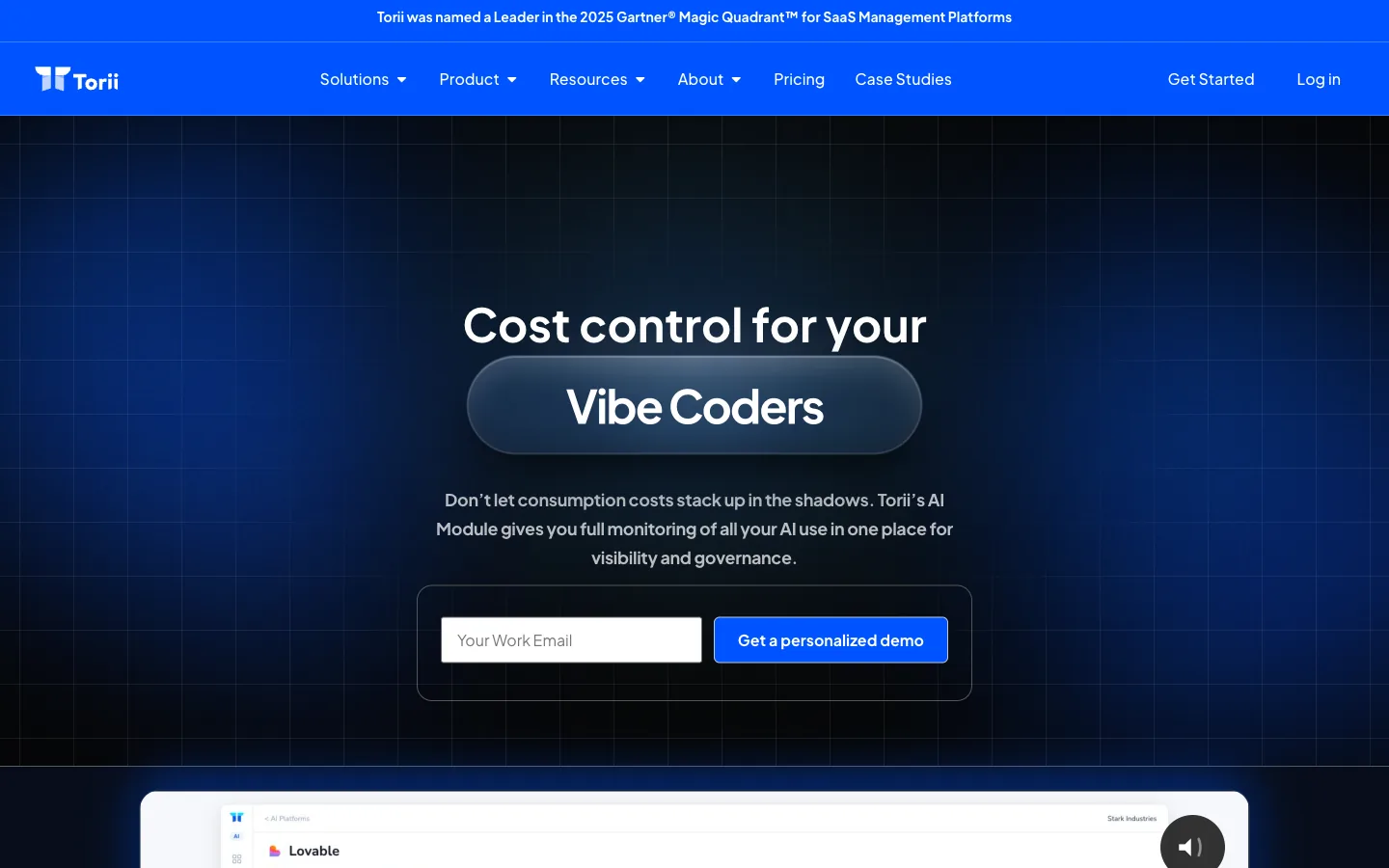
Torii surfaces every AI vendor your team uses, often before procurement gets a chance to vet them. The platform pulls signals from SSO, IdP logs, finance feeds, expense data, OAuth grants, contracts, MDM, and a browser extension, so AI tools that never touch single sign-on still show up in the inventory, which is the shadow AI discovery problem most TPRM tools never see. Each new AI vendor is auto-scored on SOC 2 status, ISO certs, data residency, breach history, and DPA coverage at the moment it lands, not three weeks into a questionnaire cycle.
The Secure Browsing extension can block unsanctioned AI tools at the browser and enforce DLP rules against pasting source code or customer records into free-tier models. That matters because the OmniGPT breach in early 2025 exposed more than 34 million chat lines, reportedly including API keys and credentials, almost entirely from individual employee accounts (CSO Online). Torii’s AI Dashboard ties risk to spend, surfacing overlapping copilots, runaway token usage, and forecasted bills against contracted limits, the same problem covered in our AI spend management tools roundup.
For a closer look at how discovery, risk scoring, and lifecycle workflows hand off to your TPRM stack (and into the broader AI tool onboarding and provisioning stack), see the Torii AI Dashboard.
Pros:
- Multi-source discovery catches AI tools that bypass SSO and procurement
- Browser-level DLP blocks data exposure before it hits a public model
- Risk scoring covers SOC 2, ISO, residency, breach history, and DPA status
- Spend-tied governance flags duplicate AI tools and runaway token usage across vendors
Cons:
- Pricing reflects enterprise-grade coverage, not entry-level point pricing
- Built for SaaS and Shadow-IT environments; no on-premise deployment
| G2: 4.5/5 (302 reviews) | Capterra: 4.9/5 (26 reviews) |
OneTrust
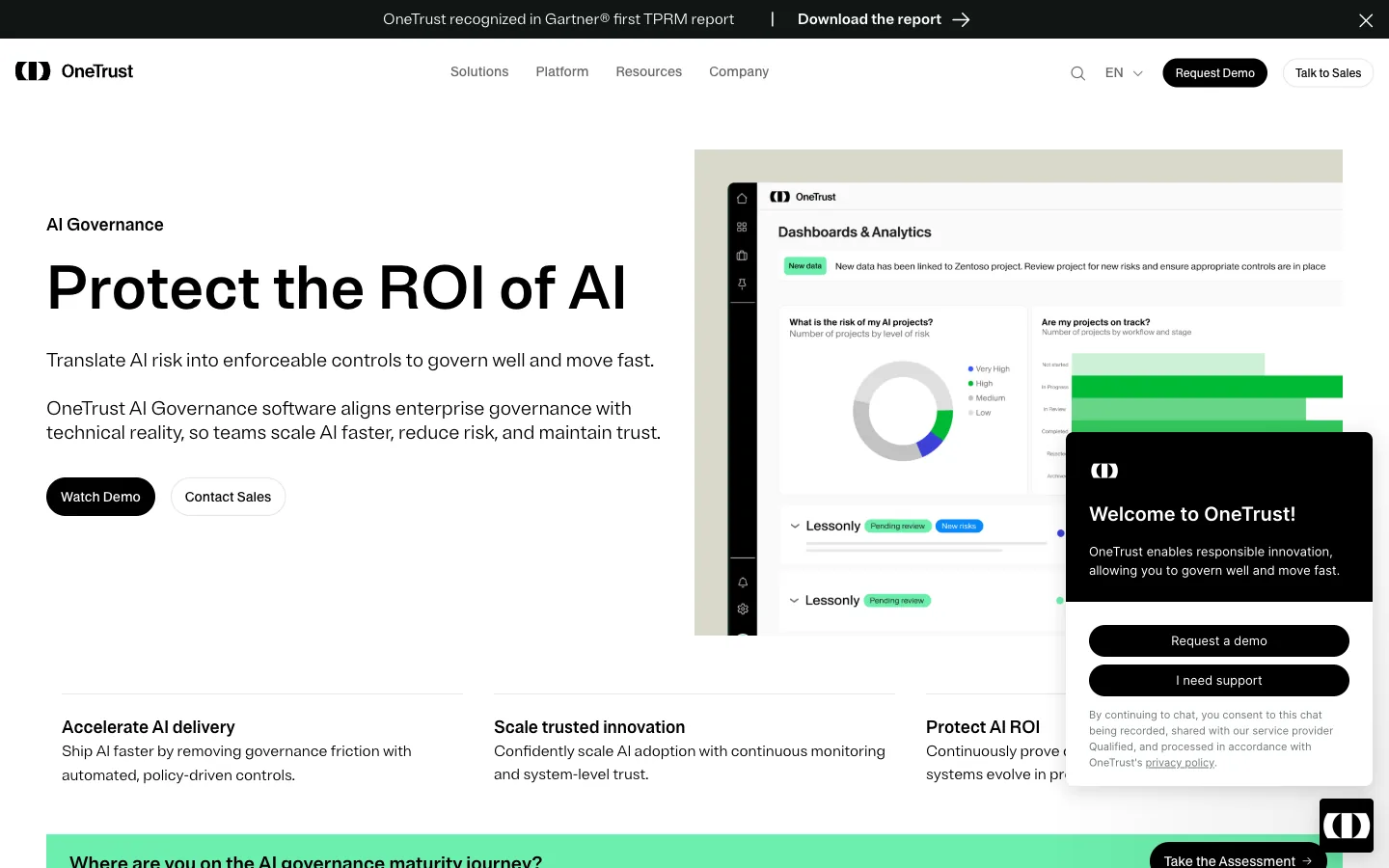
OneTrust pairs its AI Governance module with the Third-Party Management product to handle AI vendor risk from two sides. The AI Governance side keeps a centralized inventory of models, datasets, agents, and third-party AI tools mapped to EU AI Act, NIST AI RMF, ISO 42001, and OECD principles. With the EU AI Act’s general-purpose AI obligations live since August 2025 and the Annex III high-risk rules now set for December 2027 (European Commission), that regulatory mapping is what most legal teams reach for first.
The Third-Party Management side feeds vendor evidence in through thousands of pre-built Trust Profiles plus continuous monitoring from SecurityScorecard, RiskRecon, and HackNotice. OneTrust also ships a downloadable AI vendor assessment checklist and a Databricks sync for ML workloads. The trade-off is real because AI vendor risk requires stitching two products together, and the licensing reflects that.
Take the platform tour on the OneTrust AI Governance page to see how the two modules connect.
Pros:
- Deep regulatory mapping across EU AI Act, NIST AI RMF, ISO 42001, and OECD
- Pre-built Trust Profiles cut starting evidence collection time
- Native integrations with SecurityScorecard, RiskRecon, and Databricks
Cons:
- Two-product stitch increases license cost and admin overhead
- Heavier GRC orientation than runtime-control-first buyers may want
| G2: 4.4/5 (235 reviews) | Capterra: 4.5/5 (143 reviews) |
Prevalent
Prevalent, now part of Mitratech, has the most explicit NIST AI RMF alignment on this list. Its questionnaire templates map directly to the four NIST functions (Govern, Map, Measure, Manage), and a rule-based engine tiers AI risk from the responses. With the NIST GenAI Profile (AI 600-1) flagging third-party model assessment as a core control, that mapping does real audit work.
Questionnaire autofill pulls answers from prior assessments, SOC 2 reports, and ISO Statements of Applicability, while the ARIES virtual advisor gives contextual scoring guidance. Prevalent says its continuous external monitoring runs against more than 550,000 intelligence sources, and incident playbooks trigger when key risk indicators breach AI-specific thresholds. A buyer can chain risk scoring, monitoring, and incident response without leaving the platform.
For an example of how the framework mapping plays out in a real workflow, the Prevalent NIST AI RMF write-up walks through the model.
Pros:
- Direct NIST AI RMF mapping across Govern, Map, Measure, and Manage
- ARIES virtual advisor speeds questionnaire scoring
- Continuous monitoring against the 550,000+ intelligence sources Prevalent lists
Cons:
- Less polished UI than newer SaaS-native TPRM platforms
- Mitratech acquisition still being absorbed at the product level
| G2: 4.4/5 (76 reviews) | Capterra: 4.6/5 (21 reviews) |
ProcessUnity
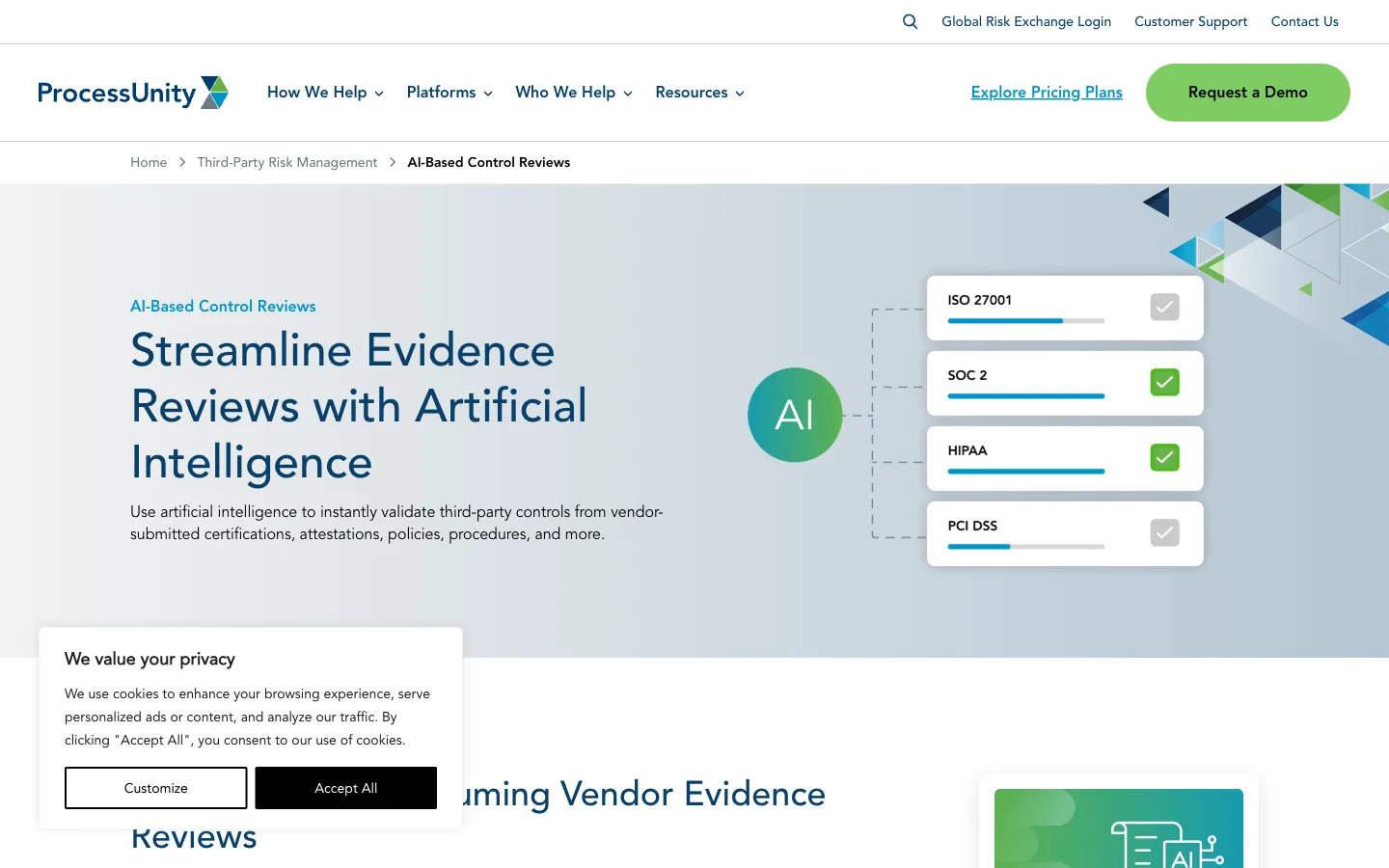
ProcessUnity’s differentiator for AI vendor risk is the CyberGRX Global Risk Exchange, the shared assessment library it absorbed in 2024. ProcessUnity describes the exchange as “containing more than 14,000 attested and validated assessments and cyber risk data on more than 250,000 companies” (ProcessUnity), so common AI SaaS vendors like OpenAI, Anthropic, and Pinecone often have pre-completed evidence on file. Risk teams pull validated answers instead of starting cold, which matters when a single questionnaire round can drag on for weeks.
Evidence Evaluator, built on an in-house cybersecurity LLM, reads SOC 1/2s, ISO certs, SIG questionnaires, and DPAs, then auto-populates responses with passage-level citations back to the source document. Predictive Risk Profiles pre-score vendors on firmographic and cyber-hygiene signals before any questionnaire is sent, giving procurement a baseline tier on day one. The platform also runs continuous monitoring for breach signals and reissues affected questionnaires automatically.
ProcessUnity walks through the AI control review workflow on its AI-based control reviews page.
Pros:
- CyberGRX Exchange holds more than 14,000 attested and validated assessments across 250,000+ companies
- Evidence Evaluator cites source documents at the passage level
- Predictive Risk Profiles tier vendors before questionnaires go out
- Continuous monitoring reissues affected questionnaires automatically
Cons:
- Exchange depth varies for emerging or niche AI startups
- Best fit for orgs that already centralize TPRM, less for point buyers
| G2: 4.4/5 (110 reviews) | Capterra: 4.4/5 (13 reviews) |
SecurityScorecard
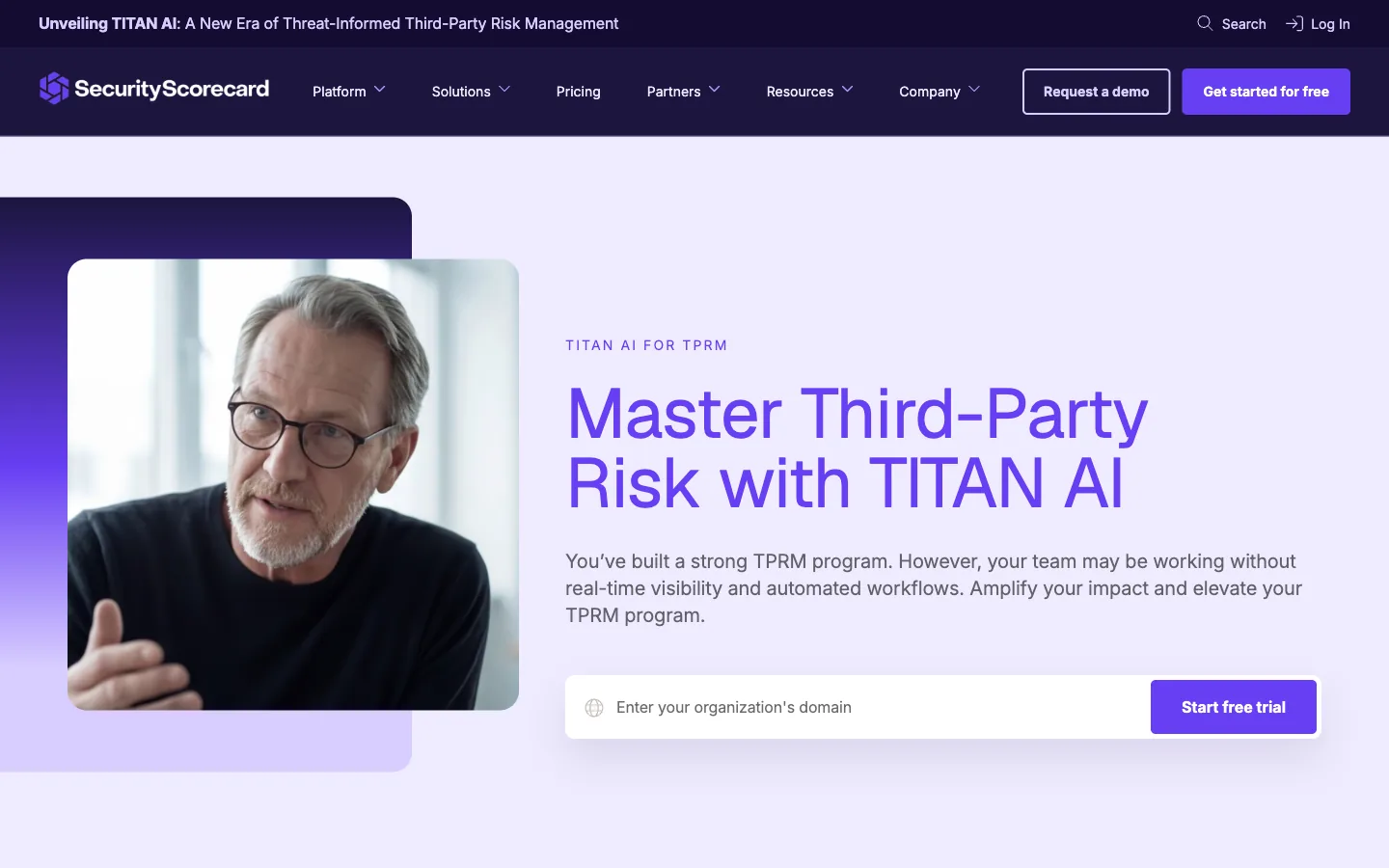
SecurityScorecard takes an outside-in posture, with scanners that sweep the open internet daily and grade any AI vendor domain A through F, with no vendor cooperation required. SecurityScorecard describes the ratings as giving “Detailed visibility into 10 key categories, including DNS Health, IP Reputation, and Patching Cadence” (SecurityScorecard). That matters because Verizon reported that “third-party involvement in breaches has doubled to 30%” (Verizon 2025 DBIR), and most AI vendors won’t sit still long enough for a full questionnaire cycle.
TITAN Watch surfaces nth-party AI dependencies, flagging when a sanctioned copilot quietly rides on OpenAI, Anthropic, or a less-known inference host. The HyperComply acquisition in 2024 folded RespondAI into TITAN Assess, which cross-validates self-reported questionnaire answers against observed technical signals to flag discrepancies before they reach legal review. The Driftnet acquisition added internet-scale scanning: SecurityScorecard says its threat intelligence team “recently identified more than 816,000 internet-exposed AI OpenClaw agent deployments, many already correlated with prior breaches” (SecurityScorecard).
The SecurityScorecard TPRM platform overview covers the full ratings-to-response pipeline and how each signal tier feeds the next.
Pros:
- Outside-in ratings need zero vendor cooperation
- TITAN Watch maps nth-party AI sub-processor exposure
- Driftnet scanning surfaced more than 816,000 internet-exposed OpenClaw agent deployments
- Cross-validates self-reported answers against observed signals
Cons:
- External signals can miss internal data-handling failures
- Heavier security-team buy than a pure procurement workflow
| G2: 4.4/5 (181 reviews) | Capterra: 4.4/5 (18 reviews) |
Torii surfaces AI tools that never touch SSO by pulling browser, finance, OAuth, IdP, and contract signals, then auto-scores each vendor on SOC 2, ISO, residency, breach history, and DPA coverage. Pair Torii with any TPRM platform on this list and your assessment queue stops being a list of vendors you've already approved by default. Tour the AI Dashboard.
UpGuard
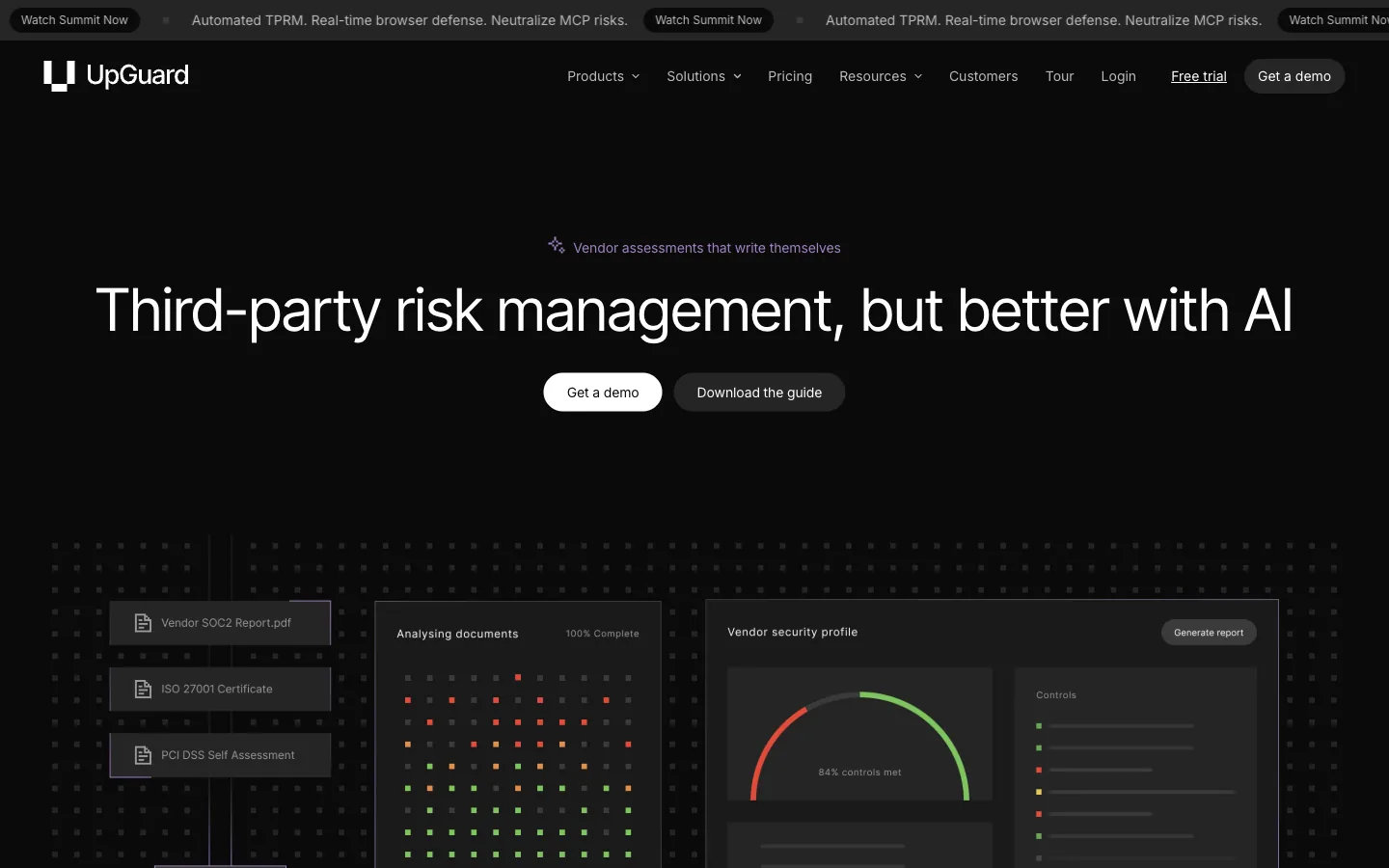
UpGuard shipped the most concrete AI-vendor-specific artifact on this list, a dedicated NIST AI RMF Security Questionnaire released in November 2024, mapped to all four NIST functions. Where most platforms bolt AI questions onto an existing SOC 2 template, UpGuard built the questionnaire from the framework outward, with sections for governance structures, training data lineage, and incident response specific to model behavior.
UpGuard says its AI-Powered Security Profiles parse vendor documentation and produce an Instant Risk Assessment in under 60 seconds, citing the source passage for every claim. That citation layer is what lets a risk team verify a vendor’s “we don’t train on customer data” line instead of trusting it. Continuous security ratings refresh multiple times daily, and UpGuard publishes its Standard plan at “$1,750/mo, billed annually” to “Monitor 50 Vendors”, which is unusually transparent for this category.
The UpGuard AI Vendor Risk product page walks through the full questionnaire and assessment workflow with examples of how the citation layer surfaces evidence.
Pros:
- Named NIST AI RMF Security Questionnaire shipped November 2024
- Sub-60-second risk assessments with source-cited claims, per UpGuard
- Public pricing: Standard plan at $1,750/month, billed annually, for 50 vendors
Cons:
- 50-vendor entry tier fills quickly for mid-market buyers
- Lighter on agentic AI and MCP-specific coverage
| G2: 4.5/5 (236 reviews) | Capterra: 4.7/5 (28 reviews) |
Vanta
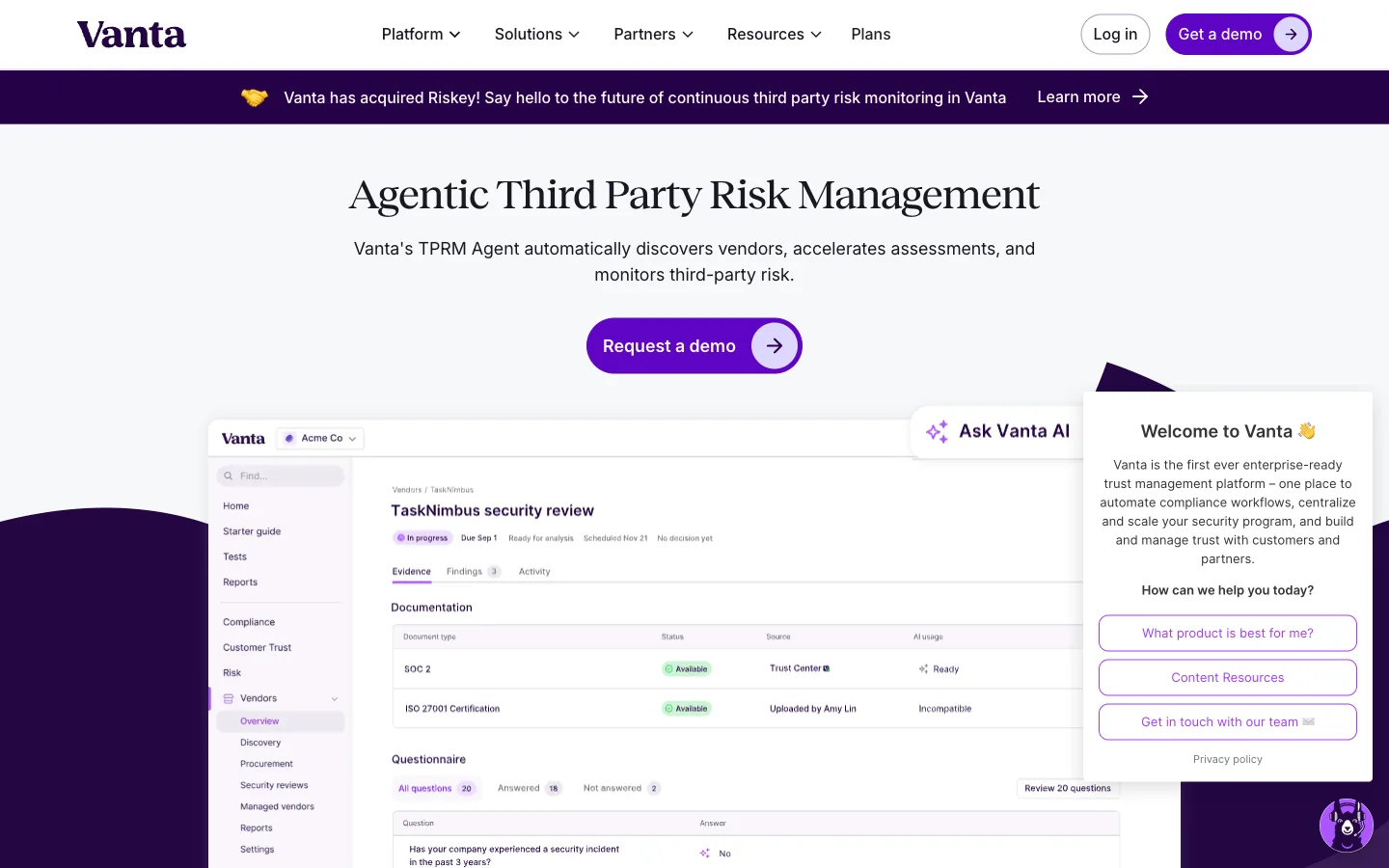
Vanta built its TPRM coverage around a purpose-built AI Security Assessment template and an AI Risk Library updated as new model behaviors emerge. The assessment is tiered by vendor criticality and covers governance, data privacy, incident management, AI tool inventory, system risk classification, and training-on-customer-data handling. The library bundles question banks for common AI risks so security teams aren’t writing the same prompt-injection control from scratch every time.
The TPRM Agent, released in June 2026, pulls evidence directly from vendor trust centers, pre-fills questionnaire answers, and auto-generates targeted follow-up questions when a monitored vendor experiences a breach. AI-powered SOC 2 and DPA extraction surfaces unusual SLA language and custom security terms that human reviewers usually miss. Vanta advertises “62% faster vendor evidence collection time” (Vanta), which is meaningful for teams running quarterly reassessments on 50 or more AI vendors.
The Vanta Third-Party Risk Management product page covers the assessment template, the TPRM Agent workflow, and how evidence extraction connects to compliance programs already running on the platform.
Pros:
- Dedicated AI Security Assessment template and AI Risk Library
- TPRM Agent auto-pulls evidence from vendor trust centers
- 62 percent faster vendor evidence collection time, per Vanta
Cons:
- Best value when paired with Vanta’s broader compliance platform
- Less depth on agent-layer and MCP-specific governance
| G2: 4.7/5 (1,932 reviews) | Capterra: 4.6/5 (52 reviews) |
Whistic
Whistic flipped TPRM into a two-sided marketplace where vendors publish their own security profiles in a shared Trust Catalog. If an AI SaaS vendor has already loaded a Whistic profile (and most major ones have), risk teams pull SOC 2 reports, DPAs, and questionnaire responses zero-touch. That cuts the typical questionnaire cycle from weeks to hours for any vendor already in the catalog.
Assessment Copilot autocompletes incoming questionnaires from uploaded documentation with confidence-scored citations. Whistic describes the underlying system as “Whistic AI that has been in production for more than two years, with 96% accuracy, confidence scores, and source citations” (Whistic), while the SOC 2 AI Summarization feature extracts controls and exceptions for review. Vendor Insights lets risk teams ask natural-language questions across their entire library, such as which AI vendors train on customer data by default, and returns answers with linked source passages. The model works well when most of your AI vendors are catalog members and falls back to traditional assessment when they aren’t.
For a walkthrough of the Trust Catalog and the Assessment Copilot workflow, see Whistic AI and Whistic’s Automation Orchestrator announcement.
Pros:
- Zero-touch evidence pull from vendors with Whistic profiles
- Natural-language search across the full vendor evidence library
- Whistic reports 96 percent accuracy, with confidence scores and source citations
Cons:
- Coverage depth depends on vendor adoption of Whistic profiles
- Less effective for vendors outside the catalog
| G2: 4.6/5 (153 reviews) | Capterra: 4.6/5 (12 reviews) |
How to Choose an AI Vendor Risk Tool
The right tool depends on where your AI risk actually lives in the stack. Regulatory-heavy industries lean toward OneTrust, Prevalent, or UpGuard for framework mapping against the EU AI Act and NIST AI RMF. Outside-in posture buyers gravitate to SecurityScorecard. Catalog-heavy assessment shops pick Whistic or ProcessUnity. Vanta works well when the compliance program already runs there.
Most TPRM stacks miss the AI vendors that never reach procurement in the first place. Torii closes that gap by discovering shadow AI across SSO, browser, finance, and OAuth signals, then feeding each new tool into the TPRM workflow with risk scoring already attached.
Do you train on customer data by default, and what is the opt-out path? Name every AI sub-processor and inference host. Where is prompt and output data stored, and for how long? Do you hold SOC 2, ISO 27001, or ISO 42001? Will you notify us before changing model versions? Can you provide an AI-BOM? How do you handle GDPR Article 17 erasure for data already in a trained model? What is your AI-specific incident response SLA? Does your DPA cover inference endpoints? What is your shutdown notice window for the model itself?
Frequently Asked Questions
Use multi-source telemetry—SSO, IdP logs, finance feeds, OAuth grants, MDM and browser extensions—to surface unsanctioned AI tools. Tools like Torii tie discovered vendors to risk scores and spend, feeding them into TPRM workflows for faster mitigation.
Ask whether they train on customer data by default, the opt-out mechanism, retention windows, and how training data are isolated. Require documented DPAs, logging of training activities, and contractual guarantees to prevent unauthorized model retraining.
Questionnaires miss runtime behaviors: shared-model training, opaque sub-processor chains, inference-host swaps, and silent model version changes. These dynamic exposures—exemplified by the OmniGPT breach—require continuous discovery, outside-in signals, and runtime evidence rather than static surveys.
An AI-BOM (AI Bill of Materials) inventories models, sub-processors, inference hosts, data flows, and training sources. It clarifies third-party chains, aids regulatory compliance, speeds incident response, and lets you assess point-in-time and nth-party exposures.
Combine citation-backed evidence extraction, vendor-published trust profiles, and outside-in ratings. Use tools that auto-cite SOC 2, ISO, and DPA passages, cross-validate technical signals, and run continuous monitoring to detect discrepancies or emergent sub-processor exposure.
Regulatory-heavy teams favor OneTrust, Prevalent, or UpGuard for framework mapping and audits. Security-first buyers choose SecurityScorecard for outside-in ratings. Catalog-driven assessment shops prefer Whistic or ProcessUnity, while Torii handles shadow-AI discovery and Vanta suits embedded compliance programs.