

5 Tools for Tracking AI Adoption Across Your Company in 2026
 Chris Shuptrine
•
Jun 11, 2026
•
11 min read
Chris Shuptrine
•
Jun 11, 2026
•
11 min read

Compare 5 tools for tracking AI adoption across your company in 2026, from usage metrics to shadow AI visibility.
Ask about this article
Opens Claude in a new tab to answer, using this article as the source.
AI adoption inside the enterprise outran every tool meant to track it in 2026. Stanford’s 2026 AI Index reports that “Generative AI is now used in at least one business function at 70% of organizations” (Stanford HAI), and the money moved just as fast. Menlo Ventures found that “companies spent $37 billion on generative AI in 2025, up from $11.5 billion in 2024, a 3.2x year-over-year increase” (Menlo Ventures).
The visibility gap shows up clearly when you look at the numbers. Nudge Security reports that “organizations now use an average of 39 unique AI tools” (Nudge Security), and Reco puts the sanctioned share of the wider software estate below half, describing “organizations now managing an average of 490 SaaS applications” with “only 47% of SaaS applications authorized” (Reco).
Organizations run an average of 39 unique AI tools (Nudge Security), 26 of the top 50 shadow IT apps are now AI tools (Torii), and only 47% of applications across the average SaaS estate are authorized (Reco).
The five tools below take different swings at the same question. Which employees are using which AI tools, how often, and is the spend matching the adoption. Pick the one that fits where your visibility gap is widest right now.
★ = low · ★★ = medium · ★★★ = high
| Tool | AI Tool Discovery | Usage Depth | Spend Visibility | Department Rollups |
|---|---|---|---|---|
| Torii | ★★★ | ★★★ | ★★★ | ★★ |
| Nudge Security | ★★★ | ★★ | ★ | ★★ |
| Reco | ★★★ | ★★ | ★ | ★★ |
| Zylo | ★★ | ★ | ★★★ | ★★ |
| Harmonic Security | ★★ | ★★★ | ★ | ★★ |
Table of Contents
Torii
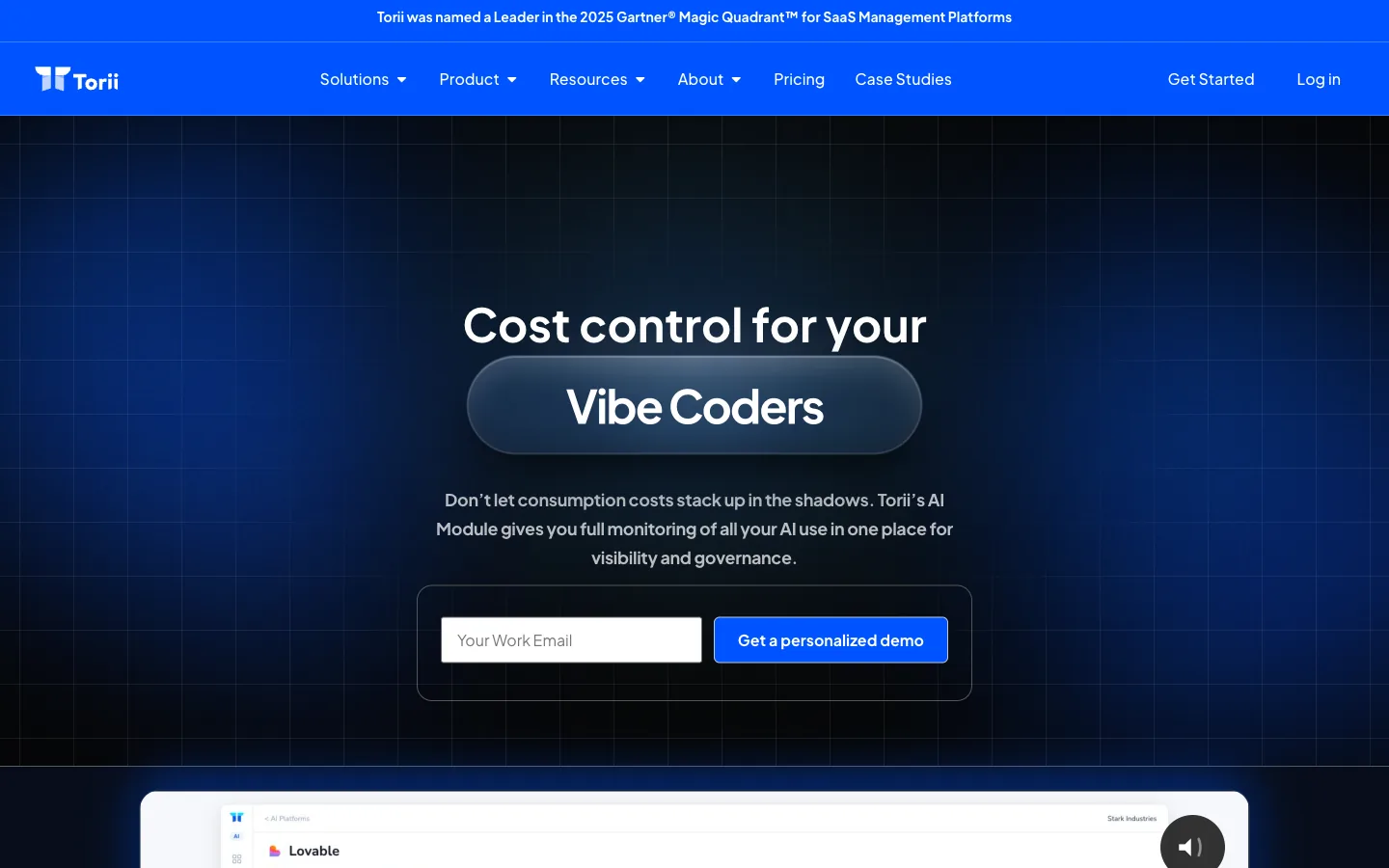
Torii treats AI adoption as a SaaS visibility problem first, then layers usage analytics on top. The platform pulls signals from browser activity, SSO logs, finance and expense data, OAuth grants, and contract metadata to surface every AI tool inside the company, including the ones someone bought on a personal card. Torii’s 2026 SaaS Benchmark Report, covering January to December 2025, found that 26 of the top 50 shadow IT apps are now pure-play AI tools.
The Torii AI Dashboard turns that inventory into adoption metrics IT can act on. Token consumption by user, department, and model sits next to spend, so finance can see when Claude, ChatGPT, and Cursor are all running side by side on the same engineering team. License utilization data flags AI seats nobody touched last quarter, ready for rationalization before the next renewal.
Here is where Torii pulls ahead of pure discovery tools:
- AI tool discovery across browser, SSO, OAuth, finance, and contracts
- Per-employee and per-department token usage by model
- Redundant AI subscription detection across teams
- Burn-rate forecasts that flag commitments months before renewal
Pros:
- Multi-signal discovery catches AI tools SSO logs never see
- Adoption metrics tie spend to actual usage, not seat counts
- Redundant tool detection surfaces overlap across teams and models
- License utilization data feeds renewal and rationalization decisions
Cons:
- Pricing reflects enterprise-grade coverage, not entry-level point pricing
- Built for SaaS and shadow-IT environments; no on-premise deployment
| G2: 4.5/5 (303 reviews) | Capterra: 4.9/5 (26 reviews) |
Nudge Security
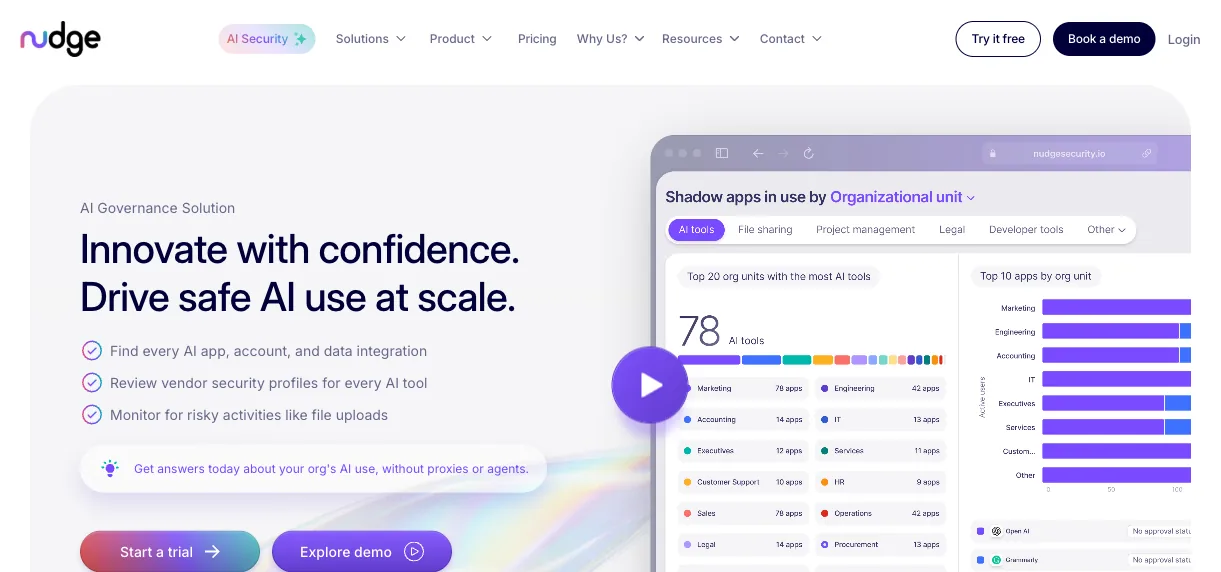
Nudge Security starts with email metadata, which catches AI signups SSO will never see. The platform ingests Google Workspace or Microsoft 365 receipts to detect every account anyone created with a corporate or personal address, then tags each one with first-seen date, frequency, and owner. Nudge’s own research puts the figure at “an average of 39 unique AI tools” per organization, measured across its customer base (Nudge Security).
A browser extension layers on the rest of the adoption picture. It records prompt activity, file upload events, and frequency data inside ChatGPT, Gemini, Microsoft Copilot, and Perplexity, so security can see not just who signed up but who actually uses the tool every day. The Nudge AI security page walks through the discovery flow in detail.
What Nudge surfaces that other AI tracking tools tend to miss:
- Employee-built agents on Agentforce, Copilot Studio, n8n, OpenAI Workflows, and Cursor
- Personal-email AI accounts tied to corporate work
- File upload events and prompt frequency inside the major chat apps
- Permissions and connected data on every agent the org builds in house
Pros:
- Email-first discovery catches signups that bypass SSO completely
- Agent inventory covers tools most AI tracking platforms still ignore
- Browser data adds real usage frequency, not just account existence
Cons:
- Strongest fit for orgs running Google Workspace or Microsoft 365 at scale
- Light on spend forecasting compared to finance-oriented tools
G2: 4.5/5 (10 reviews)
Reco
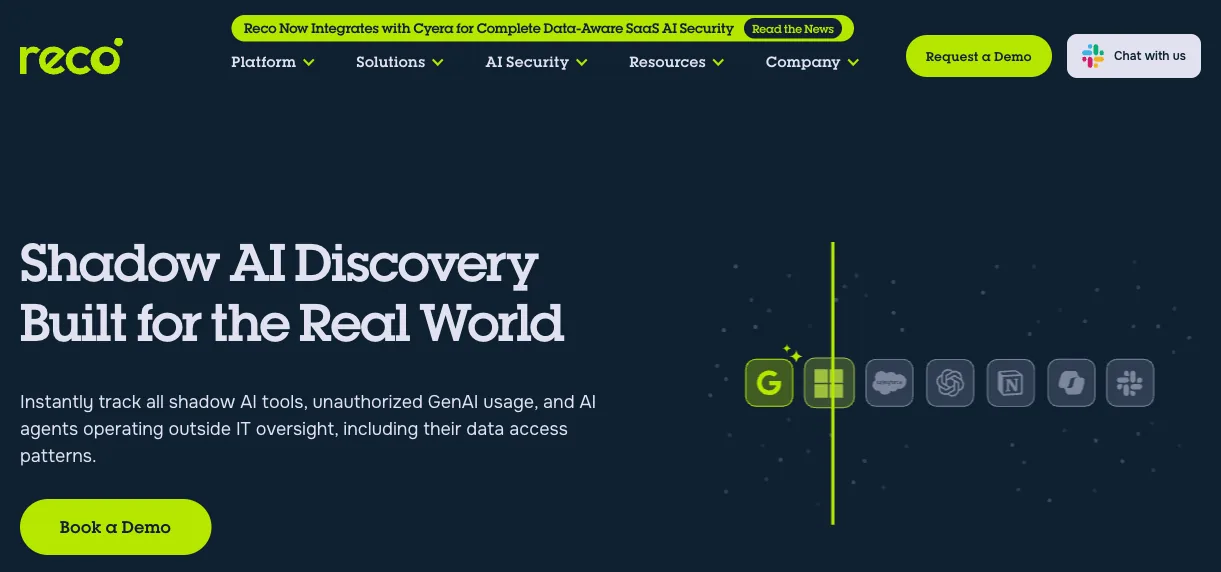
Reco builds an identity-driven knowledge graph that ties every AI tool back to the people using it. SSO logs, OAuth grants, email metadata, browser data, and SaaS-to-SaaS integration maps all feed one graph that connects users, roles, permissions, and data flows. Reco’s State of Shadow AI research, built on more than 50 enterprise environments under continuous monitoring, found the sharpest exposure at the small end of the market: “Small businesses face the highest shadow AI risk, with 27% of employees in companies with 11-50 workers using unsanctioned tools” (Reco). It is the same LLM shadow AI risk story playing out across IT teams at every size.
The platform pays attention to AI hiding inside sanctioned SaaS, not just standalone GenAI apps. Salesforce Einstein, Slack AI, Microsoft Copilot inside Office, and Notion AI all light up next to the obvious ChatGPT footprint. Adoption rollups show which roles drive usage, which teams hit data exposure risk, and where AI access overlaps a sensitive system. The Reco AI governance page details the discovery model.
A few specific places where Reco’s identity graph helps most:
- Mapping AI tool usage to specific job roles and access tiers
- Catching embedded AI features that flip on inside existing SaaS contracts
- Tracing data flow between an AI tool and the systems it talks to
- Spotting AI tools that sit outside policy for a regulated team
Pros:
- Identity graph ties AI usage to people, roles, and data, not just app counts
- Embedded AI feature detection covers the long tail inside sanctioned SaaS
- Strong on SaaS-to-SaaS connection mapping for downstream risk
Cons:
- Identity-first model needs SSO and IdP coverage to shine
- Lighter on real-time spend tracking than finance-focused tools
Torii pulls every AI tool, account, and integration inside the company into a single inventory, then layers token usage, per-department adoption, and redundant-subscription detection on top. Pair it with a runtime or prompt-level tool when deeper signal depth matters. See the Torii AI management platform.
Zylo
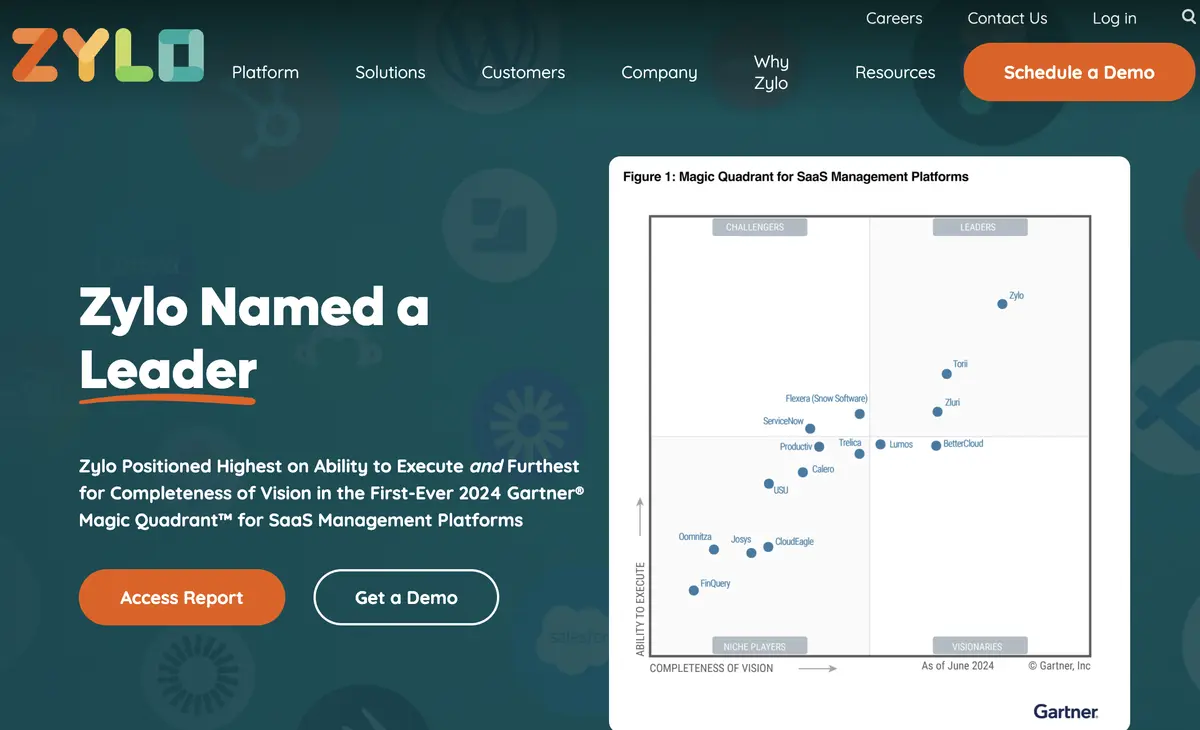
Zylo treats AI adoption as a spend problem and tracks consumption cost in real time. The AI Consumption Cost Management module unifies usage data with contract context, then breaks it down by team, project, and individual user, with burn-rate forecasts that flag commitment overages well before a true-up bill arrives.
Zylo also publishes an annual SaaS Management Index that its customers use for category context, and the platform leans on that benchmarking to frame AI-native spend growth against the rest of the portfolio. That combination is what pushes many finance teams toward dedicated AI spend management tools. The Zylo AI consumption page covers the forecasting model in depth.
Common dashboards and spend alerts that Zylo customers configure first:
- Per-team and per-project consumption dashboards refreshed daily
- Burn-rate alerts that fire weeks before a contracted ceiling
- ChatGPT and Anthropic spend reconciliation across credit-card and invoice data
- Adoption-versus-cost views that flag heavy spend on light usage
Pros:
- Real-time consumption tracking with team and project breakdowns
- Burn-rate forecasts catch overage risk before contract renewal
- Strong AI spend reconciliation across credit-card and invoice data
Cons:
- Spend-first lens means less depth on prompt-level usage
- Greatest value for orgs already running contract data inside Zylo
| G2: 4.8/5 (51 reviews) | Capterra: 4.5/5 (4 reviews) |
Harmonic Security
Harmonic Security tracks adoption at the prompt level itself, a layer none of the other tools here reach. A browser extension inventories AI interactions across the estate, a desktop client captures Claude Desktop, ChatGPT Desktop, and Cursor (which use end-to-end encryption that network tools cannot inspect), and an MCP Gateway watches agentic workflows. Its Explore product promises to “View prompt level insights across over 1,000 applications, including embedded AI features inside the SaaS tools your teams already work with” (Harmonic Security). The research base behind it is substantial: Harmonic’s AI Usage Index analyzed “22,458,240 enterprise GenAI prompts from January 1 - December 31, 2025” (Harmonic Security).
Raw prompt data rolls up into business-level adoption views inside the AI Usage Intelligence layer. Security and IT see which teams lead adoption, which tools they reach for first, where personal accounts pop up in place of corporate ones, and where employees hit policy friction. The Harmonic AI usage intelligence page covers the prompt-level model.
A few questions Harmonic can answer that prompt-blind tools cannot:
- Which prompts inside Claude Desktop touched customer data this week
- Which teams write the most prompts and which models they prefer
- Where personal-account ChatGPT usage replaced sanctioned access
- Which policy categories push employees back to shadow tools
Pros:
- Prompt-level visibility covers tools that network and SSO data miss
- Desktop client catches Claude, ChatGPT, and Cursor end-to-end encrypted traffic
- MCP Gateway brings agentic workflows into the adoption picture
Cons:
- Heavier deployment than discovery-only tracking tools
- Best fit for security-led AI programs, not finance-led ones
How to Choose an AI Adoption Tracking Tool
Pick the tool that matches where your visibility actually breaks down today. Nudge wins on email-first discovery and employee-built agents, Reco pulls everything into an identity graph, Zylo zeros in on real-time consumption cost, and Harmonic goes deep at the prompt level. Each one owns a different slice of the adoption picture. Feature-level detection of embedded AI inside sanctioned SaaS is worth asking every one of them about, since that is where the quiet additions land.
Most IT teams in 2026 pair a discovery and ownership tool with one of the specialty depth tools above. Torii surfaces every AI tool inside the company, ties each one to a human owner, maps licenses to actual usage, and feeds the rest of the stack a clean inventory of what employees are really running.
1. Does it discover AI tools bought on personal cards or signed up through personal email? 2. Can it tie token or seat spend back to specific users and teams? 3. Does it flag embedded AI features inside sanctioned SaaS? 4. Does it surface redundant subscriptions across departments? 5. Will it feed your renewal, security review, and finance workflows without a separate integration project?
Frequently Asked Questions
Shadow AI refers to employees using unauthorized AI tools or accounts without IT approval. It is widespread: Nudge Security reports organizations now use an average of 39 unique AI tools, and Reco finds only 47% of applications across the average SaaS estate are authorized.
Torii combines multi-signal discovery across browser activity, SSO logs, OAuth grants, finance and contract data to inventory AI tools. It measures per-user and per-department token consumption, flags redundant subscriptions, and surfaces license utilization to tie spend to actual adoption.
Zylo specializes in AI consumption cost management, unifying usage with contracts to show team- and project-level costs in real time. It provides burn-rate forecasts, credit-card and invoice reconciliation, and alerts for overages before renewals.
Use prompt-level tools like Harmonic Security, which captures prompts via browser extensions, desktop clients and an MCP gateway. It links prompt content to users, models and data flows so security can see which prompts touched customer data and which teams drive usage.
Require multi-signal discovery: browser and SSO logs, email and finance/credit-card receipts, OAuth and contract metadata, plus token or seat-level usage. Ensure the tool detects embedded AI features, redundant subscriptions, and exports data into renewals, finance and security workflows.
Yes. Pair a broad discovery and ownership tool such as Torii or Reco with a depth specialist: Harmonic for prompt-level visibility, Zylo for spend, or Nudge for email and agent discovery, so inventory feeds detailed usage, governance and finance workflows without blind spots.