

8 Tools to Manage GitHub Copilot Business and Enterprise Plans in 2026
 Chris Shuptrine
•
Jun 21, 2026
•
14 min read
Chris Shuptrine
•
Jun 21, 2026
•
14 min read

Compare 8 tools to manage GitHub Copilot Business and Enterprise plans in 2026, from seat provisioning to policy governance.
Ask about this article
Opens Claude in a new tab to answer, using this article as the source.
GitHub Copilot Business runs $19 a seat and Enterprise runs $39, and in 2026 the bill moved to usage-based premium request credits on top of those base costs. GitHub’s billing announcement explains that “credits will be consumed based on token usage, including input, output, and cached tokens, according to the published API rates for each model.” Many companies now run both plans side by side, with some teams on Enterprise for codebase indexing and others fine on Business. Managing that mix is harder than buying it.
Native admin tools cover the basics but leave real gaps. Seat provisioning at scale requires Enterprise Managed Users, a heavy commitment, and there is no built-in way to reclaim an idle seat or certify access on a schedule. Policy settings can be delegated per org, yet you cannot see in one place what each org turned on, the kind of gap Copilot usage dashboards are built to close. Multi-org enterprises end up stitching seat queries by hand.
Teams reach for platforms that handle the parts GitHub does not, from automated seat lifecycle to access reviews and policy visibility. Here is how Torii, Lumos, BetterCloud, Zylo, Productiv, Josys, CloudEagle, and Nudge Security compare for managing Copilot Business and Enterprise plans in 2026.
Business seats run $19 per user a month and Enterprise runs $39, with usage-based credits on top. An idle Enterprise seat is roughly $468 a year of pure waste, and with Nexthink reporting that "half (49.96%) of all software installed went unused by employees," native admin tools still have no scheduled way to find or reclaim one.
★ = low · ★★ = medium · ★★★ = high
| Tool | Policy Enforcement | Seat Lifecycle | Provisioning / SCIM | Access Reviews |
|---|---|---|---|---|
| Torii | ★★★ | ★★★ | ★★★ | ★★ |
| Lumos | ★★ | ★★ | ★★ | ★★ |
| BetterCloud | ★★ | ★★★ | ★★ | ★ |
| Zylo | ★ | ★★★ | ★★ | ★★ |
| Productiv | ★ | ★★ | ★★ | ★ |
| Josys | ★ | ★★ | ★★★ | ★★ |
| CloudEagle | ★★★ | ★★ | ★★ | ★ |
| Nudge Security | ★★ | ★★ | ★ | ★ |
Table of Contents
Torii
Torii is an AI Management Platform that finds every sanctioned and shadow Copilot seat across your stack. It pulls from SSO, HRIS, browser activity, and expense feeds, so a Business or Enterprise seat bought on a personal card still shows up. Each seat ties to real license-level usage rather than a login count, which is how IT and finance learn which seats sit idle.
Provisioning and offboarding run on always-on joiner-mover-leaver workflows that grant Copilot access at hire and revoke it the day someone leaves. Every step lands in an audit trail, so a later review has a paper record behind it. Its Access Reviews product routes each Copilot entitlement to the right owner with multi-step approval and automatic enforcement when a reviewer says no.
Reclamation is where the spend math closes, since Torii watches usage and can downgrade or pull idle Enterprise seats back to Business or off entirely. The Eko AI assistant turns those waste patterns into policies you approve in a click. Cost tracking benchmarks Copilot spend by user and department against the contract, then fires a renewal alert before the bill auto-renews. You can see the full model on the Torii AI management platform page.
Where Torii fits Copilot plan management:
- Discovers every Business and Enterprise seat through SSO, HRIS, browser, and expense data
- Grants and revokes Copilot access through joiner-mover-leaver workflows
- Routes entitlement decisions through Access Reviews with enforcement
- Downgrades or reclaims idle seats by real license usage
Pros:
- Multi-source discovery that catches seats off the IdP
- Usage-based reclamation that downgrades idle tiers
- Access reviews with automatic enforcement and an audit trail
- Cross-tool view of Copilot, Cursor, and Claude spend
Cons:
- Built for enterprise breadth, so it is not the lowest-cost option here
- Centered on SaaS and shadow IT, with no on-premises deployment
| G2: 4.5/5 (303 reviews) | Capterra: 4.9/5 (26 reviews) |
Lumos

Lumos handles identity governance across 300-plus integrations, and GitHub Copilot is one of the apps it provisions end to end. Seat assignment pulls from your HRIS as the source of truth, then applies role-based rules through a self-service AppStore with multi-stage approval. A new engineer requests Copilot, the right manager signs off, and the seat lands without a ticket queue.
Its agentic access-review engine is the part that matters for Enterprise plans at scale. The engine reads role, recent activity, peer-group access, and separation-of-duties conflicts, then auto-certifies the low-risk Copilot seats and flags the unusual ones for a human. Lumos reports “70% faster quarterly access reviews,” which adds up when you certify hundreds of seats a quarter.
Just-in-time access is the other lever, giving a contractor a temporary Copilot seat that expires on its own. Standing access disappears, so nobody keeps a paid seat months after the project ends. The Lumos access reviews page covers how the certification flow works.
What Lumos handles for Copilot:
- HRIS-driven seat assignment through a self-service AppStore
- Agentic reviews that auto-certify low-risk seats
- Just-in-time seats that expire without manual cleanup
Pros:
- Deep identity governance across 300-plus apps
- AI-driven certification that scales to thousands of seats
- Time-boxed access that kills standing privilege
Cons:
- Heavier identity platform than a pure seat tracker
- Full value needs your HRIS and IdP wired in
G2: 4.8/5
BetterCloud
BetterCloud automates the SaaS lifecycle through a no-code workflow builder that covers Copilot from grant to revoke. Its User Automation module assigns the right Copilot tier by role at onboarding, so a junior dev and a staff engineer can land on Business or Enterprise by rule. Offboarding reverses the assignment with an approval gate before the seat goes away.
Spend Optimization is the piece aimed at idle Copilot seats that quietly renew. It watches engagement depth, flags seats that fall below a usage threshold, and runs an automated off-ramp. The user gets a notice first, and if nobody responds the workflow deprovisions the seat on its own.
Reporting breaks Copilot spend down by department and employee, which helps heading into a GitHub renewal and pairs with dedicated Copilot license and spend tools. BetterCloud also draws on a contract-benchmark database of over $35B to support pricing negotiations. You can see the workflow approach on the BetterCloud spend optimization page.
Where BetterCloud fits:
- No-code workflows for Copilot grant and revoke
- Role-based tier assignment at onboarding
- Usage-threshold off-ramp that deprovisions idle seats
Pros:
- Visual workflow builder needs no scripting
- Automated off-ramp clears idle seats on its own
- Spend breakdowns by team for renewal talks
Cons:
- Workflow depth has a learning curve to set up
- Less focused on formal access certification
- Pricing aimed at larger SaaS portfolios
| G2: 4.4/5 | Capterra: 4.4/5 |
Zylo
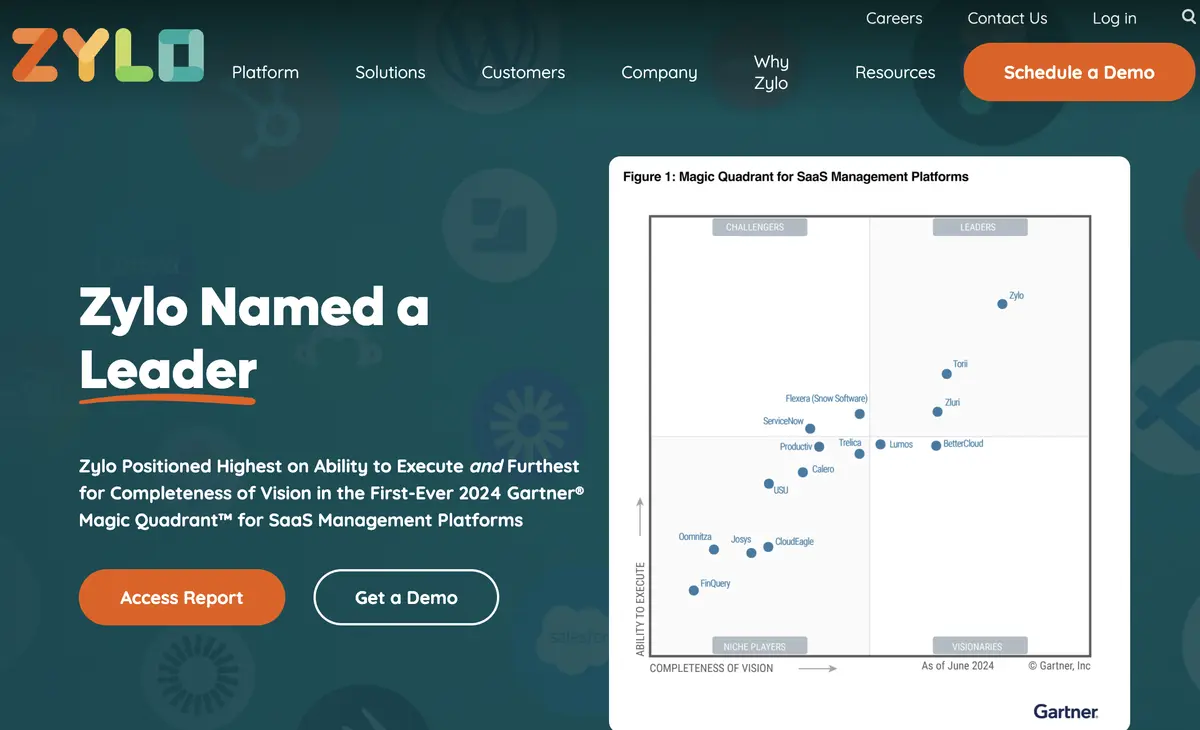
Zylo is the most GitHub-native tool in this group, with a direct Copilot integration that reads user-level usage. It separates the active seats from the dormant ones instead of trusting the assigned count. Zylo’s own documentation names tracking Copilot and GHAS adoption as a use case, so the connector is built for the job.
License Reclamation Workflows handle the cleanup on a recurring cadence you set. The system surveys seat holders about whether they still need Copilot, then opens IT tasks to remove and reassign the seats that come back unused. Okta Actions pushes it further, deprovisioning a seat the moment someone’s SSO status flips.
Spend analysis is the deeper strength, where Zylo’s Savings Center and Clarity AI benchmark your per-seat Copilot price against peer buyers. That number gives finance a real anchor heading into a renewal. The Zylo license management page shows the reclamation flow.
What Zylo brings to Copilot:
- Direct integration reading user-level seat activity
- Recurring reclamation surveys with IT follow-up tasks
- Okta-triggered deprovisioning on SSO change
- Peer benchmarking on per-seat Copilot price
Pros:
- GitHub-native connector built for Copilot
- Strong contract and price benchmarking
- Survey-driven reclamation on a set cadence
Cons:
- Spend focus over deep policy enforcement
- Best value at larger SaaS spend levels
G2: 4.8/5
Native tools have no way to pull an idle Enterprise seat back before renewal. Torii reads real usage by license tier, then routes a downgrade or reclaim through approval with a full audit trail. See how Torii governs Copilot seats.
Productiv
Productiv reads how deeply each person uses Copilot, not just whether the seat shows a login. Its feature-level engagement analytics separate the active power users from the passive assignees who opened it once. For plan management, that tells you which Enterprise seats earn the upgrade and which should drop to Business.
License rightsizing compares what you bought against what people actually use, with historical trends behind it. Industry benchmarks add context when you size the next GitHub order. Shadow-IT detection sits alongside it, surfacing unsanctioned Copilot use before it turns into a billing surprise.
Spend reporting splits Copilot cost by team, job type, and cost center for cleaner chargeback. That breakdown suits a finance lead who owns the whole AI line rather than a single tool. The Productiv platform page details the engagement model.
Where Productiv fits Copilot plans:
- Feature-level engagement to grade seat value
- Rightsizing seat counts against real usage
- Shadow Copilot detection before billing surprises
- Spend split by team, job type, and cost center
Pros:
- Engagement depth beyond simple login data
- Clear chargeback by team and cost center
Cons:
- No acceptance-rate or IDE completion metrics
- Heavier fit for broad AI portfolios
G2: 4.6/5 (75 reviews)
Josys
Josys puts identity lifecycle first, creating, changing, and deleting Copilot seats directly from its console. Account Provisioning handles the assignments, and a no-code workflow builder triggers grant or revoke on employee attributes like department or role. A team change can shift a Copilot tier without a manual step.
Access Review Surveys are the standout feature for plan governance on a schedule. Josys sends structured questionnaires to managers or seat holders for quarterly or annual Copilot audits, then lets a reviewer adjust a license in one click from the response dashboard. The audit and the action stay in the same place.
A License Optimization Dashboard and a SaaS Management Score pull usage across 300-plus integrations into one view. Josys cites customers cutting costs by around 20% after they trim what those dashboards expose. The Josys platform page walks through provisioning.
What Josys handles:
- Console-based provisioning and deprovisioning of seats
- Attribute-driven workflows for grant and revoke
- Survey-based access reviews with one-click adjustment
Pros:
- Direct seat provisioning from a single console
- Structured review surveys for scheduled audits
- Management score that benchmarks governance
Cons:
- Smaller North American footprint than some rivals
- Lighter on real-time policy enforcement
- Deeper analytics trail dedicated spend tools
G2: 4.6/5
CloudEagle
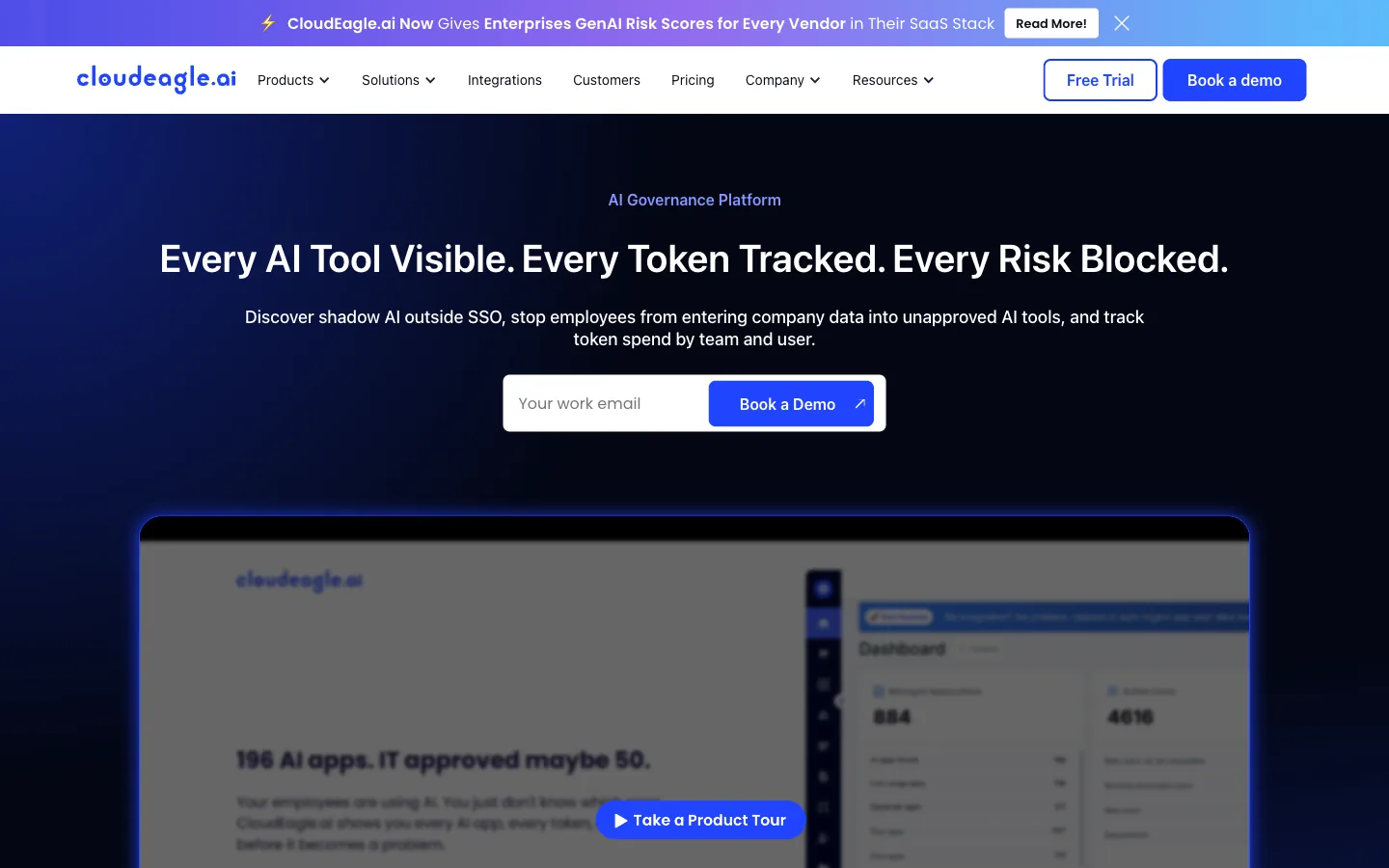
CloudEagle connects via API to Copilot and the rest of the AI stack, including Cursor, ChatGPT Enterprise, Claude, and Gemini. It normalizes seat counts, token use, and API spend into one dashboard with breakdowns by user, team, and model. For a company running several AI tools at once, that unified view is the main draw.
Automated license-harvesting workflows trigger when a Copilot seat sits unused past the threshold you set. The system alerts IT to deprovision or reassign, so the seat does not coast to the next renewal. It also surfaces shadow Copilot use by correlating SSO, finance, browser, and app signals against the sanctioned list.
Real-time policy enforcement is the sharper edge, letting you set spend thresholds and model-access controls across tools. CloudEagle can block or redirect an unapproved AI tool the moment it appears. The CloudEagle AI governance page covers the enforcement rules.
Where CloudEagle fits:
- One dashboard for Copilot, Cursor, Claude, and more
- Harvesting workflows on unused-seat thresholds
- Real-time block or redirect on unapproved tools
Pros:
- Consolidated view across many AI tools
- Real-time policy and model-access control
Cons:
- Broad scope can be more than a Copilot-only team needs
- Newer brand than the longtime SaaS platforms
- Setup spans several integrations to pay off
G2: 4.7/5
Nudge Security
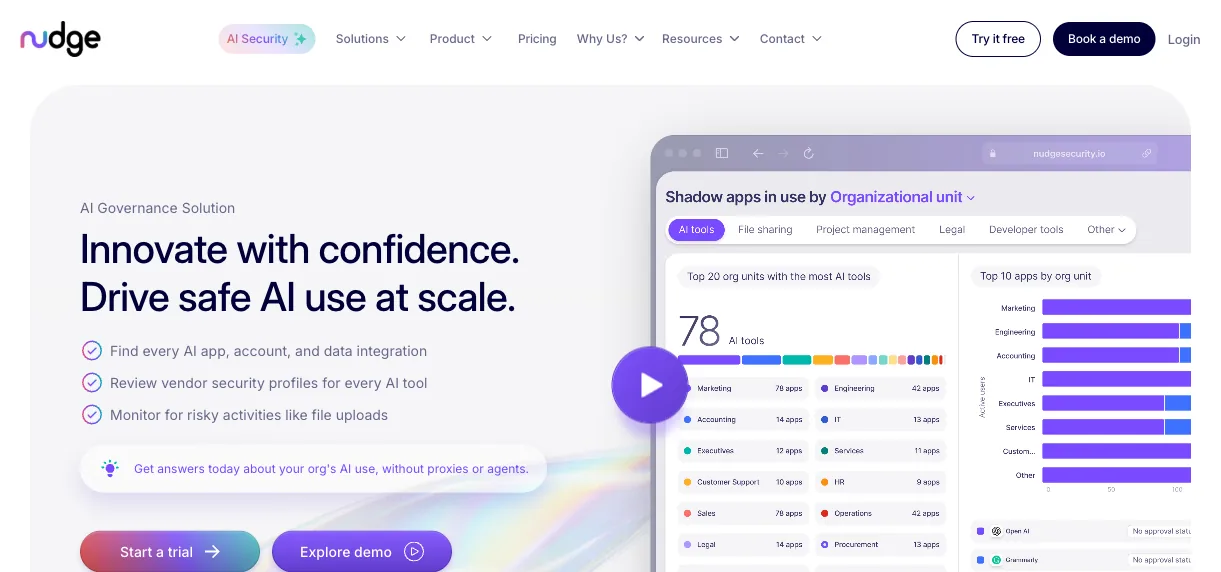
Nudge Security starts from discovery, building a historical inventory of every SaaS and AI account in minutes. A lightweight browser extension and API integrations do the work without a proxy or agent to deploy. That speed matters when you are tracking down Copilot seats nobody registered with IT.
AI Agent Discovery is the angle others miss, surfacing shadow AI agents on platforms like Copilot Studio. The view captures who built each agent, what it connects to, and the permissions it holds. For a security team, that turns an invisible Copilot footprint into something you can actually audit and review.
Automated offboarding playbooks pull accounts roughly 90% faster than manual cleanup, by Nudge Security’s own figures. Rule-based nudges then prompt users via browser, Slack, or email for a business justification when unapproved AI shows up. The Nudge Security AI discovery page details the approach.
What Nudge Security brings:
- Fast inventory with no proxy or agent
- Shadow AI agent discovery on Copilot Studio
- Automated offboarding and behavioral nudges
Pros:
- Agentless discovery stands up fast
- Strong shadow-AI and agent visibility
- Nudges drive cleanup without heavy admin work
Cons:
- Security-led, so lighter on spend benchmarking
- Less focused on seat-tier optimization
G2: 4.8/5
How to Choose a Copilot Plan Management Tool
The right tool depends on which Copilot problem is most pressing in 2026. Lumos and Josys lead on access reviews and identity lifecycle, BetterCloud and Zylo focus on workflow automation and spend, Productiv reads engagement depth, and CloudEagle and Nudge Security cover multi-tool governance and shadow-AI discovery. If renewal terms are the sticking point, pair this with Copilot contract management; if you are standardizing across many AI tools, a broader AI management platform may be the better anchor.
If idle seats and unseen spend are the bigger concern, start with full visibility. Torii discovers every Copilot seat across both plans, runs the joiner-mover-leaver lifecycle, and routes access reviews and reclamation before the next renewal lands.
Torii discovers every Copilot Business and Enterprise seat through SSO, HRIS, browser, and expense data, reads real usage by tier, and frees or downgrades seats the day they go idle. Explore the Torii platform.
Frequently Asked Questions
Copilot Business is $19 per user per month and Enterprise is $39, with usage-based credits added in 2026. That makes an idle Enterprise seat roughly $468 per year of pure waste before credits or overage charges are considered.
Teams run both plans side by side, but native admin tools lack cross-org policy visibility, scheduled access certification, and automated reclamation. Provisioning at scale requires Enterprise Managed Users, so enterprises often stitch seat queries and workflows by hand.
Use tools that read real license-level usage and trigger workflows to notify users, downgrade or deprovision idle Enterprise seats, and route access reviews. Vendors like Torii, BetterCloud, and Zylo automate reclamation, downgrades, and SSO-triggered deprovisioning before renewal.
Prioritize multi-source discovery (SSO, HRIS, browser, expense), usage-based license tracking, automated joiner-mover-leaver workflows, scheduled access reviews, SCIM/SCIM-like provisioning, reclamation workflows, and spend benchmarking against contracts and peer pricing.
Lumos and Josys lead on identity lifecycle and access reviews. Lumos offers agentic auto-certification and just-in-time access; Josys provides attribute-driven provisioning and survey-based reviews with one-click license adjustments from a centralized console.
Pick a multi-tool AI governance platform when you run several models and AI products and need consolidated spend, token/API usage, cross-tool policy enforcement, shadow-AI discovery, and real-time blocking. CloudEagle and Nudge Security excel at unified visibility and fast discovery.