

7 Best SaaS Management Platforms (2026)
 John Baker
•
Oct 1, 2026
•
16 min read
•
Updated October 1, 2026
John Baker
•
Oct 1, 2026
•
16 min read
•
Updated October 1, 2026

Compare the 7 best SaaS management platforms for 2026, from Torii to Zylo and Zluri, and choose by owner, whether IT, Finance, Procurement, or Security.
Ask about this article
Opens Claude in a new tab to answer, using this article as the source.
Gartner’s session on its Magic Quadrant for SaaS Management Platforms opens on a blunt gap, saying organizations are aware of only 30 to 50% of the applications in use (Gartner). The same session puts up to 30% of licenses in the unused or underused column, while SaaS spend per employee grows at a 25% compound annual rate. A SaaS management platform is the software built to close that gap, and our guide to SaaS management covers how one works.
The 2026 Gartner Magic Quadrant report puts a price on doing nothing about those numbers. In its words, “Through 2028, organizations that fail to attain centralized visibility and coordinate SaaS life cycles will overspend by at least 25%, due to unused entitlements and unnecessary overlapping tools.”
Source: Gartner, Magic Quadrant for SaaS Management Platforms, 2026. Download the report from Torii.
Which SaaS management software fits depends on the team that owns the problem, whether that is IT, Finance, Procurement, or Security. Each of the seven SaaS management tools below is matched to the team it serves best, and Torii comes first as the one built for all four together.
- Productiv, Inc. shut down on August 6, 2026, so its former customers are shortlisting again. Our write-up on why Productiv shut down covers what happened.
- Trelica now sells as 1Password SaaS Manager. 1Password announced the acquisition on January 7, 2025.
- Gartner evaluated 16 vendors in its 2026 SaaS management platform research. Six of the seven platforms in this guide are among them, and Lumos is the one that is not.
Source: Torii blog, 1Password blog, Gartner Critical Capabilities for SaaS Management Platforms, checked October 1, 2026.
★ = low · ★★ = medium · ★★★ = high
| Tool | IT | Finance | Procurement | Security |
|---|---|---|---|---|
| Torii | ★★★ | ★★★ | ★★ | ★★★ |
| Zylo | ★ | ★★★ | ★★★ | ★ |
| Zluri | ★★★ | ★ | ★ | ★★★ |
| BetterCloud | ★★★ | ★★ | ★ | ★★ |
| Lumos | ★★ | ★ | ★ | ★★★ |
| 1Password SaaS Manager | ★★ | ★ | ★ | ★★★ |
| CloudEagle | ★ | ★★ | ★★★ | ★★ |
Ratings are Torii's editorial read of each vendor's product pages as of October 1, 2026.
Torii
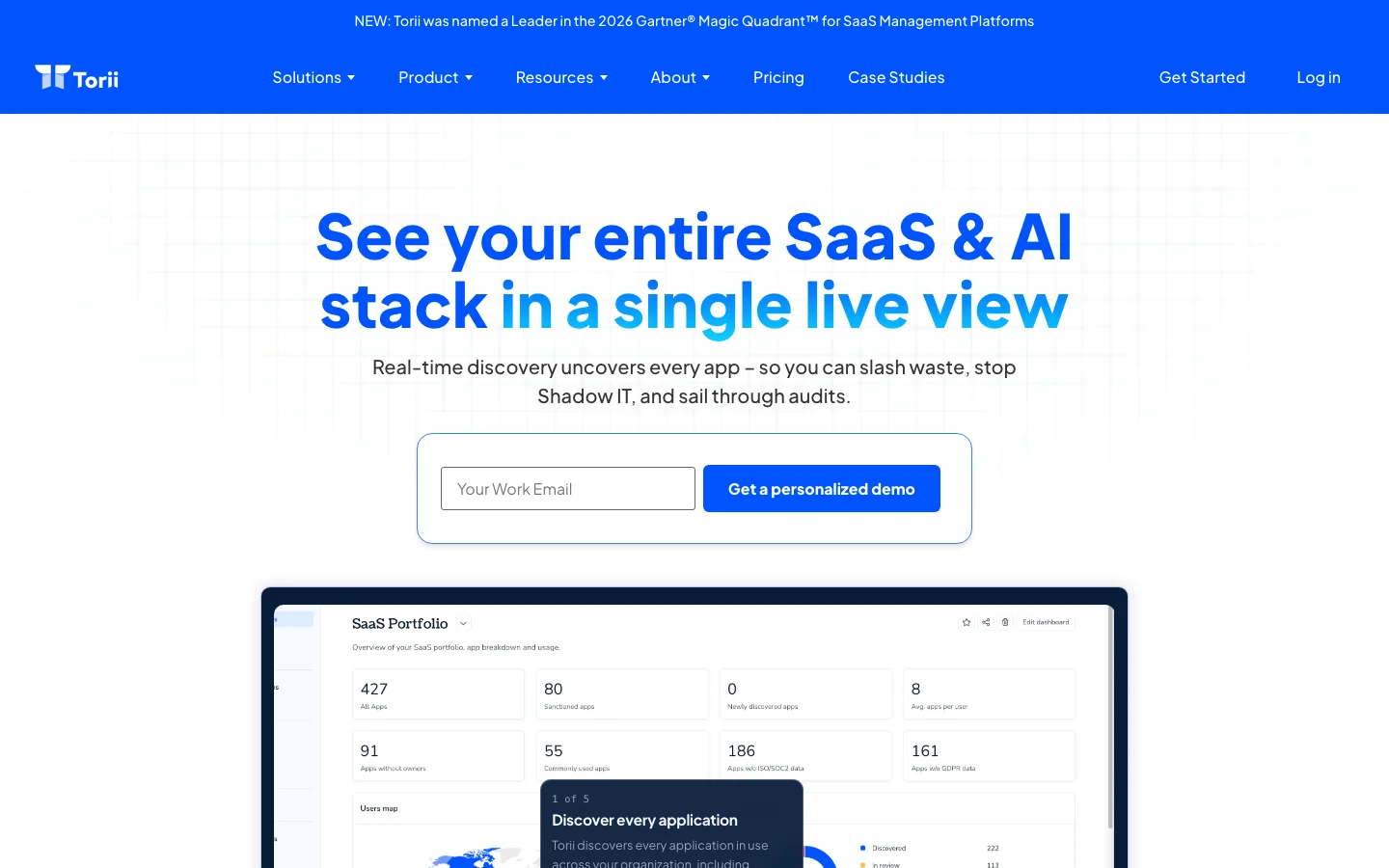
Torii’s SaaS management platform is the one to shortlist when IT, Finance, Procurement, and Security each run part of the SaaS program, because every team works in one shared inventory. Torii was named a Leader in the 2026 Gartner Magic Quadrant for SaaS Management Platforms for the third year in a row. Since 1Password and CloudEagle report the same placement, the case for Torii rests on scope.
IT and Security get discovery that combines the IdP, SSO, the Torii browser extension, desktop agents such as Jamf, Kandji, and Microsoft Intune, and expense and contract data. The browser extension is the source that catches apps outside the IdP and SSO, and it measures days used per month for each app, so a paid seat shows whether it gets real use.
Finance sees expenses from integrations such as NetSuite, Ramp, Coupa, and Brex matched to each app month over month. Procurement gets Magic Auto-Fill, which reads contract PDFs into a renewal calendar, with renewal notifications automated as workflows.
Seats still held by former employees are the plainest place to test that inventory, because offboarding and the rest of the joiner, mover, and leaver steps (people starting, changing roles, and leaving) run in Torii as no-code workflows. Torii’s 2026 SaaS Benchmark report found that about 2.5% of seats in paid apps are still assigned to people who have left, and the Licenses page lists “License assigned to past employees” as a wasted-license reason, so those seats show up for reclaiming.
Source: Torii, 2026 SaaS Benchmark report, data January to December 2025.
Pros:
- One inventory that IT, Finance, Procurement, and Security work from together
- Discovery past the IdP through the browser extension and desktop agents
- Spend and contracts side by side, from card and ERP feeds to Magic Auto-Fill and the renewal calendar
- Flags seats held by past employees and runs offboarding as no-code workflows
Cons:
- No public price list, and quotes are sized for enterprise coverage rather than a small starter plan
- Covers SaaS and cloud apps only, with no on-premise deployment option
G2: 4.5/5 (325 reviews). Checked October 1, 2026.
A Torii demo walks IT, Finance, Procurement, and Security through the same app inventory, so each team sees the view it would work in before anyone signs. Book a Torii demo.
Zylo
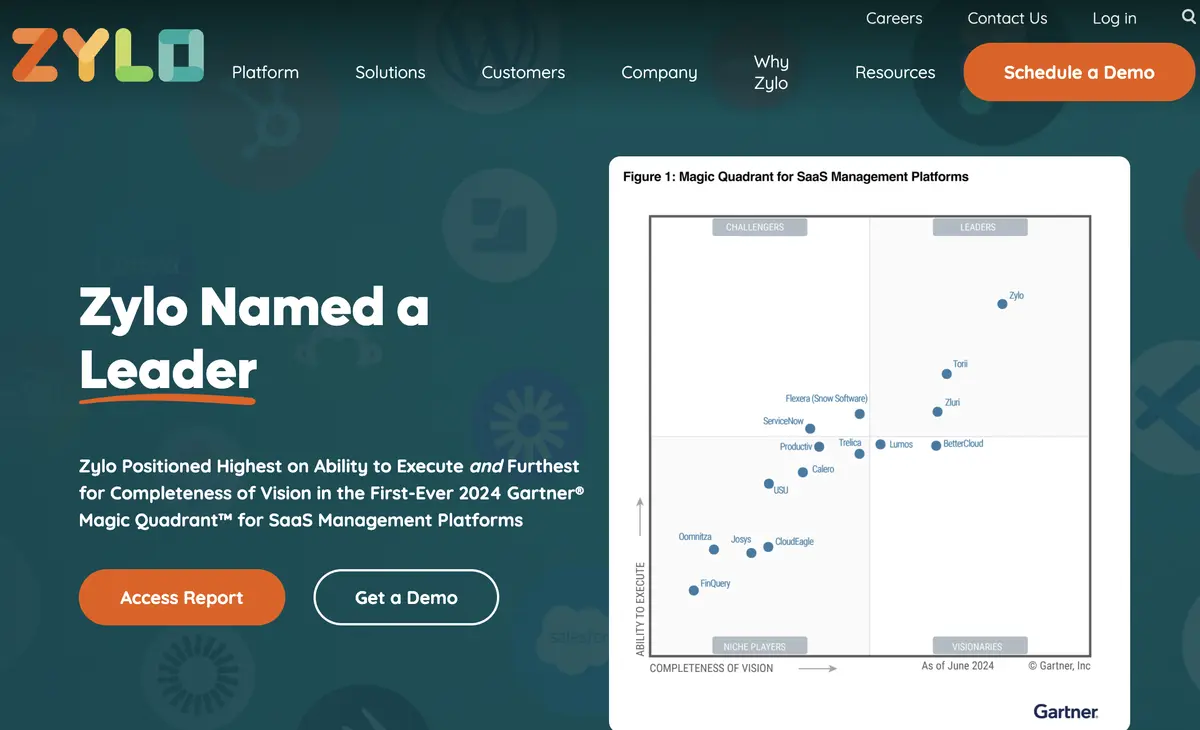
Zylo sells enterprise SaaS and AI spend management to software asset managers, FinOps, and Procurement, and its strongest work happens around renewals. A centralized renewal calendar draws on contract, spend, and app data, and renewals are prioritized by savings potential rather than by date alone. Contract Assist extracts metadata from uploaded contracts, Premium customers get pricing benchmarks, and SaaS Negotiator is a managed service that runs purchases and renewals on the customer’s behalf.
Access is the area Zylo hands to other tools, and the company says as much in its own writing. Describing offboarding automation in September 2026, the Zylo blog explained, “It does not execute deprovisioning or downgrading natively but rather relies on partners like Okta and Microsoft Entra.” That post puts the usage data refresh at every 24 hours, and Zylo’s pricing page places the Okta and Entra actions on the Premium tier.
For a Finance or Procurement team that owns renewals and already trusts its IdP with offboarding, that split works well. Teams that need access reviews or self-service requests will pair it with another tool, which is usually the IdP they run today. Zylo sells three quote-only tiers (Core, Premium, and Enterprise), so the Premium features above belong in the first pricing conversation. Our Torii vs Zylo comparison covers both products side by side.
Pros:
- Renewal calendar built from contract, spend, and app data
- A managed negotiation service for purchases and renewals
- Contract Assist pulls metadata out of uploaded contracts
Cons:
- Offboarding runs through Okta or Entra rather than inside Zylo
- No access request or access review product on its site
- The Okta and Entra actions are Premium features
G2: 4.7/5 (53 reviews). Checked October 1, 2026.
Zluri
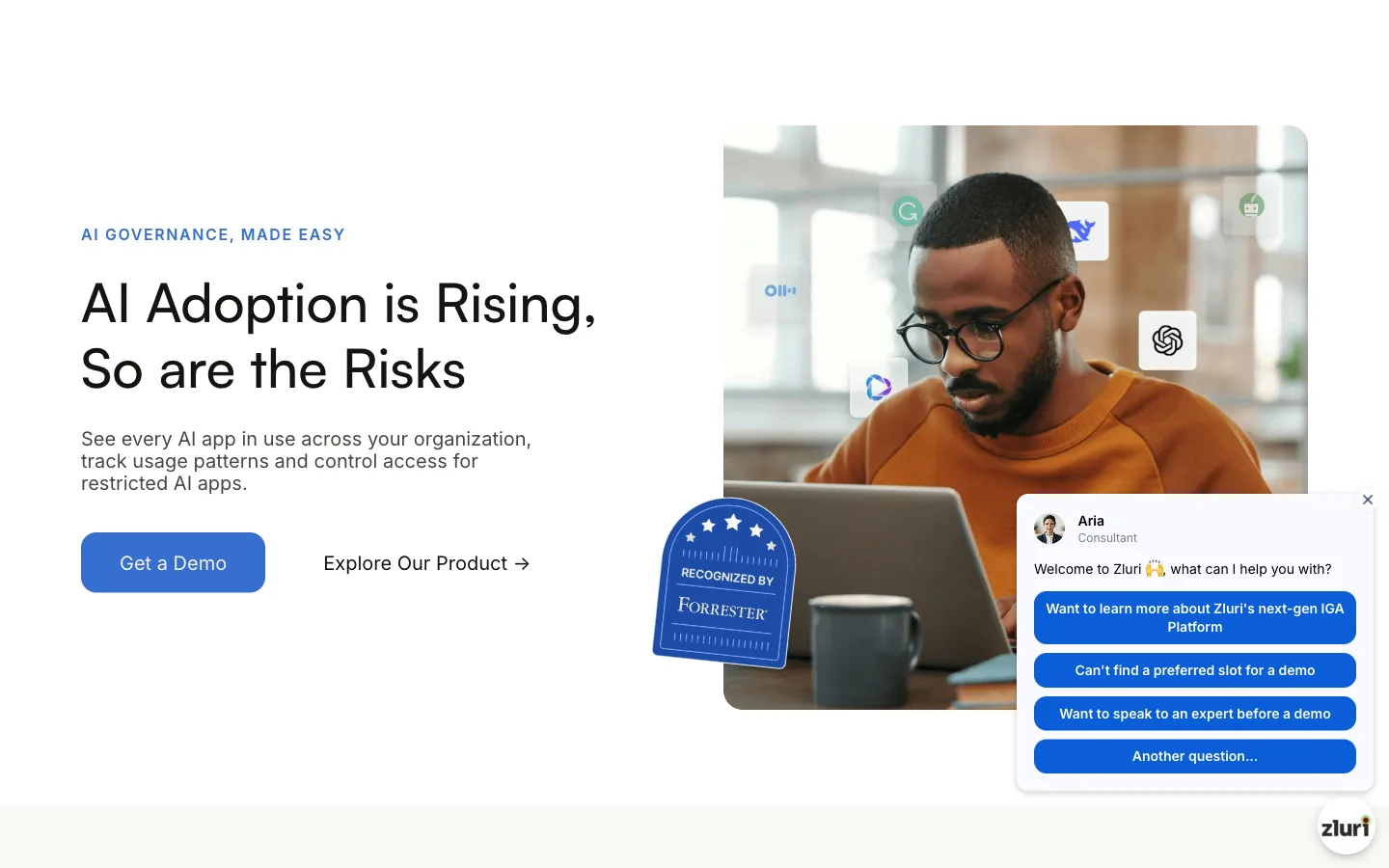
Zluri’s homepage now leads with identity security for autonomous enterprises, and SaaS management is one of four modules on a shared identity platform. The SaaS management module claims 300+ direct API integrations. A Zluri blog post updated in February 2026 describes eight discovery methods working over a library of 240,000+ apps, drawing on signals from CASB tools (cloud access security brokers), MDM tools (mobile device management), HR systems, and directories.
On the spend side, Zluri reclaims or downgrades licenses once usage drops below a threshold you set, sends renewal alerts, and forecasts spend. The heavier investment sits in access reviews. They use multi-level reviewers and closed-loop deprovisioning, and Zluri positions them for SOC 2, ISO 27001, HIPAA, SOX ITGC, and PCI DSS audits.
Zluri makes the most sense for a security team that wants SaaS discovery to live inside an identity program. It fits tightest where the same people collect SOC 2 evidence and run the IdP. Teams weighing it against Torii can work through our Torii vs Zluri comparison.
Pros:
- Discovery signals from CASB, MDM, HR systems, and directories
- Access reviews set up for SOC 2 and SOX audits
- Lifecycle automation that sits next to its identity governance modules
Cons:
- SaaS management is one of four modules in an identity-first suite
- G2’s review summary notes that setup and configuration take time
G2: 4.6/5 (177 reviews). Checked October 1, 2026.
BetterCloud
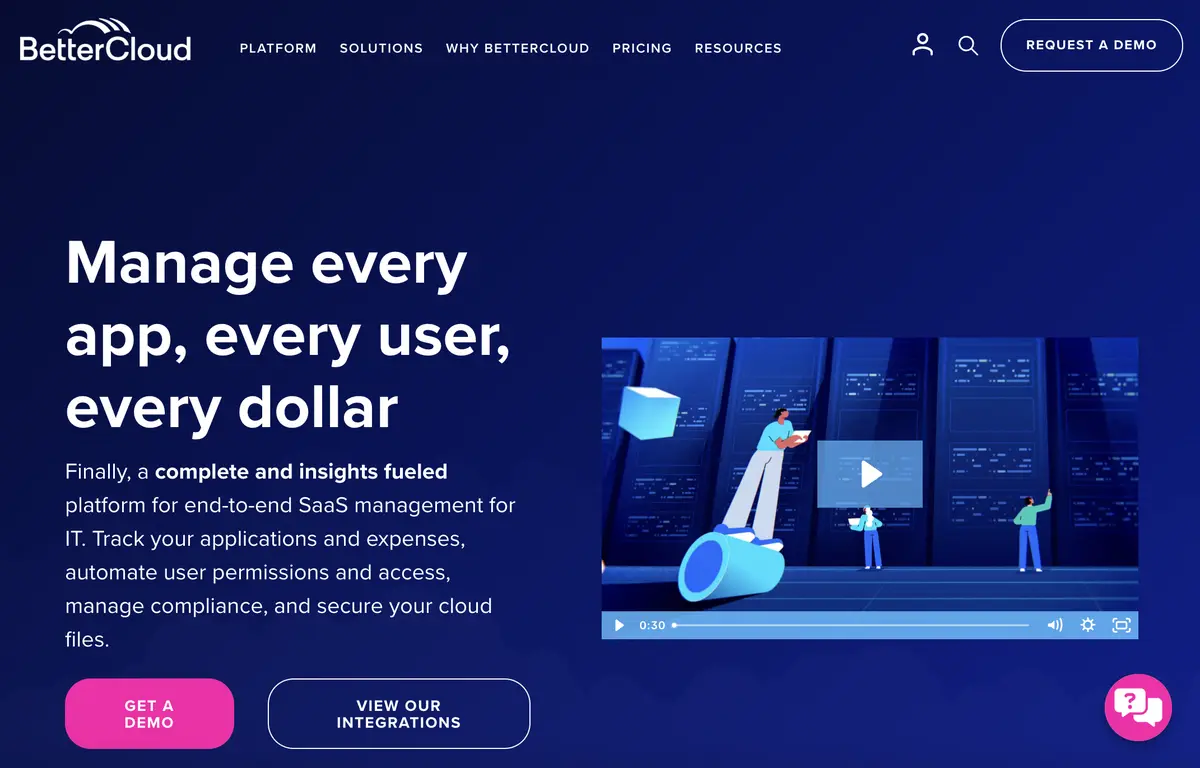
BetterCloud is built around a no-code workflow engine, and the BetterCloud homepage counts 100+ integrations and 1,000+ actions. User Automation handles onboarding, offboarding, and the changes in between, with HRIS triggers, branching, and scheduled runs. Workspace Management covers Google Workspace, File Governance covers shared files, and an IT Agent takes admin requests in plain language.
Its spend module is lighter than the automation side but cheap to try, since the pricing page lists a Spend Optimization Basic tier at $0 a month. Renewals get custom 30/60/90-day key date alerts, per the spend optimization page, and the module flags unused and overlapping apps. A team that wants to see where licenses go unused before it commits budget can start on the free tier and add paid modules later. Those are priced by license count, connected apps, chosen modules, and add-ons, according to the same pricing page.
BetterCloud suits the IT operations team whose bottleneck is lifecycle tickets and suite administration, and our Torii vs BetterCloud comparison covers the two products in detail. Its product pages list no browser extension or desktop agent, so discovery depends on the apps you connect.
Pros:
- A deep workflow builder with HRIS triggers and branching
- Google Workspace administration and file governance modules
- A free entry tier for spend optimization
- An IT Agent for natural-language admin requests
Cons:
- No browser extension or desktop agent on its product pages
- Access reviews have no dedicated module
G2: 4.4/5 (486 reviews). Checked October 1, 2026.
Lumos
Lumos sells identity governance for what its homepage calls the agentic era, and it lists 300+ integrations on that page (Lumos). The AppStore takes self-service access requests from Slack, Teams, a CLI, or the IT ticketing tool and grants time-bound access that expires on its own. HR system events drive joiner, mover, and leaver changes, with access revoked across every connected system when someone leaves, and the Albus AI agent works alongside reviews that go down to the entitlement level (the specific permission a person holds inside an app).
Lumos goes furthest on governing identities that aren’t people, through NHI Governance and MCP Governance modules that reach non-human identities and AI agents (MCP is the protocol AI agents use to connect to apps). That coverage matters to a security team watching agents get access to production apps.
Lumos earns its place with teams that treat SaaS management as an access problem first. Its product navigation lists no spend, license, or renewal module, so a company that wants spend and renewals tracked in the same place as access will be buying two platforms.
Pros:
- Access reviews and self-service requests built with audits in mind
- Governance for AI agents, MCP servers, and non-human identities
Cons:
- No visible spend or renewal product
- Outside Gartner’s 2026 SaaS management platform research
- No public pricing
G2: 4.7/5 (69 reviews). Checked October 1, 2026.
1Password SaaS Manager (Trelica)
1Password SaaS Manager (formerly Trelica) is the SaaS management module of 1Password’s Unified Access platform, built on the Trelica product 1Password acquired. Discovery pulls from 1Password Enterprise Password Manager vaults, IdPs, SSO, finance systems, and the 1Password browser extension. The vault source is the unusual one, because 1Password says it governs accounts beyond SSO, and the shared and sensitive credentials stored there point to apps nobody connected to the IdP.
Access reviews run through 400+ integrations, according to the SaaS Manager product page, and the same module automates provisioning and deprovisioning. Its FAQ adds a promise for gaps in that list, “We will also add new app connectors on-demand, for free, where an app has an open API.” An AI spend view breaks costs down by team, user, model, and API key, with token budgets and burn-rate alerts, and AI-assisted contract upload pulls out key terms.
Pricing is quote-based, with SaaS Manager sold on its own or inside Unified Access, and 1Password sells through AWS Marketplace as well. 1Password says the product is a Leader in the 2026 Gartner Magic Quadrant for SaaS Management Platforms. The natural buyer is a company standardized on 1Password that wants SaaS governance to sit next to the credentials its vaults already hold.
Pros:
- Discovery from password manager vaults and the browser extension, including accounts outside SSO
- Access reviews with one-click revoke and an exportable audit trail
- AI token spend tracked by team, user, model, and API key
Cons:
- No procurement features, such as benchmarks or intake, on the product page
- Packaging and roadmap tied to 1Password’s Unified Access platform
- Renewals appear only as an FAQ line about renewal opportunities and contract waste
G2: 4.8/5 (41 reviews). Checked October 1, 2026.
CloudEagle
CloudEagle.ai calls itself an AI governance and SaaS management platform, and it sells five modules: AI Governance, SaaS Management, SaaS Security & Compliance, Identity Governance, and SaaS Procurement. CloudEagle announced that it was named a Leader in the 2026 Gartner Magic Quadrant for SaaS Management Platforms, up from Niche Player in 2025. Each module is pitched at a different buyer, from IT, IT asset management, and FinOps teams (the people who manage cloud and software costs) to CISOs and identity and access teams.
Procurement teams get the deepest toolkit on this list, starting with peer price benchmarks and renewal alerts. The CloudEagle homepage says its benchmarks draw on $50B+ in SaaS transactions, and it claims automated 90-day renewal alerts. The same page says its inventory is built through 500+ direct integrations, while buying guides, intake-to-procurement workflows, procurement requests handled in Slack, Coupa and contract management integrations, and expert negotiation advisory fill out the module.
A Procurement-led program that wants benchmarks and negotiation help in the same tool as its contracts is the clearest fit, since contract metadata is extracted by AI and feeds an auto-updated renewal calendar. An IT-led team gets less from the services side. Scoping five modules takes time before a price comes back, so open the first call by naming the modules you need.
Pros:
- The deepest procurement toolkit here, from peer benchmarks to intake workflows
- AI-extracted contract metadata feeding a renewal calendar
- One vendor across SaaS, identity, security, and AI governance
- A free trial offered from its site
Cons:
- Five modules to scope and price separately
- G2’s review summary notes thin documentation and a confusing initial setup
- Negotiation and outsourced procurement services count for less in an IT-led program
G2: 4.7/5 (107 reviews). Checked October 1, 2026.
How to Choose a SaaS Management Platform
Pick by the team that will own the platform day to day, since that team’s routine decides which capabilities get used and which sit idle. Gartner’s Critical Capabilities research scores SaaS management platforms across five use cases, and each one maps to an owner in the table below: IT Operations and IT Asset Management fall to IT, FinOps to Finance, IT Procurement to Procurement, and IT Security and Compliance to Security. The same research says these platforms help IT “address the challenges of unmanaged SaaS and generative AI use, which lead to limited visibility, overspending, elevated risk and contract sprawl.”
More companies will be making this choice soon, since the 2026 Gartner Magic Quadrant report projects that through 2028, over 70% of organizations will centralize SaaS management on SMPs (Gartner’s shorthand for these platforms), up from less than 30% in 2025.
Source: Gartner, Magic Quadrant for SaaS Management Platforms, 2026. Download the report from Torii.
| Who owns the program | Start with | What to read next |
|---|---|---|
| IT operations | BetterCloud or Zluri | Our guide to automating the SaaS user lifecycle |
| Finance | Zylo | Our guide to unused SaaS licenses |
| Procurement | CloudEagle or Zylo | Our comparison of procurement tools and SaaS management platforms |
| Security | Zluri, Lumos, or 1Password SaaS Manager | Our Trelica alternatives guide, for teams that bought Trelica before the 1Password acquisition |
| All four teams together | Torii | The 2026 Gartner Magic Quadrant report, downloadable from the source line above |
- Discovery beyond the IdP Which sources find the apps that never pass through SSO
- Native or partner offboarding Whether the platform removes accounts itself or hands the job to your IdP
- Your data if the vendor changes How you export usage history if the vendor is acquired or stops operating
Find the row for the team that runs your program, shortlist two platforms from it, and ask each vendor the three demo questions while the contract terms are still open to change.
Frequently Asked Questions
Torii is the strongest pick when IT, Finance, Procurement, and Security share the SaaS program, because all four work from one inventory, and it was named a Leader in the 2026 Gartner Magic Quadrant for SaaS Management Platforms. A program with a single owner can start narrower, with BetterCloud for IT operations, CloudEagle for Procurement, or Zluri for Security.
A SaaS management platform discovers apps and ties them to usage, spend, and contracts. Identity governance controls who has access, through access requests, access reviews, and joiner, mover, and leaver changes. Lumos is an identity governance platform with no visible spend module, while Torii covers both, with access requests, reviews, and identity lifecycle next to SaaS management.
Of the seven platforms in this guide, Torii, 1Password SaaS Manager, and CloudEagle.ai were named Leaders in the 2026 Gartner Magic Quadrant for SaaS Management Platforms, per each vendor's announcement. Torii has held that placement for three years in a row. Gartner evaluated 16 vendors in its 2026 research, and Lumos was not one of them.
Start with the team that will run the platform every week, because Gartner scores SaaS management platforms across five use cases, from IT Operations to FinOps, and the score that matches your owner's job is the one that counts. Then ask each vendor how it finds apps outside SSO, whether it offboards natively, and how you export your data.
Most platforms in this guide sell by quote after a demo, including Torii, 1Password SaaS Manager, and CloudEagle, and Lumos publishes no pricing at all. BetterCloud is the exception at the entry level, since its pricing page lists a Spend Optimization Basic tier at $0 a month. CloudEagle offers a free trial from its site.
Yes, if you need to find apps that never pass through your identity provider or SSO. Gartner says organizations are aware of only 30 to 50% of the apps in use. Torii's extension runs its analysis locally, collects only business-email logins, and ignores private use. 1Password SaaS Manager discovers through its own extension too.