

Shadow AI Response Kit: A Framework for Discovery and Governance
 John Baker
•
Mar 4, 2025
•
28 min read
John Baker
•
Mar 4, 2025
•
28 min read
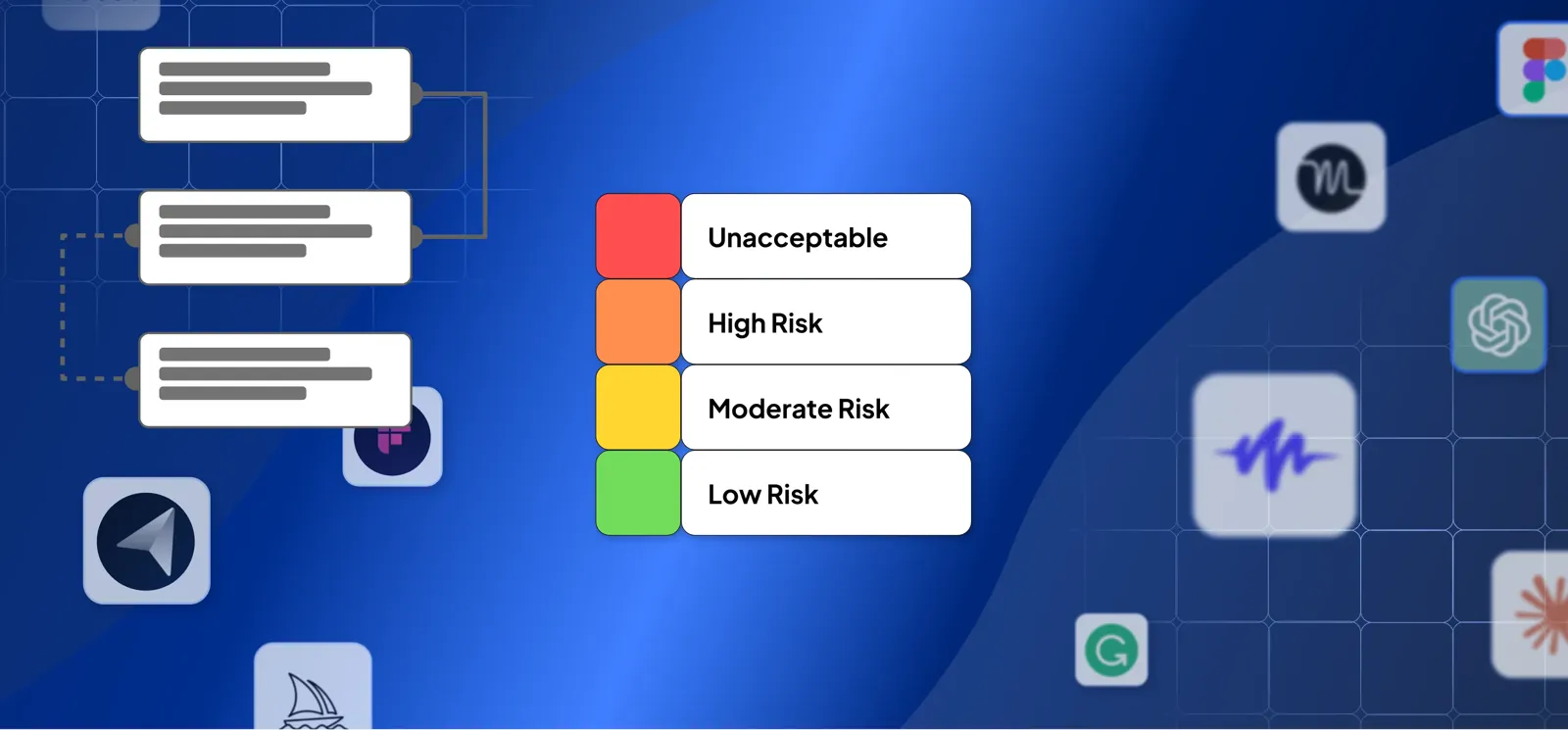
A Shadow AI response kit for IT leaders: a practical framework for discovering ungoverned AI tools and building right-sized governance for any org.
Ask about this article
Opens Claude in a new tab to answer, using this article as the source.
The Rise of Shadow AI is Staggering
Shadow AI – the use of AI tools and applications outside of official IT oversight – is fast becoming the next evolution of shadow IT. By definition, shadow AI refers to AI systems that are unknown, untracked, and unmanaged by IT or risk management functions.7</h2>8 In practice, this means employees or departments adopting generative AI platforms, chatbots, or machine learning tools without the knowledge or approval of IT.
The rise of shadow AI is staggering.
Recent data shows AI-driven tools make up the majority of unmanaged applications, in the 2025 Annual SaaS Benchmarks Report, we found that the top four most frequently ungoverned apps in companies all being AI-driven (and four of the next five also AI-dependent).15
16 Countless organizations have experienced a shocking surprise upon conducting their first Shadow IT discovery only to find that the number of unmanaged apps is far higher than expected and shadow AI accounts for a startling amount of those apps. These examples underscore a critical truth: you cannot manage what you can’t see, and shadow AI represents a massive blind spot for many organizations.
For IT Managers and Directors, tackling this challenge requires a strategic, action-oriented approach. The following framework – enriched with insights from recent industry discussions – offers a practical guide to discovering and governing shadow AI. It covers establishing ownership, scaling governance to organization size, ensuring industry compliance, and prioritizing risks. With the right strategy (and the right tools), IT leaders can turn shadow AI from a lurking liability into a well-governed asset.
AI Governance in Enterprises vs. Smaller Organizations
Large enterprises and lean startups alike are wrestling with how to govern this rapid influx of AI usage. However, the approach to AI governance can differ greatly by organization size:
- Large Enterprises: Enterprises typically integrate AI oversight into existing risk and compliance programs.3435 They often have formal governance bodies (e.g. AI committees or working groups) and established frameworks to evaluate AI initiatives. These companies may adopt standards like the NIST AI Risk Management Framework3637 or ISO 31000-based processes, ensuring every new AI application is assessed for security, compliance, and ethical impact. Heavily resourced IT and compliance teams in enterprises also work to enforce data policies and regulatory requirements from day one of AI tool deployment. The benefit is a thorough, if sometimes slower, process that catches risks early. The drawback is that stringent controls can dampen agility or user enthusiasm if not balanced with innovation goals.
- Small and Mid-Sized Organizations: Smaller companies may not have dedicated AI governance teams, but they still must address key risks in an agile way.4243 Without the luxury of large compliance departments, their AI governance tends to be leaner – focusing on the most critical risks and regulatory obligations. For example, a 50-person tech startup might not draft a comprehensive AI ethics charter upfront. Still, it can institute basic policies (e.g. “Don’t upload customer data to ChatGPT”) and conduct lightweight reviews of new AI apps. These are the kinds of policies and sequences which this response kit will go over. The goal for smaller firms is to mitigate major security or compliance exposures without introducing too much bureaucracy. In practice, this means prioritizing controls for high-impact scenarios (like any use of customer personally identifiable information in an AI tool) and otherwise relying on vendor trust and periodic audits. This flexible approach lets small businesses move quickly with AI. Still, it requires vigilance – a single unchecked AI integration could expose them to outsized risk if it touches sensitive data or operations.</li>
</ul>
In short, enterprises trade speed for assurance, embedding AI governance into robust risk management, while smaller organizations trade formality for agility, addressing AI risks in focused bursts. Regardless of size, a common thread is emerging: companies are realizing that some level of AI governance is necessary to avoid security, privacy, or ethical mishaps. Even a startup cannot afford a data breach or compliance fine, and even a Fortune 500 needs to empower innovation – so the governance model must scale appropriately. The following sections outline how industry regulations shape these efforts and then present a tactical framework to manage Shadow AI in any organization.
Industry-Specific Compliance: High-Impact Considerations
Industry and sector play a pivotal role in defining AI governance requirements. In highly regulated fields, unsanctioned AI usage can quickly escalate into compliance violations, whereas in less regulated industries, the focus may be more on best practices and reputational risk. Here are the most high-impact points to consider:
Heavily Regulated Sectors (e.g. Healthcare, Finance, Government)
These organizations face strict laws around data and AI usage. For instance, a hospital must ensure HIPAA compliance before an employee uses an AI transcription service with patient data.67</strong>68 Banks and financial services have to watch for AI-driven decisions that could violate fair lending laws or SEC regulations. In such industries, Shadow AI can introduce severe legal liabilities if employees feed sensitive data into unvetted AI tools or use AI outputs in regulated decision-making (like loan approvals) without oversight. Compliance teams in these sectors often require that any new AI application be vetted for things like data residency, security controls, audit logging, and bias/fairness if it impacts customers.
The tolerance for unsanctioned tools is therefore low.
High-risk Shadow AI use (say, an advisor using ChatGPT to generate investment advice for clients) might be blocked or urgently brought under governance. Industry-specific guidelines are increasingly clarifying these expectations; for example, forthcoming regulations like the EU AI Act explicitly categorize certain AI uses (e.g. social scoring, real-time biometric ID) as unacceptable or high-risk, effectively banning or heavily regulating them.7-8 Thus, in regulated sectors, AI governance is non-negotiable – it’s about ensuring no AI experiment, however small, puts the organization out of compliance.
Moderate or Less Regulated Sectors (e.g. Retail, Manufacturing, Tech Startups)
Organizations in these arenas enjoy more flexibility, but they are not risk-free. They may not have explicit AI laws to follow yet, but general data protection and security regulations still apply. A retail company using a generative AI for marketing must worry about customer data privacy (to avoid violating laws like GDPR) and brand reputation (an AI error on social media could go viral). These businesses often emphasize ethical AI use and customer trust even without being forced by law. They might create internal guidelines to prevent AI from producing offensive content or misleading information. Industry standards can also influence them – e.g. a software company might follow emerging best practices for AI ethics to stay competitive and demonstrate responsibility. In practice, less regulated firms will allow more experimentation with AI (encouraging employees to find productivity gains). Still, they set guardrails: providing training on what data can/cannot be shared with third-party AI, requiring at least a security review of any app that gains traction, and monitoring for any signs of data leakage or misuse.
The focus here is on preventive measures and rapid response.
If an employee in a tech startup connects a new AI design tool to the company’s Slack, IT might not pre-approve it, but they will react swiftly if the tool starts requesting sensitive access. In these sectors, the biggest risk is often the unknown: without clear regulations, companies must self-police to avoid scandals (like an AI tool exposing customer info or biased AI outputs harming the brand). Shadow AI governance in this context leans on broad principles of data security, transparency, and corporate values rather than detailed regulatory checklists.
In all cases, aligning AI use with the organization’s existing security and compliance posture is key.
Each industry will have unique red lines – a healthcare provider will outright prohibit AI that uploads PHI to external servers. At the same time, a game development studio might be more concerned with not infringing creative IP with generative AI. Knowing these high-impact points ensures that your governance efforts concentrate on what truly matters for your business context.
Framework for a Tactical Response to Shadow AI
This framework is designed twofold. To help you proactively manage Shadow AI and react to existing AI concerns within your organization that you might not yet see.
To proactively manage Shadow AI, IT leaders should adopt a risk-based response framework. Within most organizations, the goal is not to eliminate all unsanctioned AI (this is unrealistic for most organizations and would require a significant cost), but to improve the organization’s security posture and compliance standing with regard to these tools.
In essence, we want to shine a light on Shadow AI, assess its risks, and respond pragmatically.
Below is a step-by-step framework, including a scoring system and heat map approach, to evaluate and address Shadow AI usage effectively:
1. Establishing AI Ownership
The first step in reining in shadow AI is to assign clear ownership of AI governance within the organization before you even begin discovery efforts. Without defined roles and responsibilities, any attempt to inventory or control AI usage will falter. Executive sponsorship and cross-functional alignment are critical at this stage.
In practice, this means forming a governance structure – often an AI steering committee – backed by a C-level champion to ensure AI oversight is taken seriously across the company.
At Torii, we’ve taken this approach and it has been pivotal in seeing broad adoption of policies. Behavior must be modeled from the top down if there’s any hope of establishing a process that will “stick.” Just like John Kotter’s Harvard Business Review article states “...most of the executives I have known in successful cases of major change learn to “walk the talk.” They consciously attempt to become a living symbol of the new corporate culture.”145
146</p>Beyond the C-Suite, secure allies across key departments:
- IT: Lead the charge by deploying discovery tools and integrating AI oversight into existing IT management. IT teams should coordinate with others to enforce policies and monitor AI usage in real time.
- Security: Assess and mitigate risks by evaluating AI tools for vulnerabilities and data leakage. Establish policies (e.g., encryption and access control) and align closely with IT to flag any unauthorized usage immediately.
- Legal/Compliance: Define acceptable AI uses based on applicable laws. Review vendor contracts to ensure data protection and update corporate policies to cover ethics, bias, and regulatory requirements.
- Procurement/Vendor Management: Vet AI software rigorously. Enforce purchasing policies so that employees can’t simply buy AI tools without oversight. Work with IT to maintain an approved list, turning “shadow” tools into sanctioned, secure solutions.
Bring these functions together under a cross-functional AI governance committee—with executive sponsorship—to oversee AI initiatives. This committee should monitor AI usage, enforce policies, conduct regular risk assessments, and maintain a clear chain of command to decide whether to ban, sandbox, or formally adopt an AI tool.
Establishing clear governance ownership upfront is crucial. When leadership models the desired behavior, your organization is much better prepared to identify shadow AI usage and respond effectively, ensuring policies that truly “stick.”
2. Discovery – Identify Shadow AI Usage
You can’t manage what you can’t see. The first step is to illuminate all AI applications and integrations in use across the organization. This includes obvious services like ChatGPT or Claude, as well as less overt cases (e.g. a marketer using Grammarly, or a developer plugging an AI API into a side project). Many organizations are surprised at the numbers – on average companies now manage hundreds of applications, and over half may be Shadow IT. In our research, we found that in 2024, companies with employee counts of 100 or more experienced an app portfolio growth of 20%.177
178 The majority of these newly adopted apps were Shadow AI. Your first priority
- Leverage SaaS Management Platforms (SMPs): Platforms like Torii can automatically discover cloud applications in use (via SSO logs, network traffic, expense reports, etc.), exposing hidden AI tools employees have signed up for. For example, Torii’s multi-source discovery might reveal that several teams have begun using an AI data visualization tool that IT wasn’t aware of.
- Employee Surveys and Culture of Transparency: Encourage staff to self-report useful AI tools. Make it clear the goal is not punishment but support – if certain AI apps are helping productivity, IT wants to know so they can assess and possibly officially support them. Sometimes a quick survey or a discussion in team meetings can uncover smaller “stealth” uses of AI.
- Monitor Network and OAuth Connections: Use cloud access security broker (CASB) features or firewall logs to spot unusual API calls or traffic to known AI services. Also, review authorized OAuth app lists in Google Workspace or Office 365 – Shadow AI often enters organizations through users granting a new AI app access to company data like Drive or Outlook.
- Shadow IT “Hotspots”: Pay special attention to departments known for tech experimentation (e.g. marketing, R&D). These are often hotbeds of Shadow AI as staff look for creative solutions. Identifying clusters of unsanctioned AI use can help prioritize where to investigate first.
By the end of this discovery phase, you should have a list of Shadow AI applications (and their usage context) to evaluate. Don’t forget to include AI features within larger platforms – for instance, if employees are using an AI-based add-on inside a sanctioned platform like Salesforce, it might not appear as a separate app but still deserves scrutiny. The discovery step lays the foundation for risk assessment by creating a “Shadow AI inventory” – essentially, your dataset for the next step. You can store this information within the Software Database of a SaaS Management Platform such as Torii. For more, learn how to conduct a full application discovery.
3. Risk Assessment – Evaluate and Score Each AI Tool
Not all Shadow AI is equally risky. Once you have the inventory, perform a risk assessment. To do this, you will need to identify the:
- Risks for various AI tools or classes of AI tools
- The Impact (I) if those risks were to occur
- The Probability (P) of those risks occurring
You will use this to establish a scoring system for each risk.
Risks
242
Risks can range from issues limited to a single application’s output to larger behavioral or systemic problems. Each AI tool presents unique threats based on its use. For a visual representation of the 30 common AI risks, see Appendix, Figure 1. For a more in-depth list, consult resources like MIT’s AI Risk Repository.241Impact
Impact measures the potential damage if the AI fails, is misused, or leaks data. Consider the sensitivity of the data involved, the tool’s role (e.g., customer-facing vs. internal), and possible repercussions. Remember, impacts are more than security. Financial, reputational, technological, strategic, and competitive risks also apply and should be considered. Rate impact on a 1–5 scale (with 5 being severe harm). Ratings should be considered within the context of your company and industry.AI App Risk Risk Category Impact New LLM Inadequate Supply Chain Visibility:
Limited insight into outsourced AI processes hampers risk control.Third/Fourth Party Risk 285</strong>286 Cost Overruns:
AI projects exceed budgets, reducing return on investment.Financial 300 301</td></tr></tbody></table></figure>
Probability
Probability gauges how probable it is for AI use to cause incidents or non-compliance. Key factors include the AI vendor’s maturity, how the tool is deployed, and mitigating controls. Assign a score of 1–5 (1 = 1% - 20% probability, 5 = 80% - 100% probability).Additional Factors
Other considerations may include data sensitivity (public, internal, confidential), relevant certifications (SOC2, ISO27001, HIPAA), or risk velocity (how quickly harm could occur). However, Impact and Probability remain the core components of a simple yet effective risk assessment.Once you have these factors, calculate a risk score for each Shadow AI application. A common approach is to multiply the Impact and Probability values yielding a composite risk score. For example, a tool rated Impact 4 (major harm if it goes wrong) and Probability 3 (possible to occur) gets a score of 12. In the next section, we will explore defining risk tiers by score ranges.
Example
You discover your organization is using an AI-powered coding tool (unofficially, as Shadow AI). You identify a number of risks such as:
- Privacy Leakage
- The tool may transmit proprietary or confidential information to external servers or inject it into the codebase.
- Insecure Code / Vulnerabilities
- Generated code could contain security flaws if not reviewed.
- Intellectual Property (IP)
- AI models might inadvertently generate code snippets under restrictive licenses.
For each risk, you assign a score based on the probability of occurrence and the impact if the event were to occur. You then multiply the numbers to calculate a Risk Score (P x I)
AI App Risk Probability (P) Impact (I) Risk Score (P × I) AI Powered Code Tool Privacy Leakage 401402403404405406</tr>Insecure Code / Vulnerabilities 415</strong>416417</strong>418419</sup>420Intellectual Property (IP) 429430431432433434</tr></tbody></table></figure>
4. Prioritization – Plot a Risk Heat Map
With scores in hand, the next steps are to:
- Define risk tiers
- Visualize with a Risk Heat Map
- Prioritize
Define Risk Tiers:
Your tiers can be as broad or granular as you see fit. Most organizations will opt for somewhere between 3 and 5 tiers ranging from unacceptably high risk to low risk if monitored.
It’s important to document the rationale for each score – essentially creating a mini risk register for Shadow AI. Note what data is involved, what potential non-compliance could occur, etc. This will not only guide your response but also serve as documentation if auditors or management ask later why a certain app was or wasn’t a priority.
Note: Remember that risk assessment should involve relevant stakeholders: IT security will gauge technical risks, compliance or legal teams can speak to regulatory impact, and business unit managers can explain how critical the tool is to operations. This collaborative evaluation ensures your scoring isn’t done in a vacuum. As one legal advisory notes, an AI governance team should “identify and rank AI risks as unacceptable, high, limited, or minimal,” taking into account probability of harm and then mitigating or prohibiting as needed.464
465
In practice, this means you now have each Shadow AI application tagged as (for example) Unacceptable, High Risk, Moderate Risk, or Low Risk based on your scoring system.
Visualize with a Risk Heat Map
A risk heat map is an excellent way to visualize the potential risks in relation to one another. This helps IT leaders immediately see which Shadow AI instances land in the “danger zone” of high impact/high probability and which are lower priority. Here’s how to use the heat map approach for Shadow AI governance:
Create the Matrix: Set up a two-axis chart. The X-axis is Probability (from Rare to Almost Certain, left to right), and the Y-axis is Impact (from Minimal to Severe, bottom to top). Each Shadow AI tool or use case will be placed as a point on this grid according to the scores you assigned. For example, an AI tool with Impact 5, Probability 4 would be near the top-right corner (a very risky spot). In contrast, a tool with Impact 2, Probability 1 would sit in the lower-left (relatively benign). Most risk management frameworks follow this probability vs. impact matrix concept.
.Prioritize
Color Code the Risks: The most effective way to reflect prioritization. Looking at your Risk Heat Map Matrix, assign a color to different boxes to indicate severity. Typically, you’ll use a traffic-light color scheme on the heat map. Green for low risk, Yellow for medium, Red for high. This visual coding makes it immediately clear which items demand attention.503504</p>
The heat map effectively communicates risk to stakeholders at a glance. This visual language is helpful when you need to explain to non-IT executives why certain unsanctioned AI needs intervention.
Additional options: You may want ways to indicate other factors such as regulatory notes, speed at which a risk might occur (risk velocity), or how many employees use a tool. There are different ways to indicate these factors such as the size of the bubble or some other visual cue. However, this can be optional for a straightforward Shadow AI program.
The result of this step is a clear AI Risk Heat Map tailored to your Shadow AI landscape. You now have a visual risk register: perhaps a few items in red (e.g. that AI analytics tool being fed customer data without a contract in place), a handful in yellow (maybe employees using GPT chatbots with some internal data), and many in green (uses that are low stakes). This prepares you for informed decision-making and ranking generative AI use cases by severity on a heat map to drive action.517</strong>518
Example
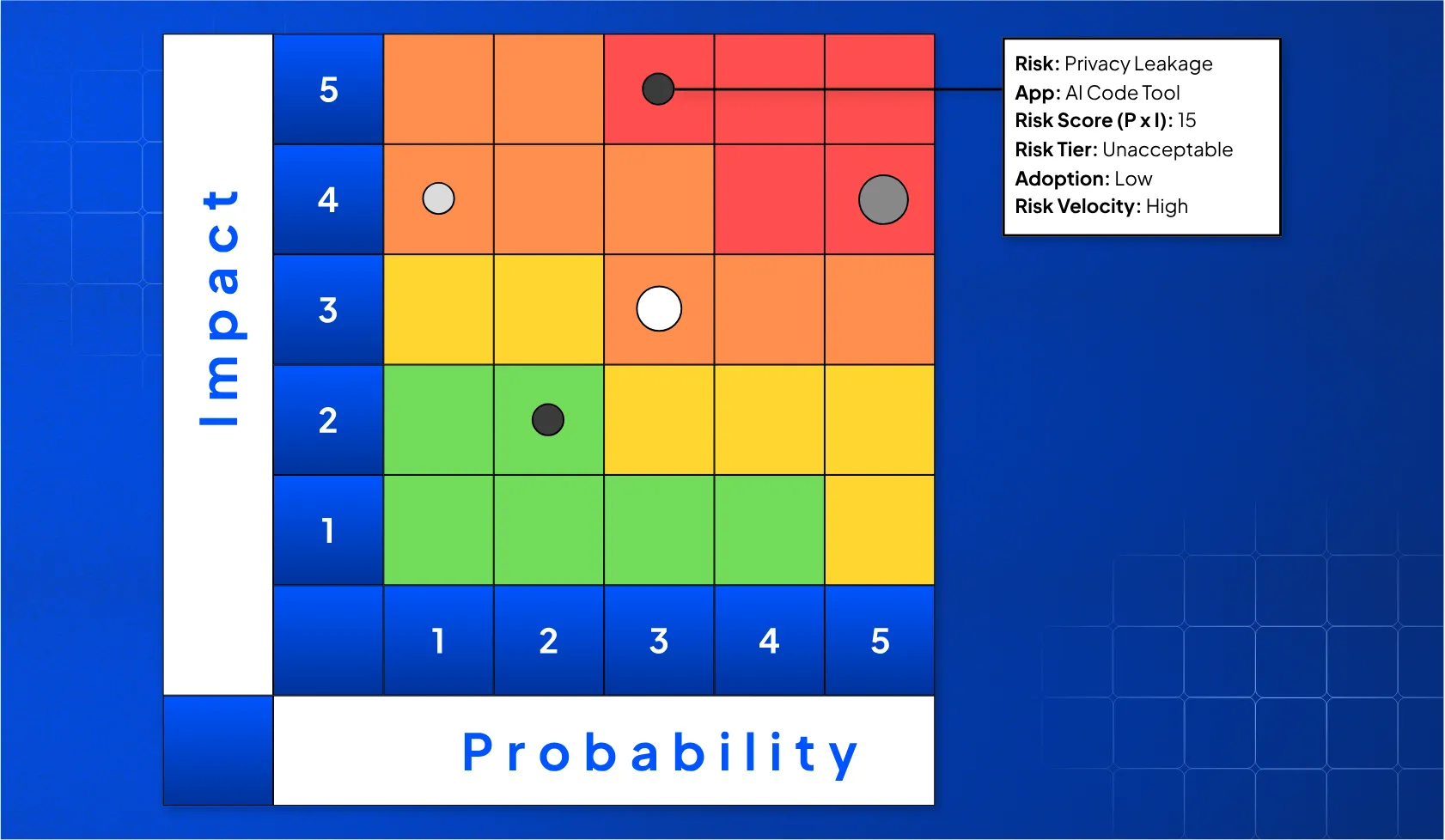
Example Risk Heat Map 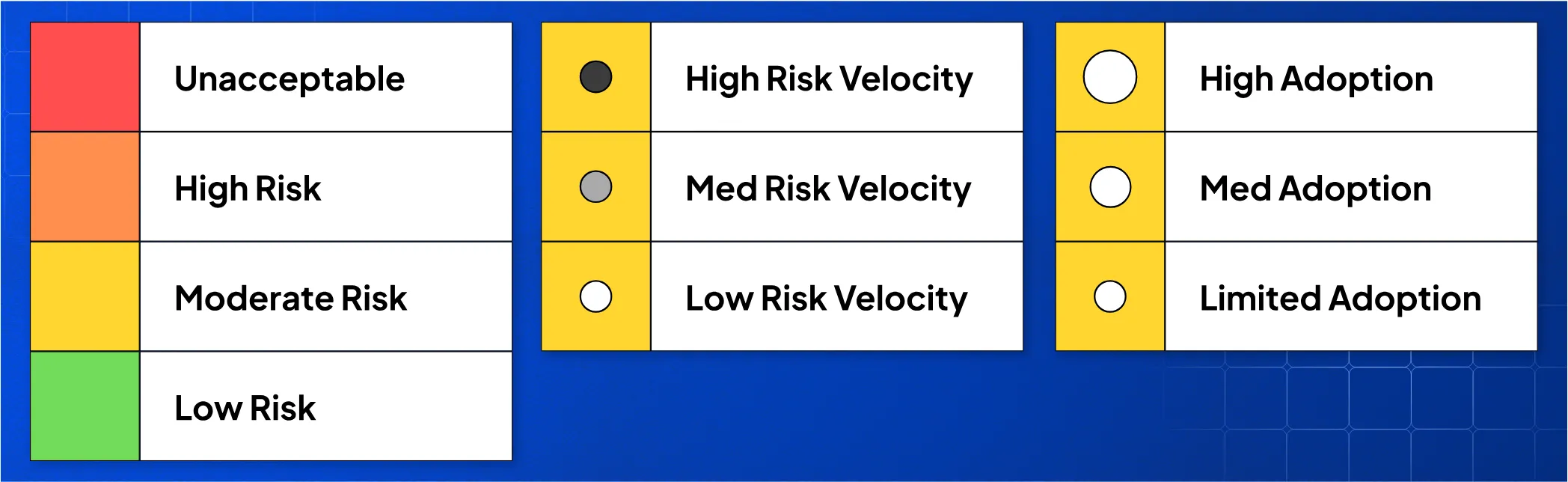
Example Risk Heat Map Legend 5. Risk Treatment – Mitigate or Embrace (Based on Risk Level)
Now that you’ve identified and prioritized Shadow AI risks, the critical question is:
What do we do about them?
The answer will vary depending on the risk level of each AI tool, and this is where a tactical but nuanced response is key.
The aim is to mitigate risks appropriately while still allowing the organization to reap the benefits of AI.
We can outline response strategies by risk category. We will use our previous Risk Tiers example:
Unacceptable (Prohibited) – Immediate Containment: If any Shadow AI use was flagged as “unacceptable” or prohibited (for instance, it blatantly violates a law or company policy), you must stop it at once. Examples could include uploading export-controlled data to a foreign AI service.
- In such cases, communicate clearly to the relevant users that this usage is not allowed and why, use technical controls if possible (block the service, disable accounts) until you can replace it with a compliant solution.
- The heat map likely showed these in the extreme risk zone (far top-right). Given their severity, risk avoidance is the only option – no reward outweighs the legal/ethical breach. (Thankfully, truly “red-light” AI uses are not common in most businesses’ Shadow IT; they’re usually edge cases you can quickly eliminate.)
High Risk – Mitigate Aggressively: Shadow AI applications in the High Risk zone of your heat map (high impact and high probability ) should be addressed as a top priority. However, mitigation doesn’t necessarily mean shutting them down; often, it means finding a safer way for the same function or putting controls around it. For each high-risk Shadow AI item, consider actions such as:
- Bring It Under IT Governance: If the tool is genuinely useful to the business, see if it can be formally adopted or replaced with an approved equivalent. Ensure security measures are in place, enable enterprise controls, and integrate it with single sign-on and monitoring. Remember, sometimes an unsanctioned AI tool is popular because it fills a real need – your job is to make its usage safe.
- Restrict Usage Conditions: For example, you might allow the tool but only in non-production environments. Or require that outputs of the AI are reviewed by a human before being used in decisions. High-risk AI aiding in decisions like hiring or financial forecasts, for instance, should have checks for fairness and accuracy before reliance.
- User Training and Warnings: Educate the specific users of these high-risk tools about the dangers. Often, Shadow AI arises simply from ignorance of risk.
- Monitor Closely: Increase monitoring of these applications. This can include setting up alerts for any large data transfers to the AI service, reviewing logs frequently, or even manually auditing outputs for signs of issues. Integrate useful tools into IT governance under proper vendor agreements.
Moderate Risk – Control and Continue: Shadow AI uses that are of moderate risk, require caution but not outright halting. With some targeted controls, the risk can be brought to acceptable levels. Strategies for medium risks include:
- Implement Policies or Guidelines: Create clear rules on how AI is used for internal memos. For instance, require fact-checking and management review before using AI-generated text externally. Clear guidelines help prevent misuse or misinformation.
- Limited Access: Restrict the tool to users trained to handle its output safely. For example, only let the development team use an AI code generator, avoiding the risk of unverified scripts by general staff.
- Periodic Review: Set a schedule (e.g., every 3 months) to reassess medium-risk tools. Check for changes in usage, features, or incidents, ensuring medium risks don’t escalate unnoticed.
- Sandboxing: Use technical containment to reduce exposure, such as running AI in a local sandbox without external data access. This protects sensitive information while allowing experimentation.
Low Risk – Monitor and Embrace: AI uses that fall into the green zone (low risk) can be tolerated with minimal intervention. In fact, part of a healthy Shadow AI posture is recognizing low-risk use cases and not overreacting to them. If an employee found a harmless AI tool that improves their productivity and poses no meaningful threat, that’s a win for innovation. For these low-risk items, the framework’s response is:
- Document & Track: Add them to your Software database (such as Torii) and simply keep an eye on them. It’s good to have it on record that IT is aware of these tools.
- Reassess Occasionally: Schedule periodic reviews if the context changes (more users adopting it, or a minor risk factor emerging), and reassess the risk.
- Learn and Share: Low-risk tools might present opportunities. If one team has found a great AI solution with little risk, consider sharing it with other teams or even officially adopting it. Many sanctioned IT tools today started life as benign Shadow IT that proved its value. By embracing safe AI innovation, IT demonstrates it is a partner to the business, not a roadblock.
Remember, across all these levels, maintain the perspective that the objective is to reduce risk, not to shut down AI adoption. This framework is about improving your risk posture relative to Shadow AI.
This also means that certain tools should be rescored. As actions mitigate risk, reflect those updates in your software database as well. Over time, you should see the heat map skewing toward the lower-risk colors as treatments take effect.
Remember, this work is iterative—avoid the worst, mitigate the bad, tolerate the acceptable, and continuously monitor.
6. Ongoing Monitoring and Adaptation
Managing Shadow AI is not a one-time project but an ongoing discipline. After the initial sweep and response, put mechanisms in place to continuously monitor for new Shadow AI and re-assess known ones. Shadow IT detection through a SaaS Management Platform, such as Torii’s Discovery Engine, plays a big role here: they can send alerts when a new AI app enters the environment.
With real-time monitoring, you can catch emerging Shadow AI trends immediately. Additionally, stay updated on the external landscape – new regulations (like an AI law coming into effect) or vendor changes (a formerly benign AI tool changing its data policy) might raise the risk of an application overnight. By keeping your finger on the pulse, you can update your heat map and risk rankings proactively. The framework should be revisited periodically: maybe quarterly, run through these steps again, as there will always be new AI solutions cropping up. Over time, patterns may emerge that allow you to refine your policies. The tactical framework thus loops: Discover → Assess → Prioritize → Mitigate → Monitor, continually cycling to keep Shadow AI risk in check.
Throughout this process, tools and automation can be your ally. For example, SaaS Management Platforms, such as Torii, are now recognized as critical infrastructure to both monitor newly adopted apps and automate the tasks associated with access control, security, and more. According to the Gartner® Magic Quadrant for SaaS Management Platforms™, "Through 2027, organizations that fail to centrally manage SaaS life cycles will remain five times more susceptible to a cyber incident or data loss due to incomplete visibility into SaaS usage and configuration."663664</p>
In summary, this tactical response framework arms IT managers with a structured, repeatable approach to handle Shadow AI. By prioritizing efforts based on risk, you ensure that the most dangerous exposures are dealt with promptly, and low-risk innovation is not needlessly smothered. IT becomes a facilitator of safe AI adoption – allowing the organization to embrace AI’s benefits while staying within the guardrails of security and compliance.
Conclusion & Key Takeaways
It’s time to manage Shadow AI practically. Rather than playing whack-a-mole or resorting to unwarranted bans—adopt a realistic strategy that works for leadership, security, and users. In closing, here are the key takeaways and best practices to remember:
- Risk-Based Governance is Essential: Treat Shadow AI like any other business risk. Score and track AI risks so you can focus on what matters most. Extend existing cybersecurity and enterprise risk methods to manage AI—instead of starting from scratch, just add AI to your existing risk matrix.
- Align with Existing Security & Compliance Posture: Weave AI risk management into your broader governance framework. Update policies and workflows to include AI, involve compliance and privacy officers in decisions, and use the same tools that track other IT risks. This keeps AI oversight efficient and consistent.
- Ensure Continuous Visibility: Manual tracking won’t keep up with AI’s rapid spread. Use a SaaS Management Platform (SMP) to discover, monitor, and score AI apps automatically. Just like SIEM tools for security, an SMP provides real-time alerts and insights, preventing surprises.
- Enable Innovation Safely (Don’t Just Block): Blocking AI entirely pushes it underground and misses business opportunities. Offer a clear path to adopt AI tools, create AI “sandboxes,” and fast-track approval for low-risk solutions. This encourages open collaboration and keeps usage visible.
- Learn from Emerging AI Governance Practices: Keep tabs on evolving standards like the NIST AI RMF, industry guidelines, and what peers do. Many organizations already use “traffic-light” models (Red/Yellow/Green) and AI oversight committees. Adopting these proven approaches prepares you for looming regulations and strengthens internal controls.
- Outcome: Mitigate Risks, Embrace Innovation: A balanced framework lets your company harness AI for productivity and growth without opening the door to security or compliance disasters. By managing Shadow AI, IT can say “yes” to the right AI tools, ensuring they’re used safely, legally, and in line with corporate values.
In the end, Shadow AI isn’t going anywhere—but with the right strategy, it can become less of a threat and more of an opportunity. A well-rounded governance framework, backed by tools that illuminate the shadows, creates a virtuous cycle: visibility guides risk management, risk management shapes smart policies, and those policies allow responsible innovation. Organizations already adopting this balanced approach—using risk matrices, heat maps, and continuous SaaS monitoring—prove that AI’s promise can be captured while its threats are contained. By adapting these steps to your own environment, you’ll move beyond “putting out fires” and instead prevent them, all while enabling your teams to explore the potential of AI in a secure and compliant manner.
Bibliography
- https://www.protiviti.com/sites/default/files/2024-10/establishing_a_scalable_ai_governance_framework.pdf
- https://www.toriihq.com/reports/saas-benchmark-annual-report-2026
- https://owaspai.org/docs/ai_security_overview/#:~:text=Organizations%20often%20adopt%20a%20Risk,key%20steps%20as%20outlined%20below
- https://www.nist.gov/itl/ai-risk-management-framework
- https://www.movingforwardsmallbusiness.com/essential-ai-governance-framework-for-small-businesses/#:~:text=to%20sensitive%20information
- https://www.thesuperbill.com/blog/ai-compliance-in-healthcare-what-providers-need-to-know-about-security-regulations#:~:text=Artificial%20intelligence%20,specific%20guidelines
- https://www.mayerbrown.com/-/media/files/perspectives-events/publications/2024/01/conducting-an-ai-risk-assessment_kourinian.pdf
- https://mitsloan.mit.edu/ideas-made-to-matter/a-framework-assessing-ai-risk
- https://hbr.org/1995/05/leading-change-why-transformation-efforts-fail-2
- https://www.toriihq.com/reports/saas-benchmark-annual-report-2026
- https://airisk.mit.edu/
- https://www.mayerbrown.com/-/media/files/perspectives-events/publications/2024/01/conducting-an-ai-risk-assessment_kourinian.pdf
- https://www.balbix.com/insights/cyber-risk-heat-map
- https://www.mckinsey.com/capabilities/risk-and-resilience/our-insights/implementing-generative-ai-with-speed-and-safety
- https://www.toriihq.com/reports/gartner-magic-quadrant-for-saas-management-platforms
Appendix
Figure 1. 30 Common AI Risks
Risk Category SN Risk and Description Strategic 765</h2>766Misaligned Organizational Goals – AI efforts conflict with core values or objectives. 775 776
Weak Executive Sponsorship – Inadequate support from top leadership undermines AI adoption. </tr>785786 Overreliance on Short-Term Wins – Quick gains overshadow long-term sustainability and ethics. </tr>Financial 797</strong>798Cost Overruns – AI projects exceed budgets, reducing return on investment. 807808 Exaggerated Revenue Projections – Overly optimistic forecasts lead to stakeholder disappointment. </tr>Data 819</strong>820Inconsistent Data Quality – Errors or gaps in data compromise model accuracy. 829830 Unrepresentative Training Sets – Narrow or biased datasets hurt real-world performance. </tr>839</sup>840 Potential Data Re-Identification – “Anonymized” data can sometimes be reverse-engineered, risking privacy. 849</p>850 Data Leakage – Models may transmit confidential data externally, exposing sensitive IP or credentials. 859 860
Overburdened Data Pipelines – High data demands strain infrastructure, causing bottlenecks. </tr>Technology 871</p>872Limited Model Transparency – Complex systems make it hard to explain or trust predictions. 881 882
Inadequate Testing Environments – Insufficient pre-production checks allow flawed models into production. </tr>891892 Single Point of Failure – No backup systems if the primary AI fails. </tr>901</strong>902 Insecure Code / Vulnerabilities – AI-generated code may introduce security flaws if not properly reviewed. 911912 Inconsistent Model Lifecycle Management – Poor version control and patching lead to outdated or insecure models. </tr>Algorithmic 923</sup>924Unintentional Biases – Hidden data patterns can result in unfair outcomes. 933934 Opaque Model Logic – Hard-to-interpret AI decisions create ethical and regulatory concerns. </tr>943</a>944 Insufficient Model Validation – Lack of rigorous testing allows hidden errors to persist. 953954 Undocumented Code Modifications – Quick fixes without version control lead to unpredictable updates. </tr>Cyber (Privacy & Security) 965</strong>966Weak Access Controls – Unauthorized users can alter models or data, causing malicious outcomes. 975</p>976 Insecure Handling of Sensitive Data – Poor encryption or network protocols expose confidential info. People 987988
Skill Gaps in AI Teams – Shortage of qualified staff slows effective deployment. </tr>997998 Eroding Employee Morale – Unclear AI-driven changes fuel anxiety or resistance. </tr>Regulatory 1009</strong>1010Unclear Compliance Requirements – Rapidly evolving laws breed confusion and risk of non-compliance. 1019</p>1020 Insufficient Internal Oversight – Weak governance mechanisms allow AI misuse and legal issues. Third Party / Fourth Party 10311032
Ambiguous Vendor Responsibilities – Vague contracts blur accountability for AI errors or breaches. </tr>1041</h2>1042 Inadequate Supply Chain Visibility – Limited insight into outsourced AI processes hampers risk control. 1051 1052
Intellectual Property (IP) or Licensing Issues – AI-generated code may infringe on licenses or create ownership disputes. </tr>Societal 1063</p>1064Community Distrust – Public skepticism of AI’s ethical use erodes confidence. 1073 - 1074
Exclusionary Outcomes – AI designs overlooking diverse needs may widen social inequalities. </tr></tbody></table></figure> **Related reading:** - What are Discovery Tools?