

7 Best SaaS Procurement Platforms (2026)
 John Baker
•
Jul 7, 2026
•
15 min read
•
Updated October 1, 2026
John Baker
•
Jul 7, 2026
•
15 min read
•
Updated October 1, 2026

Seven SaaS procurement platforms compared for 2026, including Torii, Vertice, Tropic, and Zip, on intake, negotiation, and the seat count behind each renewal.
Ask about this article
Opens Claude in a new tab to answer, using this article as the source.
Gartner warns that enterprise SaaS costs often rise 10% to 20% or more at contract renewal, far above the growth of IT budgets (Gartner, October 2025). A SaaS procurement platform runs the buying side of software: intake and approvals, price benchmarks, negotiation, and renewal tracking. Most of them meet rising prices with negotiation, through expert buyer teams and lately AI agents that work the renewal calendar, so they are built to lower the price on a contract you already plan to sign.
The seven SaaS procurement tools below weight intake, negotiation, and renewals differently, and each entry notes where the tool gets its seat count. Where procurement tools stop and SaaS management platforms start is a separate question, covered in our comparison of the two categories.
Before price comes up, a SaaS renewal asks a procurement team whether to renew at all, and at how many seats. Torii comes first on this list because it answers that from the apps it discovers and how people actually use them.
- Vertice announced its acquisition of Vendr on June 1, 2026, so the two share one entry below.
- Deel acquired Sastrify in May 2026 and is folding it into Deel IT.
- Productiv shut down on August 6, 2026, so it is not on this list. Our write-up on why Productiv shut down covers what happened.
Source: Vertice press release (June 2026), Orrick and Deel (May 2026), Torii blog, checked October 1, 2026.
★ = low · ★★ = medium · ★★★ = high
| Tool | Intake | Price benchmarks and negotiation | Renewals | Usage data | Finds spend bought outside procurement |
|---|---|---|---|---|---|
| Torii | ★★ | ★ | ★★★ | ★★★ | ★★★ |
| Vertice | ★★★ | ★★★ | ★★★ | ★★ | ★ |
| Tropic | ★★ | ★★★ | ★★★ | ★★ | ★ |
| Spendflo | ★★★ | ★★★ | ★★ | ★ | ★ |
| Zip | ★★★ | ★★ | ★★ | ★ | ★ |
| CloudEagle | ★★ | ★★ | ★★★ | ★★★ | ★★★ |
| Sastrify | ★★ | ★★★ | ★★ | ★★ | ★★★ |
Ratings are Torii's editorial read of each vendor's product pages, checked October 1, 2026.
Torii
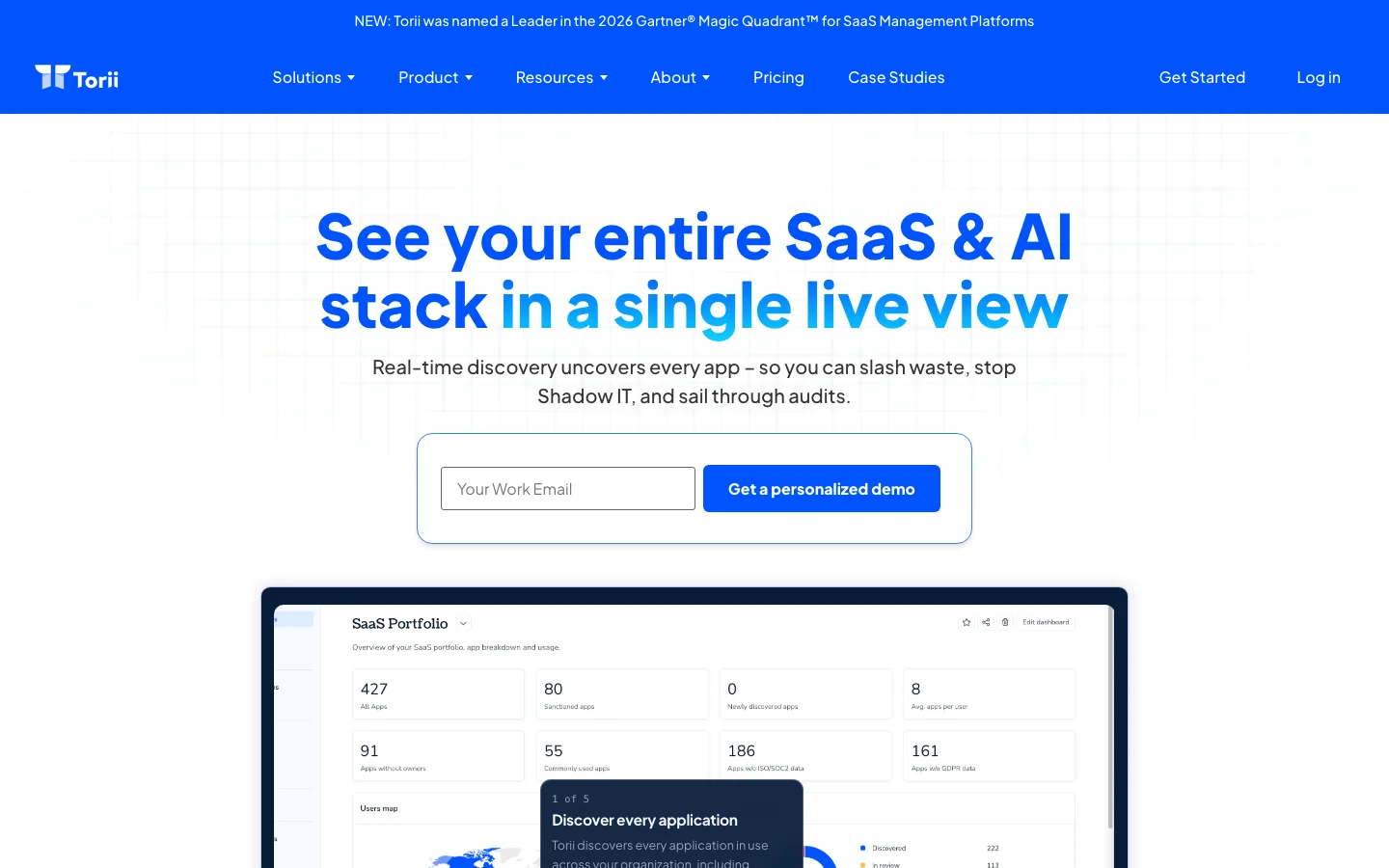
Torii handles the renew-or-cut question a buying desk (an outsourced negotiation service) leaves open, working from the apps it discovers and their usage. Discovery combines the identity provider (IdP), SSO, the browser extension, desktop agents, expense and contract data, and direct integrations. Torii’s contract and renewal management page describes the result as one view of contracts, spend, and usage that Procurement, Finance, and IT run renewals from.
The Torii help center recommends starting renewal prep 120 days out, and apps renewing within that window show a button to start a Renewal Forecast. That Enterprise plan feature compares licenses purchased with licenses used. It forecasts the seats you need and the licenses you can reclaim, then adds a buffer for the hiring plan. A renewal workflow template fires 90 days before the renewal date and branches on whether the contract auto-renews, then notifies the contract owner.
The forecast rests on the Licenses page, which splits each app’s seats into Active, Inactive, and Unassigned, with Inactive set by a default 30-day window. Contracts reach the same renewal calendar through Magic Auto-Fill from PDFs, email forwarding, CSV, or the API.
For the price itself, License Cost Benchmarks show whether your price per license sits above, at, or below what similar companies pay (benchmarks currently cover apps’ Enterprise license plans billed annually, and not every app or license type has one yet). Per the help center, Above means the top 25 percentile and Below the bottom 25 percentile, which gives your team a reference figure to bring into the vendor call.
Intake happens at the employee end of Torii, where the App Catalog shows the apps the company already owns before anyone asks for a new one. Requests for apps not yet in use follow request policies that can route approval to budget owners or InfoSec. A tool bought outside procurement channels still shows up in Torii, through the browser extension or the expense data that records its charge. Our SaaS renewal playbook covers how to carry that usage data into the negotiation.
Pros:
- Seat counts built from purchased versus used licenses, ready before the renewal call
- Renewal workflows that fire 90 days out and check for auto-renew terms
- An App Catalog and approval routing that point requests at apps the company already owns
- Spend from purchases made outside procurement channels, picked up from expense data
Cons:
- No negotiation service or buyer team, so your team (or a buying desk) runs the call
- Renewal Forecast sits on the Enterprise plan, and pricing is quote-based with no public tiers
G2: 4.5/5 (325 reviews). Checked October 1, 2026.
A Torii demo walks through a Renewal Forecast, from the users and licenses on an app to the seat count you would put in front of the vendor. Book a Torii demo.
Vertice
Vertice sells three products on its pricing page, and two of them handle SaaS buying. Intake-to-Procure is the front door for purchase requests, while SaaS Purchasing pairs a dedicated SaaS buyer and expert negotiation with pricing benchmarks, usage analytics, and an AI negotiation agent called Ana. The third is Cloud Cost Optimization. The Vertice pricing page lists no prices, though it promises hard cost savings that are guaranteed in the contract.
Vertice fits a procurement team that wants a buyer on its side of the table and one vendor for both intake and negotiation. Teams with intake elsewhere can look at SaaS Purchasing alone.
On June 1, 2026, Vertice announced its acquisition of Vendr, and Vendr customers gain access to Intake-to-Procure. Vendr’s Ruth agent negotiates in two modes, Negotiation Advisory and Autonomous Negotiations, with a human signing off before any outreach goes out.
The announcement puts the combined data at more than $75 billion in indirect spend across 32,000 vendors and 250,000 negotiated contracts. Usage analytics come from SSO and finance connectors. With two negotiation agents now at one company, ask early which one will work your renewals.
Pros:
- Intake, negotiation, and benchmarks from one vendor
- Expert buyers working alongside the Ana and Ruth agents
- Benchmarks across 32,000+ vendors and 2M+ pricing points, per Vertice
- Savings that Vertice guarantees in the contract
Cons:
- The Vendr merger is four months old, and neither company has said publicly how the Ruth and Ana agents will divide the work
- No prices on the pricing page, so every product is quoted
G2: 4.6/5 (262 reviews). Checked October 1, 2026.
Tropic
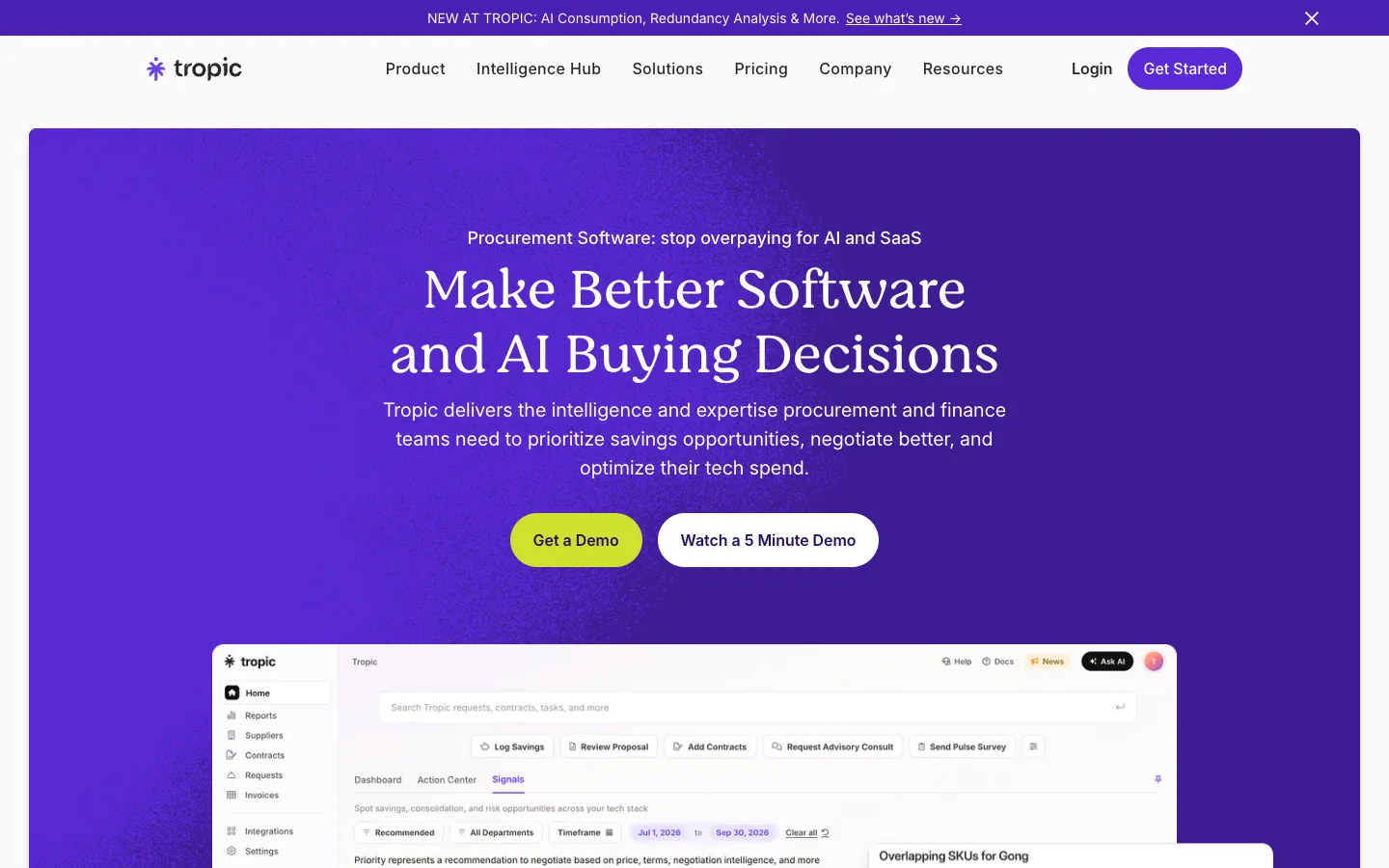
Tropic builds its renewal intelligence from the contracts you upload, then puts AI agents to work on the calendar those contracts create. The plan includes a Renewal Agent and a Proposal Agent, and an August 2026 release added Signals, which ranks savings, consolidation, and risk opportunities by contract end date. “Every technology portfolio contains more opportunities than a finance or procurement team can pursue at once,” co-founder and CEO Justin Etkin said in the Tropic announcement.
Tropic’s pricing page lists a starting price of $3,083 a month based on employee count, with Intake and Orchestration and Full Service Negotiation sold as add-ons. Usage syncs from Okta. The August release also added AI Consumption Management for OpenAI, Anthropic, and Cursor, plus SKU-level Redundancy Analysis that looks for overlapping tools inside the contracts Tropic holds.
Tropic suits a finance or procurement team that already holds its contracts and wants them worked in order of deadline and savings. Teams that run intake elsewhere can look at the Zip partnership featured on Tropic’s homepage, which pairs Tropic’s pricing data with an intake platform.
Pros:
- A public starting price
- A renewal calendar worked by AI agents
- AI consumption tracked next to SaaS contracts
Cons:
- Intake and full-service negotiation cost extra
- Duplicate-tool analysis runs on the contracts Tropic holds
G2: 4.5/5 (137 reviews). Checked October 1, 2026.
Spendflo
Spendflo began as a SaaS buying service, and negotiation is still the center of what it sells. Its managed services page describes the model in one sentence: “A dedicated pod of category experts, backed by AI-first services, negotiates every contract and benchmarks every renewal across your software stack.”
Spendflo’s pricing page sets renewal alert lead times at 30, 60, or 90 days, and its homepage describes auto-renew clause detection 60 days out with benchmark data attached. Intake runs on dynamic request forms, with no-code approval routing by cost center, spend threshold, or commodity code. Budget is checked at request time.
Pricing follows the work, with a platform fee plus a charge per completed request across three quote-only tiers named Grow, Scale, and Enterprise. The product is widening into accounts payable and general procurement, so a team buying it for SaaS renewals should ask which modules it actually needs.
Spendflo’s natural buyer wants an expert on every negotiation and a request process with approvals mapped to budgets and cost centers. Its usage view depends largely on the identity-provider connection, since Spendflo’s public pages don’t document other usage sources.
Pros:
- Negotiation run by a pod of category experts
- Approval routing set for each request
- Pricing tied to completed requests
Cons:
- All three tiers (Grow, Scale, and Enterprise) are quote-only
- The AP suite and supplier assessments are add-ons as the scope widens
G2: 4.6/5 (143 reviews). Checked October 1, 2026.
Zip
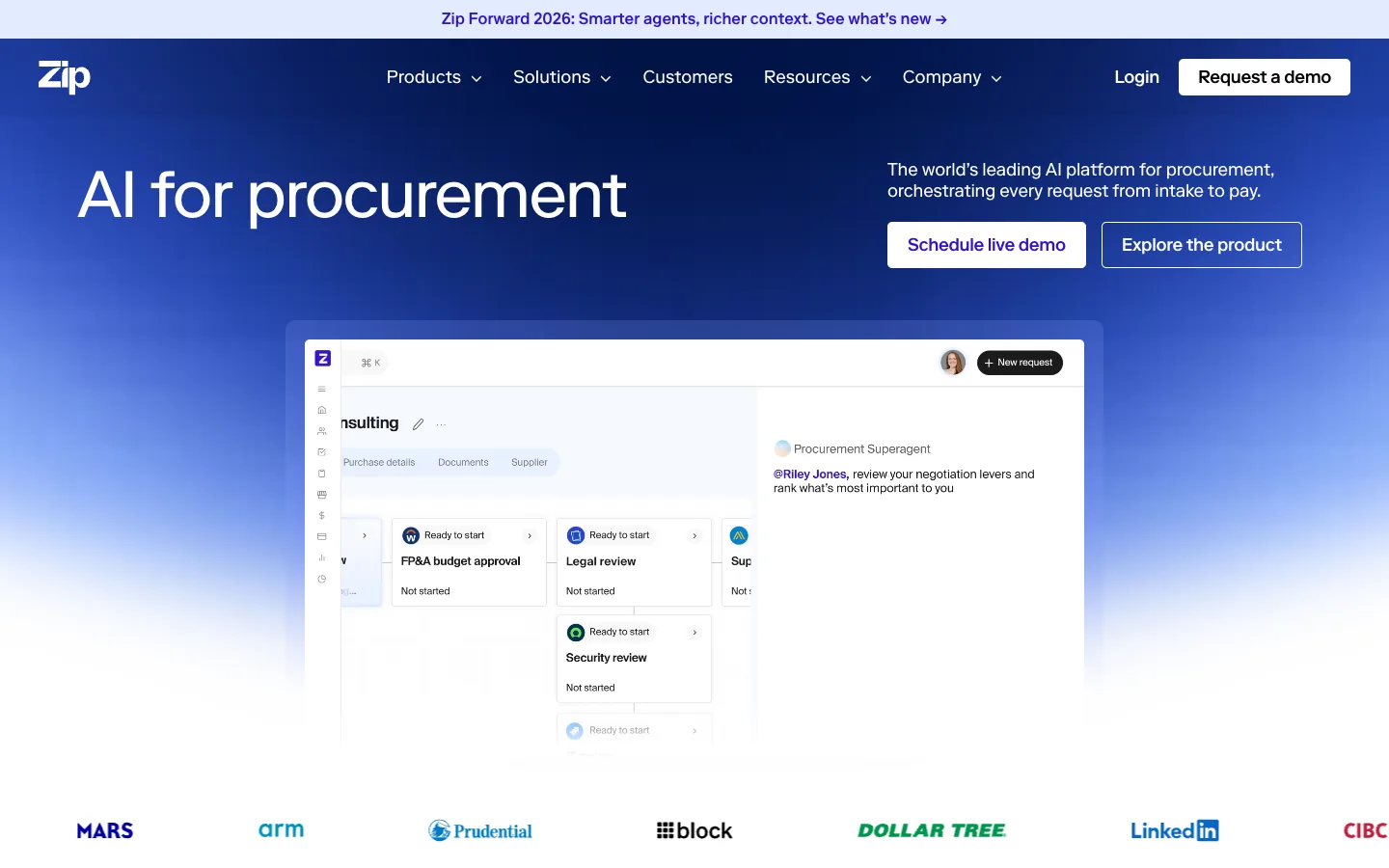
Zip orchestrates every purchase request across all spend, from intake through to payment, so a SaaS request goes through the same front door as any other purchase. The AI Procurement Concierge gives employees one entry point, IT and security risk assessments sit inside the approval workflow, and an AI contract repository tracks renewals with alerts. Sourcing benchmarks and AI redlining are software features, and the Zip homepage says Zip is the only procurement orchestration platform in the 2026 Gartner Magic Quadrant for Source-to-Pay Suites.
A SaaS management platform and Zip split the renewal job cleanly, with Zip governing the request and the purchase and the management platform supplying the usage behind the seat count. Torii’s Zip integration fetches contracts from completed Zip requests and syncs them into Torii daily, read-only, on the Enterprise plan. Zip sees what passes through intake, and discovery catches the tools people bought without filing a request.
For a company that wants every department’s buying under one policy, Zip makes IT and security review of software one approval step among several. It doesn’t publish pricing. Enterprise rollouts are supported by an Enterprise Transformation Office and Zip-certified partners.
Pros:
- One front door for every purchase, software included
- Risk reviews built into the approval path
- Contract-to-spend compliance across POs, invoices, and renewals
Cons:
- Built for all indirect spend, so seat-level SaaS usage is not its focus
- No public pricing
G2: 4.6/5 (138 reviews). Checked October 1, 2026.
CloudEagle
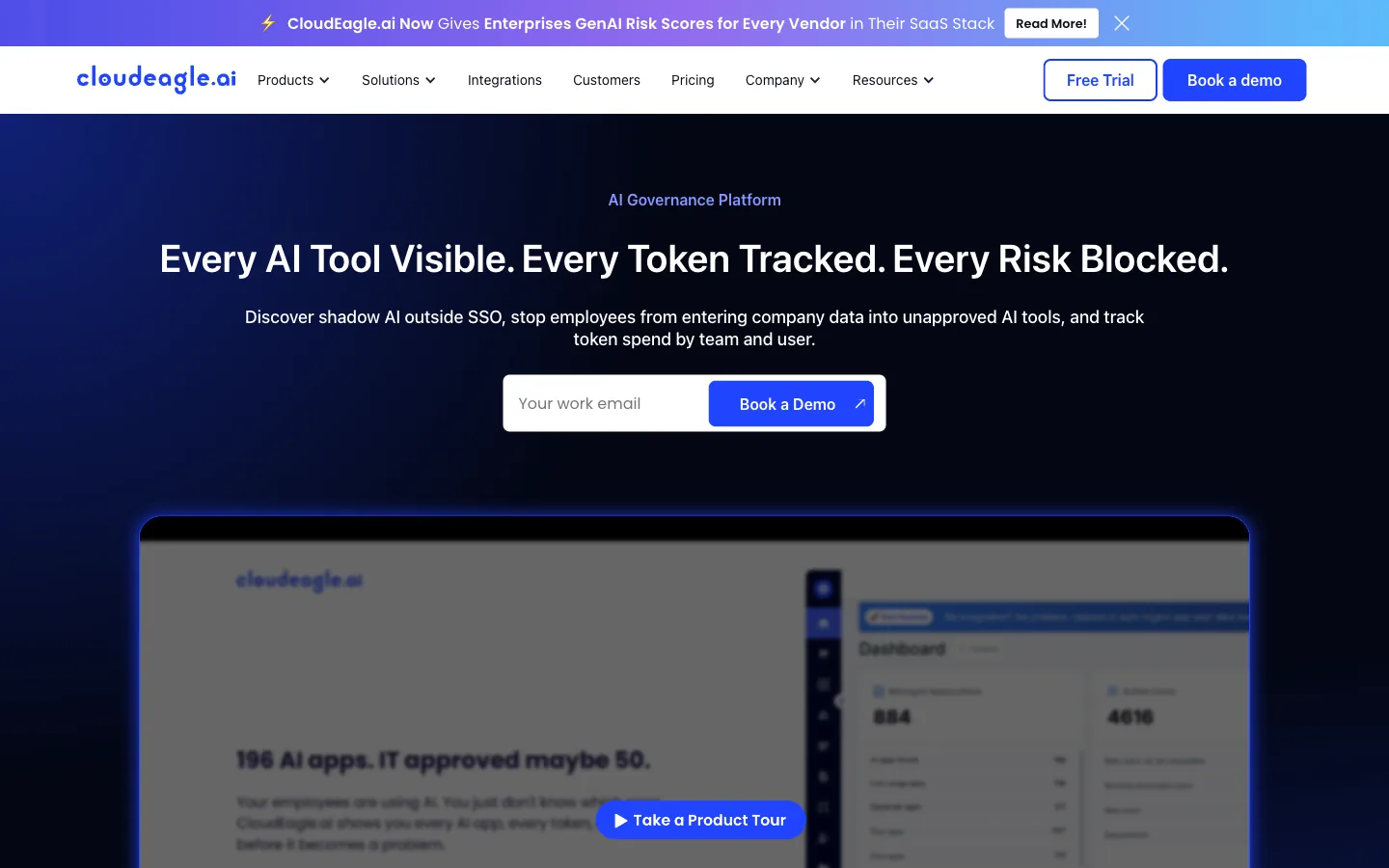
CloudEagle.ai sells SaaS Procurement as one of five modules, and the CloudEagle homepage pitches it to procurement teams as a way to keep every contract visible, with benchmarking, usage-based renewals, and procurement workflows in Slack.
According to CloudEagle, the module’s price benchmarks draw on more than $50 billion in SaaS transactions, and renewals get automated 90-day alerts. Buying guides, intake-to-procurement workflows in Slack, Coupa and contract management integrations, and expert negotiation advisory come with the module, and the advisory sits beside the software, so a team can run its own negotiations or hand some of them to CloudEagle’s experts.
CloudEagle is a SaaS management platform too, and it announced a Leader placement in the 2026 Gartner Magic Quadrant for SaaS Management Platforms, up from Niche Player in 2025. One vendor covers usage and procurement. Each of the five modules is priced through a demo, so expect the scoping call to decide which ones you buy.
Pros:
- Procurement tools and usage data from one vendor
- Procurement requests handled inside Slack
- Optional expert negotiation advisory next to the software
Cons:
- Five modules, each scoped and quoted through a demo
- G2’s review summary mentions a confusing initial setup and thin documentation
G2: 4.7/5 (107 reviews). Checked October 1, 2026.
Sastrify
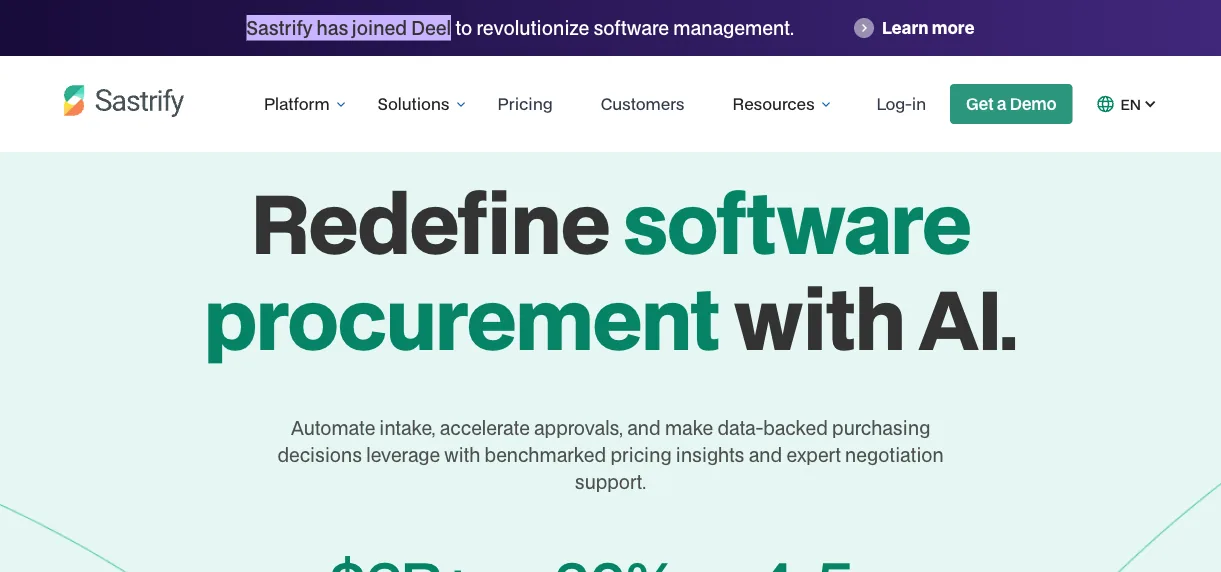
An Orrick deal note dates Deel’s acquisition of Sastrify to May 2026, and Deel is folding the product into Deel IT. Deel’s announcement described the problem it bought Sastrify to fix: “Procurement happens in one place, usage data lives in another, and no one has a complete picture until it’s too late to act on it.”
Sastrify’s pricing page lists module prices in euros, with Software Management from €12.5k a year, Vendor Benchmarks from €15k a year, and Expert Procurement from €25k a year. The expert tier is a managed service. The Sastrify procurement page offers certified experts who can handle sourcing, pricing, and negotiation on the buyer’s behalf.
Sastrify tracks usage alongside price, discovering software through IdP, browser, and ERP connectors and mapping ownership, usage, renewals, and spend before it right-sizes seats. Its homepage puts the benchmark database at $6B+. European buyers get vendor compliance documentation for the EU’s DORA and NIS2 rules and the AI Act.
A European company that wants price benchmarks, usage data, and a buyer on call from a single vendor is Sastrify’s clearest fit. During the demo, ask whether the contract is signed with Sastrify or with Deel, and how the product will change as Deel IT absorbs it.
Pros:
- Public module prices
- Discovery and usage data next to price benchmarks
- Vendor compliance documents for DORA, NIS2, and the AI Act
Cons:
- The roadmap and the contracting entity are shifting inside Deel
- Expert negotiation is a separate tier, from €25k a year on the pricing page
G2: 4.5/5 (88 reviews). Checked October 1, 2026.
How to Choose a SaaS Procurement Platform
Start planning two years before a renewal, Gartner VP Analyst Jo Liversidge told buyers at Gartner Symposium, after SaaS vendors raised prices by 9 to 25% in 2025 (The Register, September 2025). “Don’t accept increases as a done deal,” she said, and that planning includes a review of which subscriptions are underused.
Pick the platform by the job you need done first, using the table below, and expect some teams to pair two of them, because an intake tool and a usage-based renewal tool answer different questions. If your problem is the whole SaaS program rather than buying, our list of the best SaaS management platforms covers that shortlist instead.
| The job you need done first | Start with |
|---|---|
| One front door for every purchase, software included | Zip |
| SaaS negotiation handled by experts | Vertice or Spendflo |
| A contract-first renewal calendar with a public price | Tropic |
| European buying with DORA or NIS2 duties | Sastrify |
| Procurement and SaaS management from one vendor | CloudEagle |
| Renew-or-cut decisions from discovered usage, shared by IT, Finance, and Procurement | Torii, which pairs with Zip for intake |
- Where the seat count comes from SSO, the browser, finance data, or only the contracts you upload
- Software or a service Whether a person or the product runs the negotiation, and whether it is in the base price
- Your data after an acquisition What happens to your data and contract if the vendor is bought, as Vendr and Sastrify were in 2026
Shortlist two platforms from the table and take the three questions into each demo, starting with the renewal that lands soonest on your calendar.
Frequently Asked Questions
The answer depends on which buying problem comes first. Torii fits teams that want renewal decisions built on discovered apps and license usage, Vertice and Spendflo suit teams that want negotiation handled by experts, Zip routes every purchase through one intake process, Tropic works a contract-first renewal calendar, and Sastrify fits European buyers with DORA or NIS2 duties.
Yes. Vertice announced its acquisition of Vendr on June 1, 2026, and Vendr customers gain access to Vertice's Intake-to-Procure platform. Vendr.com still runs, and says Vendr is now part of Vertice. Vendr's Ruth agent negotiates in advisory or autonomous mode with human sign-off.
A SaaS procurement platform runs buying, from intake and approvals to price benchmarks and negotiation. A SaaS management platform such as Torii discovers the apps in use and tracks licenses, spend, and usage, so it can show which renewals to drop and how many seats to keep. Many teams run one of each.
Most vendors quote on request. As of October 1, 2026, Tropic's pricing page lists a starting price of $3,083 a month based on employee count, and Sastrify lists modules from €12.5k a year. Spendflo charges a platform fee plus a fee per completed request, while Torii, Vertice, Zip, and CloudEagle are quote-based.
Gartner's advice, reported by The Register, is to start planning two years before a SaaS renewal and review usage to find underused subscriptions. Inside Torii, apps renewing within 120 days show a button to start a Renewal Forecast, and a renewal workflow fires 90 days before the renewal date to check auto-renew terms.
Look for five things: an intake form with approval routing by budget or risk, price benchmarks, a contract repository with renewal alerts, negotiation support from software or experts, and usage data that shows how many seats are in use. Torii supplies the usage and renewal side, and pairs with Zip for intake.