

8 Platforms for Workday HCM Access Certification in 2026
 Chris Shuptrine
•
Mar 4, 2026
•
19 min read
Chris Shuptrine
•
Mar 4, 2026
•
19 min read

Compare 8 platforms for Workday HCM access certification in 2026, covering HR data governance, security groups, SOX compliance, and least-privilege enforcement.
Ask about this article
Opens Claude in a new tab to answer, using this article as the source.
Workday HCM holds some of the most sensitive data in any organization’s SaaS stack. Payroll records, performance reviews, compensation data, organizational charts, and employee identity information all live there, alongside the provisioning logic that governs who can approve salary changes, view headcount reports, and process payroll runs.
Workday’s native security model relies on security groups, domain security policies, and business process security policies, which together define what users can see and do. That model is comprehensive but not self-auditing. IT and security teams frequently discover that managers retain access to compensation data for employees they no longer manage, or that HR specialists carry admin-level business process rights that were granted once and never revisited. The gap between what Workday’s model permits and what users actually need tends to grow quietly until a SOX audit or a security review forces the conversation.
The eight platforms in this article approach Workday HCM access certification from different angles. Some integrate at the HRIS layer and use Workday as an authoritative source of identity data; others map Workday’s security group structure directly and enable entitlement-level certifications. Each section addresses what the platform does specifically for Workday governance, not just general IGA capabilities.
Security group memberships that grant access to compensation, payroll, and organizational data; domain security policies controlling what employees can view and modify; business process security for approvals like salary changes and promotions; integration system accounts and API credentials used by third-party HR tools; manager-scoped roles that should update automatically when reporting structures change; and HR Business Partner access that spans multiple departments or regions.
The comparison below covers integration depth, AI review capabilities, limitations, and ratings from major review platforms.
★ = low · ★★ = medium · ★★★ = high
| Tool | Ease | Cost | AI Capabilities | Reviews |
|---|---|---|---|---|
| Torii | ★★★ | ★★ | ★★★ | ★★★ |
| Veza | ★★ | ★ | ★★★ | ★ |
| Okta Lifecycle Management | ★★ | ★ | ★★★ | ★★ |
| SAP Cloud IAG | ★ | ★ | ★★ | ★★ |
| SailPoint IdentityIQ | ★ | ★ | ★★★ | ★★★ |
| Oracle Identity Governance | ★ | ★ | ★★ | ★★ |
| CloudEagle | ★★★ | ★★ | ★★ | ★ |
| Avatier | ★★ | ★★ | ★★ | ★ |
Table of Contents
- Torii
- Veza
- Okta Lifecycle Management
- SAP Cloud Identity Access Governance
- SailPoint IdentityIQ
- Oracle Identity Governance
- CloudEagle
- Avatier
Torii
Torii treats Workday HCM access reviews as part of a continuous SaaS governance layer rather than a standalone certification project. For Workday specifically, Torii pulls employee name, email, title, department, user status, license assignment, and license type directly from the integration, giving reviewers the organizational context they need to make decisions about HR platform access without assembling data from multiple sources. That context is what separates a meaningful access review from a rubber-stamp exercise.
The license type data is particularly useful in Workday environments where Full Users, Limited Users, and integration-only accounts carry different risk profiles. A full Workday user with compensation and payroll domain access warrants a different level of scrutiny than an employee with self-service access to their own time-off requests. Torii’s AI flags accounts that have accumulated access inconsistent with their organizational role and routes certification requests to the right app owner or manager automatically, reducing the back-and-forth that typically extends Workday campaign completion windows.
Torii combines identity governance with SaaS management in one product. For security and IT teams managing Workday alongside 50 or 100 other applications, that unified view eliminates the need to run parallel processes for access reviews and license optimization. Torii holds 2025 Gartner Magic Quadrant Leader recognition for SaaS Management Platforms and carries a 4.5-star rating on G2 across 302 reviews.
Pros:
- Pulls employee name, email, title, department, status, and license type directly from Workday
- AI flags role creep and anomalous access patterns with automated reviewer routing
- In-place attestations and bulk review capabilities reduce campaign completion times
- Unified SaaS management and identity governance in one platform
Cons:
- Pricing positions it above entry-level SaaS governance tools
- No on-premise deployment; built for cloud/SaaS environments only
G2 Rating: 4.5/5 (302 reviews) · Capterra Rating: 4.9/5 (26 reviews)
Veza
Veza’s authorization graph approach maps exactly the kind of access complexity that Workday HCM creates. Where many IGA tools track user-to-application assignments, Veza models the relationship at the permission level, translating Workday’s domain security policies and security group memberships into plain-language CRUD operations. For Workday, that means a reviewer can see not just that a user belongs to a Compensation_Admin security group, but what specific data objects that group can create, read, update, or delete across the platform.
For Workday-specific compliance scenarios, that visibility directly addresses the most common governance failures. SOX requirements around segregation of duties in compensation and payroll mean organizations need to confirm that no one can both initiate and approve a salary change, or that payroll access is limited to people whose current role genuinely requires it. Veza surfaces toxic permission combinations and SoD violations across security groups, and its risk-based sorting means the highest-risk Workday access gets reviewed first rather than certifications processed in whatever order the campaign queue happens to produce.
ServiceNow announced a deal to acquire Veza in December 2025. That adds strategic backing, but it also brings some product roadmap uncertainty. At the time of the deal, Veza served nearly 150 global enterprise customers, and Blackstone CTO John Stecher said in the same announcement that the combined platform would bring “smarter access management, ongoing access reviews, and seamless deprovisioning.” The platform is best suited for enterprises prioritizing deep permission visibility over deployment simplicity. Veza carries a 4.9-star rating on Gartner Peer Insights across 29 reviews.
Pros:
- Authorization graph maps Workday domain security policies to plain-language permission descriptions
- SoD violation detection for compensation and payroll security groups
- Risk-based sorting focuses reviewers on highest-risk Workday access first
- Activity insight shows which permissions are actively used versus granted but idle
Cons:
- No transparent pricing; enterprise-only quote-based model with no free trial
- Very limited public customer reviews compared to established IGA vendors
- ServiceNow acquisition creates product roadmap uncertainty for long-term planning
Capterra Rating: 5.0/5 (1 review) · Gartner Rating: 4.9/5 (29 reviews)
Okta Lifecycle Management
Okta frequently integrates with Workday as an HRIS source of truth, which gives it a natural position in Workday access governance. Workday publishes worker lifecycle events, such as new hires, role changes, department transfers, and terminations, that Okta uses to trigger provisioning and deprovisioning across connected applications. For organizations already running Okta for identity management, extending that relationship to include Workday access certification campaigns is a logical next step.
The 2025 Security Access Reviews capability in Okta Identity Governance (OIG) adds event-triggered reviews to the traditional scheduled campaign model. When Workday pushes a department change for an HR Business Partner who has access to multiple regional compensation reports, that change can automatically trigger a targeted review of the affected user’s access rather than waiting for the next quarterly cycle. The AI-generated access summaries help reviewers understand what a user’s Workday access actually covers without requiring them to navigate Workday’s security group documentation themselves.
The Okta Integration Network lists more than 8,000 pre-built integrations, and Workday is one of them. Access certification campaigns for Workday can run alongside campaigns for every other application in the organization under a single governance program. The bundled pricing model requires purchasing the full OIG governance package to access certification features, which affects the cost calculation for teams primarily interested in Workday coverage. Okta’s lifecycle management page quotes Dan Bowden, an internal IT solutions architect, who says “Now that we provision from Workday into Okta, user creation is automatic.”
Pros:
- Natural HRIS integration with Workday as identity source of truth for lifecycle automation
- Event-triggered access reviews respond to Workday lifecycle changes in real time
- AI-generated access summaries simplify Workday permission context for reviewers
- 8,000+ integration library extends governance across connected applications
Cons:
- OIG governance features require purchasing the full bundle, not available standalone
- Group-based provisioning model limits granular Workday entitlement visibility
- Higher per-user cost at scale compared to purpose-built IGA alternatives
G2 Rating: 4.5/5 (1,257 reviews) · Capterra Rating: 4.7/5 (914 reviews)
SAP Cloud Identity Access Governance
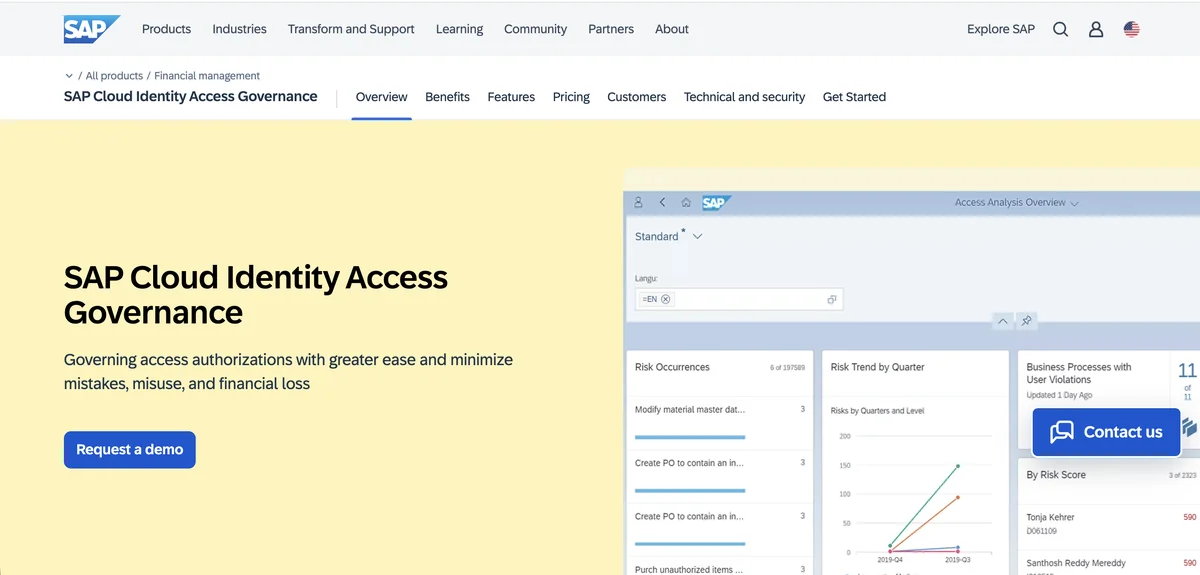
SAP Cloud Identity Access Governance (IAG) connects to Workday through SCIM-based integrations and API extensibility, which makes it relevant for organizations operating mixed SAP and Workday environments. Many enterprises use Workday for HCM alongside SAP S/4HANA or SuccessFactors for financial processes, and SAP IAG’s cross-system SoD analysis can span both environments from a single certification campaign, catching conflicts that exist between a user’s Workday compensation access and their SAP financial approval rights.
The Access Certification module runs periodic reviews with configurable scopes, from individual user certifications to full department-level campaigns. Campaign progress is visible through a centralized dashboard that tracks completion rates in real time, which is useful for compliance teams managing Workday review deadlines tied to SOX reporting calendars. SAP IAG’s machine learning-based role optimization can analyze Workday security group assignments across a workforce and suggest consolidated role structures that reduce the permission surface before the next certification cycle runs.
SAP IAG makes the most sense when Workday governance is one piece of a larger SAP-centric compliance program rather than a standalone priority. Non-SAP shops will find the value proposition limited; the platform’s native strengths are in SAP ecosystem integration, and the learning curve and enterprise pricing are hard to justify without that context. Details on the platform’s governance features are on SAP’s site.
Pros:
- Cross-system SoD analysis catches conflicts between Workday and SAP financial access
- Configurable certification campaigns with real-time completion tracking
- ML-based role optimization reduces Workday permission surface before reviews begin
Cons:
- Best suited for SAP-centric environments; differentiation is limited for non-SAP shops
- Complex learning curve and requires specialized SAP knowledge to configure effectively
- Enterprise-level pricing with no transparent public tiers
Gartner Rating: 4.4/5 (114 reviews)
SailPoint IdentityIQ
SailPoint IdentityIQ has a dedicated Workday connector and handles Workday access certification as part of what most enterprise governance programs actually look like in practice: Workday alongside Active Directory, Salesforce, ServiceNow, and dozens of other applications under a unified compliance program. The peer group analysis is directly applicable to Workday environments where the right level of compensation or HR access is determined by job function. SailPoint’s algorithms compare a user’s Workday security group memberships against their peer cohort, flag outliers, and surface them for priority review.
The AI-driven recommendation system reduces the certification fatigue that Workday reviews can generate in large organizations with complex security group structures. Reviewers aren’t starting from a blank slate on each account; the system pre-marks low-risk cases based on peer group analysis and prior certification history, focusing human judgment on accounts where it actually matters. For organizations with SOX compliance requirements tied to Workday payroll and compensation access, SailPoint’s audit trail documentation and certified access records provide the evidence auditors typically request.
The most common Workday segregation-of-duties conflicts involve compensation approval and compensation entry, payroll processing and payroll auditing, job requisition creation and job offer approval, worker termination and final payroll processing, and HR data editing combined with system administration rights. Any user who holds both sides of these pairings represents a material compliance risk in a SOX-scoped Workday environment.
SailPoint is a realistic choice for enterprises with dedicated IAM programs where Workday is one of many governed applications. Organizations focused primarily on Workday governance in a simpler environment will find the 6-12 month implementation timelines and $75,000+ entry pricing difficult to justify. Details on the IdentityIQ platform are at SailPoint’s site.
Pros:
- Dedicated Workday connector with deep entitlement modeling for security group structures
- AI peer group analysis flags Workday users with access outside their role cohort
- Handles Workday alongside every other enterprise application under one compliance program
Cons:
- 6-12 month implementation timelines limit deployment flexibility for teams with urgent needs
- Entry pricing at $75,000+ is difficult to justify for organizations without complex multi-system governance requirements
- Requires dedicated IAM engineering resources to configure and maintain effectively
G2 Rating: 4.5/5 (161 reviews) · Capterra Rating: 4.2/5 (21 reviews)
Oracle Identity Governance
Oracle Identity Governance (OIG) connects to Workday through its connector library and REST API integrations, and the event-based micro-certification capability is specifically useful for Workday environments with frequent organizational changes. When Workday records a department transfer, a job code change, or a cost center reassignment, OIG can trigger a targeted access review for that user’s profile rather than batching the change into the next quarterly campaign. For organizations where Workday drives frequent HR events, that reduces the window during which a user holds permissions that no longer match their role.
Oracle Identity Role Intelligence uses machine learning to analyze access patterns across the Workday user population and identify role assignments that reflect historical accumulation rather than current function. An HR Specialist who was temporarily assigned to a compensation project two years ago and still holds those security group memberships shows up as an outlier in the analysis. That layer complements periodic certification campaigns with ongoing visibility into access drift that might otherwise go undetected between formal review cycles.
OIG’s governance capabilities are most applicable in organizations already running Oracle infrastructure. Those without Oracle database or application dependencies generally find limited justification for the implementation complexity, per-user pricing at $3,600, and an interface that reviewers consistently describe as dated compared to cloud-native alternatives. For non-Oracle shops focused specifically on Workday governance, cloud-native platforms typically deliver better return on the implementation investment. More information on OIG is at Oracle’s governance page.
Pros:
- Event-based micro-certifications trigger Workday reviews on job changes and department transfers automatically
- Machine learning role intelligence surfaces accumulated access drift across the Workday user base
- Hybrid deployment options for organizations with mixed on-premise and cloud environments
Cons:
- Per-user licensing at $3,600 is expensive relative to alternatives with comparable Workday integration
- Implementation complexity and long deployment timelines limit suitability outside Oracle-centric environments
- Interface is dated and less intuitive than cloud-native IGA platforms; support quality receives consistent criticism
G2 Rating: 3.8/5 (71 reviews) · Capterra Rating: 4.4/5 (7 reviews)
CloudEagle
CloudEagle integrates with Workday as an HRIS source to synchronize employee identities and trigger lifecycle events across connected applications. The platform auto-collects user and access data from Workday and correlates it against app-level permissions tracked through SSO, identity providers, and its 500+ direct connector library, providing visibility into who has access to which SaaS applications based on their current Workday employee record. For organizations where Workday defines the source of truth for org structure and employment status, that HRIS integration makes the access review process considerably more accurate than maintaining identity data in a separate system.
The Slack-native workflow is a meaningful differentiator for Workday-triggered access reviews. When a Workday lifecycle event, such as a termination or a role change, initiates a downstream access review, reviewers receive Slack notifications and can approve or reject access without logging into a separate governance portal. Zero-touch offboarding ensures that departing employees captured in Workday lose application access immediately rather than through a manual deprovisioning ticket that might sit in a queue for days. According to CloudEagle’s blog, “Organizations using CloudEagle.ai reduce access review time by 80% and improve audit readiness by 40%” (CloudEagle). That figure is vendor-reported, not an independent benchmark.
CloudEagle’s governance module connects the Workday employee record to broader SaaS access management, which is its core use case. For organizations where Workday access governance at the entitlement level is the primary driver, reviewing who holds compensation domain or payroll security group access specifically, CloudEagle’s focus on SaaS application management rather than deep Workday security group modeling is a constraint worth understanding before evaluating.
Pros:
- HRIS integration with Workday synchronizes employee identity and org data to drive lifecycle events
- Zero-touch offboarding and Slack-native workflows reduce deprovisioning lag after Workday termination events
- Vendor-reported 80% cut in access review time; fast SOC 2 compliance reporting
Cons:
- Less deep entitlement modeling for Workday security group structures compared to dedicated IGA platforms
- Reporting customization is limited; some compliance requirements may need additional tooling
- No API access limits custom integration capabilities for specialized Workday configurations
G2 Rating: 4.7/5 (150+ reviews) · Gartner Rating: 4.6/5 (53 reviews)
Avatier
Avatier’s Identity Anywhere platform connects to Workday as part of its cloud and SaaS connector portfolio, enabling access certifications that span Workday alongside the 90+ enterprise systems in its connector library. The Delta Access Certification feature is worth evaluating for organizations running recurring Workday review cycles. Rather than reviewing every Workday user account in full each quarter, Delta Reviews surface only what changed since the last certification run, which cuts reviewer burden significantly in stable Workday environments where the core user base doesn’t turn over frequently but individual security group memberships shift with role changes.
Avatier’s access certification capabilities include multi-channel reviewer support, with notifications delivered through Microsoft Teams, Outlook, Slack, SMS, and mobile apps. That matters for Workday environments where HR managers need to certify access for their direct reports but spend most of their time outside a governance portal. The containerized architecture means Avatier deploys on-premise, on AWS, Azure, or Google Cloud, and organizations with strict data residency requirements around Workday HR records may find that deployment flexibility useful. The fixed-bid implementation model also avoids the open-ended professional services costs common with enterprise IGA vendors.
Avatier’s market presence is smaller than most platforms in this comparison, with 31 G2 reviews and no Gartner Magic Quadrant inclusion. The practical implication is fewer community resources, fewer third-party integration guides, and a procurement process that may require extra justification in organizations where analyst validation drives vendor selection. The platform suits mid-market buyers who need functional Workday access governance at a lower total cost than SailPoint or Oracle, without the pure SaaS management focus of CloudEagle or Torii. Platform details are at Avatier’s site.
Pros:
- Delta Access Certification reviews only changed Workday accounts since the last audit, cutting campaign time
- Multi-channel reviewer notifications through Teams, Slack, and mobile for managers certifying HR access
- Containerized deployment works on-premise or on any cloud for HR data residency requirements
Cons:
- Smaller market presence with fewer community resources and no analyst recognition in Gartner or Forrester reports
- Some workflows require multiple steps to complete; navigation can be complex for administrators new to the platform
- Custom reporting capabilities are limited compared to larger enterprise IGA platforms
G2 Rating: 4.6/5 (31 reviews)
How to Choose
Workday HCM access governance consistently splits into two distinct problems that require different tooling. The first is lifecycle management: making sure new hires get appropriate access, role changes trigger adjustments, and terminations result in immediate deprovisioning. The second is periodic certification: regularly confirming that existing Workday security group memberships are still appropriate given current roles, org structure, and compliance obligations.
Platforms that handle both well for Workday differ on where they focus and how they price. Torii combines SaaS management with identity governance in one product and is built for cloud-first IT teams managing Workday alongside many other SaaS tools. It fits teams that want access reviews and license cleanup in the same workflow. SailPoint and Oracle are enterprise IGA platforms with deep Workday connector support, but both require substantial implementation investment and ongoing technical resources that mid-market organizations often can’t sustain. Veza’s authorization graph delivers the deepest permission-level visibility into Workday’s security model, with particular strength in SoD detection for payroll and compensation access.
For teams with tight timelines or limited implementation budgets, CloudEagle and Avatier both provide functional Workday access governance with faster deployment paths. CloudEagle’s strength is in HRIS-triggered lifecycle automation and Slack-native workflows; Avatier’s differentiation is deployment flexibility and Delta Certification for recurring audits. Okta is the right choice for organizations already using it for identity management and wanting to extend their existing investment into Workday certification campaigns. SAP Cloud IAG fits organizations running Workday alongside SAP SuccessFactors or S/4HANA where cross-system SoD analysis across both platforms is a compliance requirement.
Native HRIS integration with Workday for real-time employee data, security group-level visibility rather than just application-level access tracking, SoD policy enforcement across compensation and payroll domains, event-triggered certifications that respond to Workday lifecycle changes, and audit-ready reporting that supports SOX evidence collection without manual compilation.
Frequently Asked Questions
Workday HCM holds payroll, compensation, performance, identity, and provisioning logic. Poor governance lets managers or HR specialists retain excessive rights, creating SOX, privacy, and fraud risk. Regular certification and lifecycle controls prevent access drift and enforce segregation of duties for sensitive HR data.
Security group memberships granting compensation, payroll, and org-data access; domain and business process security rules; API and integration accounts; manager-scoped roles tied to reporting structures; and HR Business Partner privileges that span departments or regions — all common focus areas for Workday reviews.
Authorization-graph tools translate Workday security groups and domain policies into plain-language CRUD permissions, surface toxic permission combinations and SoD violations, show active versus idle entitlements, and sort risk so reviewers prioritize the highest-risk Workday access first.
Event-triggered micro-certifications use Workday lifecycle events—hires, transfers, terminations, job code changes—to automatically start targeted reviews for affected users. This reduces the time users hold inappropriate permissions versus waiting for scheduled quarterly campaigns.
Choose based on scale and priorities: Torii or CloudEagle fit cloud-first teams needing SaaS and lifecycle governance; SailPoint and Oracle suit large enterprises with deep entitlement modeling but longer implementations; Avatier and CloudEagle offer faster, lower-cost paths for mid-market buyers.
AI and peer-group analysis reduce reviewer burden by flagging role creep, pre-marking low-risk accounts, and surfacing outliers against job-function cohorts. Automated recommendations and anomaly detection let human reviewers focus on high-risk Workday access rather than repetitive confirmations.
Look for native Workday HRIS integration, security group- or entitlement-level visibility, SoD enforcement across compensation and payroll, event-triggered certifications, audit-ready SOX reporting, and deployment or pricing options that match your organization's scale and data residency needs.