

7 Ways to Run Zapier Access Audits in 2026
 Chris Shuptrine
•
Mar 16, 2026
•
18 min read
Chris Shuptrine
•
Mar 16, 2026
•
18 min read

Compare 7 access review tools for Zapier in 2026, covering automation governance, connected app permissions, license auditing, and SaaS access certification.
Ask about this article
Opens Claude in a new tab to answer, using this article as the source.
Zapier accounts carry more access risk than their position in the org chart suggests. A single Zapier user stores persistent OAuth tokens for every app they connect, and those tokens grant ongoing access to Salesforce records, Google Workspace files, Slack channels, GitHub repos, and whatever else feeds into their automations. When someone leaves the company and their Zapier account stays active, every one of those token-based connections keeps running in the background without anyone reviewing what data is still flowing.
The problem compounds because Zapier sits in a governance blind spot. It doesn’t show up in most IGA tool catalogs the way Salesforce or Okta does. Business users create Zaps without IT approval, often granting broader OAuth scopes than the automation actually requires. The built-in audit log on Team plans only covers six months and doesn’t include a native access review workflow, so there is no internal mechanism for periodically certifying who should still have access or what connections their account maintains.
Zapier stores persistent OAuth tokens that survive password resets and MFA changes. A compromised or orphaned account doesn't just expose Zapier data; it exposes every SaaS tool connected through that account. Enterprise plans support SCIM and SAML for automated provisioning, but Team plan customers and organizations running Zapier outside IT's purview have no automated deprovisioning path. Roles include Owner, Super Admin (Enterprise only), Admin, and Member, with separate project-level permissions on individual Zaps, Tables, and Interfaces.
Each platform in this comparison handles Zapier access governance differently, from identity lifecycle automation to structured certification campaigns. The sections below cover what each tool does for Zapier specifically, along with integration depth, AI capabilities, pricing context, and review ratings.
★ = low · ★★ = medium · ★★★ = high
| Tool | Ease | Cost | AI Capabilities | Reviews |
|---|---|---|---|---|
| Torii | ★★★ | ★★ | ★★★ | ★★★ |
| Veza | ★★ | ★ | ★★★ | ★★ |
| Nudge Security | ★★★ | ★★ | ★ | ★ |
| Lumos | ★★ | ★★ | ★★★ | ★ |
| Zluri | ★★ | ★★ | ★★ | ★★ |
| One Identity | ★ | ★★ | ★★ | ★★ |
| Saviynt | ★★ | ★ | ★★★ | ★★ |
Table of Contents
Torii
Torii’s Zapier integration feeds employee name, email, title, department, user status, and license assignment into the access review workflow without manual data exports. The organizational context those fields provide is critical for Zapier audits, because the risk attached to any account depends almost entirely on who holds it. A marketing coordinator with two Zaps connecting a form tool to a spreadsheet carries a different risk than a revenue operations manager whose account holds OAuth tokens for Salesforce, HubSpot, and the company’s payment processor. Torii surfaces those distinctions without requiring anyone to export a CSV from Zapier’s admin panel.
The platform doesn’t currently pull last-used date or historical usage data from Zapier, so inactivity-based reviews need supplemental data from Zapier’s own audit log. That said, the employee status and department fields Torii does pull catch the most common Zapier access problems: accounts belonging to people who left the company months ago with OAuth tokens still active, users who switched departments but kept automation permissions tied to their old team’s tools, and license holders who no longer build or manage Zaps but still occupy a paid seat.
Torii’s AI flags anomalous access patterns across the full SaaS stack, not just Zapier in isolation. When a Zapier account connects to apps that fall outside its owner’s normal job function, the system surfaces that mismatch for review. The automated license reclamation workflow also identifies Zapier seats going unused, which directly reduces per-seat costs on Team and Enterprise plans. Torii is a 2025 Gartner Magic Quadrant Leader for SaaS Management Platforms with a 4.5-star G2 rating across 302 reviews.
Pros:
- Pulls employee name, email, title, department, status, and license data from Zapier for contextual reviews
- AI detects anomalous access patterns and routes certification requests to the right account owner
- Automated license reclamation catches unused Zapier seats to cut per-seat spending
- Unified SaaS management and identity governance in a single platform
Cons:
- Not the lowest-cost option in this comparison; positioned for mid-market and enterprise
- Cloud and SaaS only; no on-premise deployment option
G2 Rating: 4.5/5 (302 reviews) · Capterra Rating: 4.9/5 (26 reviews)
Veza
Veza builds an authorization graph that maps every identity to the resources it can reach. For a Zapier user holding persistent connections to a dozen SaaS apps, that graph shows the full downstream exposure of the account, not just the role label inside Zapier. The platform translates those relationships into plain-language permissions (Create, Read, Update, Delete), so a reviewer understands what each connected app actually allows. That visibility into effective permissions addresses one of the hardest parts of Zapier governance, which is quantifying how much access a single account really carries.
Risk-based sorting in Veza’s review campaigns puts accounts with the most sensitive connections at the top of the queue. A Zapier account wired into the company’s billing system and customer database surfaces before one connected only to a project tracker. Veza also tracks whether permissions are actively exercised, separating Zapier users who run automations daily from those whose Zaps haven’t fired in months. Reviewers get that usage context before making a revocation decision, so they know the connection isn’t powering an active business process.
Veza raised $108M in Series D funding in April 2025 and was announced to be acquired by ServiceNow in December 2024. The platform carries a 4.9-star Gartner Peer Insights rating from 29 reviews and a 5.0-star Capterra rating from 1 review. Campaign creation is agentless, deploying in minutes rather than weeks.
Pros:
- Authorization graph maps the full blast radius of each Zapier account’s OAuth connections
- Effective permission translation shows what connected apps actually allow, not just role labels
- Activity tracking distinguishes actively used Zapier connections from dormant tokens
Cons:
- No transparent pricing; enterprise-only model requires contacting sales
- Limited public reviews compared to established IGA vendors
- Being acquired by ServiceNow introduces uncertainty about product direction
Capterra Rating: 5.0/5 (1 review) · Gartner Rating: 4.9/5 (29 reviews)
Nudge Security
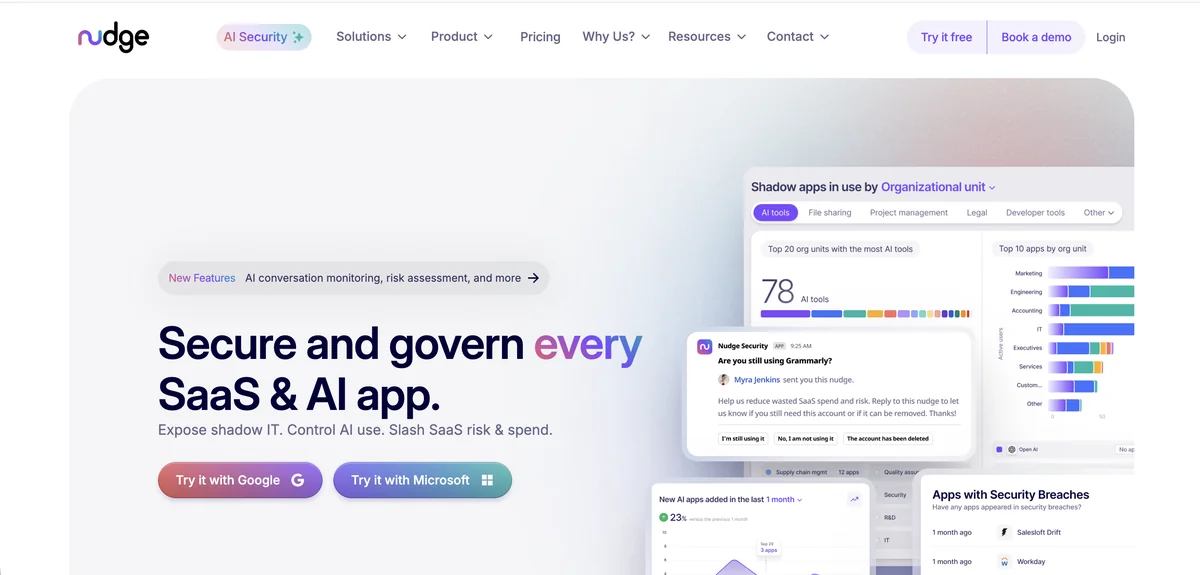
Zapier is one of those tools where the admin roster rarely tells the full story. Employees sign up with company email addresses, connect production apps through personal OAuth grants, and build automations that never appear in the official account list. Nudge Security picks up those shadow accounts through its patented email-based discovery method, scanning account creation confirmations, login notifications, and app connection alerts without requiring agents, proxies, or browser extensions. Full visibility into the organization’s Zapier footprint typically arrives within 75 minutes of connecting the platform.
The review workflow uses behavioral nudges rather than formal certification campaigns. When Nudge identifies a Zapier account that appears orphaned or tied to a user who no longer exists in the identity provider, it sends an automated prompt through Slack or email asking the account owner whether the access is still needed. Those prompts achieve an 83% compliance rate, which works well for Zapier environments where the goal is cleaning up shadow accounts rather than running a formal SOX audit. The offboarding playbook is where Nudge adds the most value for Zapier governance: it surfaces all of a departing employee’s SaaS accounts, including Zapier, so the deprovisioning team doesn’t miss the OAuth tokens that keep running after the person’s primary accounts are disabled.
Nudge Security also monitors for supply chain breaches affecting SaaS vendors that your Zapier accounts connect to. If one of those vendors reports a security incident, Nudge alerts you so you can evaluate whether the OAuth tokens stored in your Zapier environment are affected. The platform holds a 5.0-star G2 rating (limited reviews) and 4.7 stars on Gartner Peer Insights across 22 reviews.
Pros:
- Discovers shadow Zapier accounts created outside IT’s visibility through email analysis
- Supply chain breach alerts flag risks in apps connected through Zapier OAuth tokens
- Offboarding playbook catches all Zapier access for departing employees automatically
Cons:
- Requires Google Workspace or Microsoft 365 for email-based discovery
- Nudges are behavioral, not mandatory; users can ignore prompts without enforcement
- Very limited public review data on G2 and Capterra
G2 Rating: 5.0/5 (limited reviews) · Gartner Rating: 4.7/5 (22 reviews)
Lumos
Zapier Team accounts support Owner, Admin, and Member roles, while Enterprise accounts add Super Admin. Each role carries different permissions for managing app connections, inviting users, and creating automations. Beyond account-level roles, Zapier also assigns project-level permissions (viewer, editor, owner) on individual Zaps, Tables, and Interfaces. An effective access review needs to consider both layers, since a Member with editor access on a sensitive automation pipeline carries more risk than their account-level role suggests.
The core of Lumos’s approach to Zapier governance is Albus, an AI agent that handles the bulk of access review decisions without manual intervention. During a Zapier review cycle, Albus compares each account against peer group data and flags users whose connected apps or permission levels diverge from similar roles in the same department. For organizations where most Zapier users share a consistent set of connected apps, that peer comparison cuts the number of accounts requiring manual review substantially. A sales operations analyst with the standard Salesforce-to-Sheets Zap setup won’t trigger a flag, but a new hire in accounting who connected Zapier to the company’s payment processor and source code repository probably will.
Delta Reviews handle recurring Zapier audits efficiently by focusing only on what changed since the last review cycle. New accounts, role changes, newly connected apps, and accounts that went inactive all surface without re-certifying the entire Zapier user base. In teams where the core group of Zapier users is stable but new connections get added regularly, Delta Reviews prevent certification fatigue while still catching access drift.
Lumos launched Agentic User Access Reviews in late 2025, completing campaigns at a reported six times the speed of manual processes. The self-service access portal also reduces IT ticket volume when employees need new Zapier provisioning. Learn more at Lumos. The platform carries a 4.7-star rating on both G2 (54 reviews) and Gartner Peer Insights (47 reviews).
Pros:
- Albus AI pre-populates Zapier review decisions based on peer group analysis and usage anomalies
- Delta Reviews narrow recurring audits to only changed accounts and connections
- Self-service portal reduces IT involvement in standard Zapier provisioning requests
- Compliance reports for SOC 2, SOX, ISO 27001, and HIPAA generated with one click
Cons:
- No free trial; evaluating the platform requires engaging the sales team
- No live chat support; complex issues route through self-service channels first
- Cloud and SaaS focus creates blind spots for organizations with significant on-premises infrastructure
G2 Rating: 4.7/5 (54 reviews) · Gartner Rating: 4.7/5 (47 reviews)
Zluri
Most organizations have Zapier users spread across two groups: those provisioned through SSO and those who signed up on their own with a company email. Zluri’s discovery engine covers both categories through nine separate detection methods, including API integration, SSO group mapping, browser agent telemetry, and OAuth tracking. The platform builds an organizational profile for each Zapier user before any review starts, pulling job titles, departments, and account types from connected HRIS and identity systems alongside the Zapier account data itself.
The multi-level reviewer support fits Zapier governance well because Zapier accounts carry different risk levels depending on what they are connected to. A standard member account used for simple form-to-spreadsheet automations might be reviewed by a team lead, while an admin account holding OAuth tokens for financial systems routes to the security team. Zluri configures that routing automatically based on account attributes pulled during discovery, so a Zapier certification campaign doesn’t require manual reviewer assignment for each account.
Customers report reducing audit cycles from a full day to under 30 minutes through Zluri’s bulk approval capabilities and automated reminders. The closed-loop remediation feature removes Zapier access through the platform’s API integration, cutting out the manual deprovisioning delay between a reviewer deciding to revoke and the account actually getting disabled. More at Zluri.
Pros:
- Multi-method discovery catches Zapier accounts regardless of how they were created
- Multi-level reviewer routing assigns different approvers based on account risk level
- Closed-loop remediation removes Zapier access directly without manual deprovisioning tickets
Cons:
- Reporting customization is limited for teams with specific format requirements
- Discovery engine occasionally misidentifies applications, creating unnecessary review noise
- Some niche integrations need custom development beyond the pre-built connector library
G2 Rating: 4.6/5 (175 reviews) · Capterra Rating: 4.9/5 (27 reviews)
One Identity
One Identity’s Identity Manager governs Zapier through its attestation framework, which defines what gets certified, how often, and by whom. For organizations already running One Identity across Active Directory, SAP, or ServiceNow, extending coverage to include Zapier accounts slots into an existing certification program without requiring a separate governance workflow. The attestation policy engine handles the scheduling, reviewer assignment, and audit trail generation that Zapier doesn’t provide natively, filling the gap left by Zapier’s audit log, which tracks activity but doesn’t include any built-in certification mechanism.
The platform’s strength for Zapier governance lies in its hybrid deployment flexibility. Companies that need Zapier access reviews to be part of a broader program covering both cloud SaaS and on-premises systems can manage both through a single identity platform. One Identity connects to Zapier through its SCIM 2.0 connector library and Starling Connect, handling user provisioning and deprovisioning as part of the joiner-mover-leaver lifecycle. When someone’s HRIS record changes, Identity Manager can adjust or revoke their Zapier access automatically based on policy rules tied to department, title, or employment status.
The combined IGA and privileged access management (PAM) capability under a single vendor is relevant when Zapier admin and owner accounts qualify as privileged. Those roles control app connections and team-wide automation permissions, which means they warrant the same governance rigor as admin accounts in any other business-critical platform. One Identity pricing runs roughly $10-50 per user per month depending on deployment size, with a median annual cost around $31,216 according to Vendr data. The vendor serves over 11,000 organizations managing more than 500 million identities.
Pros:
- Attestation framework adds structured certification to Zapier, which lacks native review workflows
- Unified IGA and PAM covers both standard and privileged Zapier account types
- Hybrid deployment supports organizations governing Zapier alongside on-premises systems
- SAP-certified since 2003; proven enterprise track record across 11,000+ organizations
Cons:
- Attestation interface is dated; multiple reviewers cite poor UX for access certifications
- Steep learning curve; implementation typically requires a consulting partner
- Complex implementation with costs ranging from $5,000 to $50,000
- Azure AD/Entra ID connector has had gaps in earlier versions
G2 Rating: 3.5/5 (limited reviews) · Capterra Rating: 5.0/5 (2 reviews) · Gartner Rating: 4.4/5 (155 reviews)
Saviynt
Saviynt’s Identity Cloud platform applies continuous compliance monitoring to Zapier accounts rather than relying solely on periodic review campaigns. When a Zapier user’s risk profile changes, such as connecting a new high-sensitivity app or accumulating admin-level permissions, Saviynt can trigger a micro-certification targeting that specific user rather than waiting for the next quarterly cycle. For Zapier environments where OAuth connections change frequently as teams build new automations, that event-driven approach catches access drift between scheduled reviews.
The AI trust scoring system reduces the manual review burden by auto-approving low-sensitivity Zapier accounts that match expected access patterns. Saviynt reports that trust scoring cuts approver workload by up to 75% and predicts correct access decisions with 94% accuracy based on peer group analysis. A Zapier member account with connections limited to the same apps their teammates use gets processed automatically, while an account with outlier connections or elevated permissions surfaces for human review. That division of labor keeps certification campaigns from becoming a rubber-stamping exercise where overwhelmed reviewers approve everything to clear their queue.
Saviynt raised $700 million at a $3 billion valuation and holds the distinction of being named Gartner Peer Insights Customers’ Choice for IGA four consecutive years (2021-2024). The platform starts at $10,000 annually and provides a free trial, unlike several competitors. The unified IGA and PAM architecture covers both standard Zapier users and privileged admin accounts through a single code base. Visit Saviynt for more details.
Pros:
- Continuous compliance catches Zapier access changes in real time, not just during scheduled campaigns
- AI trust scoring auto-resolves low-risk Zapier certifications, reducing manual review by up to 75%
- Mobile certification experience allows managers to review Zapier access on the go
Cons:
- Customer support receives mixed reviews, with some tickets staying open too long before resolution
- Steep learning curve despite a modern frontend; backend configuration requires specialized expertise
- Starting at $10,000 annually creates a cost barrier for smaller organizations
G2 Rating: 3.5/5 (limited reviews) · Capterra Rating: 4.5/5 (2 reviews) · Gartner Rating: 4.8/5 (185 reviews)
How to Choose the Right Zapier Access Review Tool
Picking the right platform depends on what your Zapier governance challenge actually looks like. If shadow Zapier accounts created outside IT are the primary concern, a discovery-first tool like Nudge Security finds those accounts faster than anything else in this comparison. If the priority is formal compliance certification for SOX or SOC 2 audits, platforms with structured campaign engines like Saviynt or One Identity provide the audit trails that regulators expect.
For organizations managing Zapier alongside a larger SaaS portfolio, Torii is worth evaluating first. It combines SaaS management with identity governance in one platform, which means Zapier access reviews happen alongside the rest of the stack rather than in a separate workflow. The AI-powered anomaly detection, automated license reclamation, and 170+ deep integrations reduce the operational overhead of running access reviews across every application. Torii holds 2025 Gartner Magic Quadrant Leader recognition, and the accessible pricing starting at $2.50 per employee per month puts it within reach for mid-market teams that aren’t ready to commit to a six-figure enterprise IGA contract.
Check whether your organization runs Zapier on a Team or Enterprise plan, because the available admin controls differ significantly. Enterprise plans include SCIM for automated provisioning, SAML SSO, Super Admin roles, and 12 months of audit log history. Team plans cap at 25 members, provide six months of audit history, and lack automated provisioning. Understanding your plan tier determines which external governance tools can integrate deeply and which will need to work around Zapier's native limitations.
Budget constraints narrow the field quickly for most teams. Veza and Saviynt are enterprise-grade platforms with pricing to match, built for organizations with complex identity environments across hundreds of applications. Nudge Security and Lumos occupy the middle ground with modern interfaces and faster deployment. One Identity and Zluri serve different segments: One Identity for large enterprises with hybrid environments, and Zluri for mid-market teams wanting discovery and governance in one package.
Frequently Asked Questions
A: Inventory Zapier accounts and connected OAuth apps, map each account to its owner and HR attributes, run risk-based certification focusing on high-sensitivity connections, revoke orphaned tokens, automate deprovisioning where possible, and schedule recurring or delta reviews.
A: Zapier stores persistent OAuth tokens that survive password resets and MFA changes, giving ongoing access to every connected SaaS app. Orphaned or compromised accounts keep tokens active, exposing downstream data across Salesforce, Google Workspace, Slack, GitHub, and other integrations.
A: Team plans cap membership, offer six months of audit history, and lack SCIM/SAML automated provisioning. Enterprise adds SCIM, SAML SSO, Super Admin roles, and 12 months of audit logs, enabling automated lifecycle management and deeper IGA integrations for access reviews.
A: Nudge Security excels at email-based discovery, finding accounts created outside IT. Zluri uses multi-method detection including API and SSO mapping. Torii and Zluri both surface employee context from HRIS to prioritize orphaned or unmanaged Zapier accounts for review.
A: Authorization graphs map each Zapier identity to the downstream resources and CRUD permissions its OAuth tokens enable. That visibility reveals the blast radius of a compromised account, surfaces sensitive connections first, and supports risk-prioritized certification campaigns.
A: Match tool strengths to your priorities: pick discovery-first vendors like Nudge for shadow accounts, compliance engines like Saviynt or One Identity for SOX/SOC 2 audits, Torii or Zluri for unified SaaS governance, and Veza for fine-grained authorization visibility.