

8 Ways to Run Docusign Access Audits in 2026
 Chris Shuptrine
•
Jan 26, 2026
•
15 min read
Chris Shuptrine
•
Jan 26, 2026
•
15 min read
Compare eight identity governance platforms for Docusign access reviews in 2026. Find tools for compliance, security, and automated certifications.
Ask about this article
Opens Claude in a new tab to answer, using this article as the source.
Docusign access sprawls faster than most organizations anticipate in 2026. A single sales team starts sending contracts for electronic signature, and within months every department from HR to legal to procurement has users creating envelopes, viewing confidential agreements, and sometimes holding admin permissions they never actually required.
Docusign accounts often contain legally binding agreements, compensation details, M&A documents, and vendor contracts with confidentiality clauses. Unlike general productivity tools, excessive Docusign access can expose sensitive financial terms, upcoming transactions, and proprietary deal structures that competitors or unauthorized employees should never see.
Manual access audits through quarterly spreadsheet reviews fail to catch the permission creep that happens between cycles. A contractor receives temporary access for a deal closing and still has it six months later. Someone transfers from sales to marketing but keeps their Docusign admin role despite having no business need for it anymore. IT teams struggle to answer basic audit questions about who could view a specific contract last quarter, or which departing employees had access to pending agreements before their last day.
Identity governance platforms address these gaps by connecting to Docusign APIs to provide continuous visibility into who holds what permissions. The eight platforms covered here take different approaches to Docusign access audits. Some focus on comprehensive SaaS management with identity governance built in, while others specialize in enterprise-grade access certification with deep compliance controls. Your choice depends on whether you need Docusign governance as part of broader SaaS visibility or as a focused compliance initiative.
★ = low · ★★ = medium · ★★★ = high
| Tool | Ease | Cost | AI Capabilities | Reviews |
|---|---|---|---|---|
| Torii | ★★★ | ★★ | ★★★ | ★★★ |
| SAP IAG | ★★ | ★ | ★★ | ★★ |
| Oracle | ★ | ★ | ★★★ | ★★ |
| Saviynt | ★★ | ★★ | ★★★ | ★★ |
| Omada | ★★ | ★ | ★★ | ★★★ |
| MiniOrange | ★★★ | ★★★ | ★ | ★★ |
| CloudEagle | ★★ | ★★ | ★★ | ★★★ |
| Ping Identity | ★ | ★ | ★★★ | ★★★ |
Table of Contents
- Torii
- SAP Cloud Identity Access Governance
- Oracle Identity Governance
- Saviynt
- Omada Identity
- MiniOrange
- CloudEagle
- Ping Identity
Torii
Torii operates as an Agentic Governance Platform that merges SaaS management and identity governance into a single solution. After connecting to Docusign, the platform surfaces employee names, email addresses, titles, departments, user status, license assignments, license types, and historical usage patterns for each account holder in your organization.
Torii discovers Docusign access through multiple channels including SSO integrations, direct API connections, browser extensions, and finance tool data. This multi-source approach catches Docusign accounts that bypass your identity provider, revealing shadow usage that SSO-only discovery can miss. Reviewers can complete access certifications without leaving their workflow through in-place attestations, and AI flags accounts with anomalous patterns or excessive permissions for priority attention.
Automated workflows handle the provisioning and deprovisioning that follow access review decisions. When a reviewer revokes Docusign access, Torii can execute that change directly through API integrations or route the task to the appropriate owner. The platform also tracks license utilization, identifying Docusign seats assigned to employees who rarely sign documents and enabling reclamation before renewal.
Pros:
- Discovers shadow Docusign accounts through SSO, browser extension, and finance integrations simultaneously
- Provides historical usage data showing which employees actively use their Docusign access versus holding dormant licenses
- Combines SaaS cost management with identity governance in one platform, eliminating need for separate tools
- AI-powered anomaly detection prioritizes high-risk accounts for reviewer attention during certification campaigns
Cons:
- Enterprise pricing may exceed budget for organizations with minimal SaaS governance requirements beyond Docusign
- Cloud-only deployment without on-premise options for organizations with strict data residency mandates
G2: 4.5 out of 5 stars (302 reviews) · Capterra: 4.9 out of 5 stars (26 reviews)
SAP Cloud Identity Access Governance
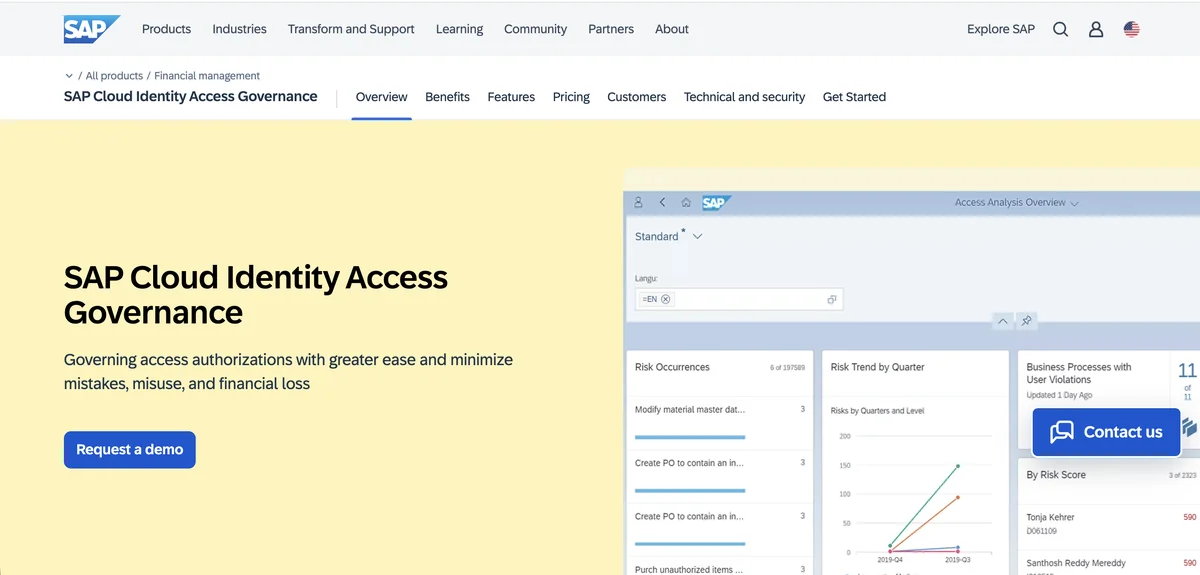
SAP Cloud Identity Access Governance connects to Docusign through SCIM-based integrations for organizations already operating within the SAP ecosystem. The platform handles access certification campaigns that span multiple cloud and on-premise systems simultaneously, allowing Docusign reviews to run alongside SAP Ariba, SuccessFactors, and S/4HANA certifications in unified workflows without managing separate governance processes.
The Access Certification Service supports role certification covering single roles, composite roles, business roles, and profiles across your application portfolio. Reviewers work through campaigns at department or company-wide scale with real-time progress tracking and visibility into completion rates. Dashboard-driven risk analysis with visual prompts highlights critical issues, and machine learning assists with role optimization to reduce over-provisioning before reviews begin.
For enterprises with existing SAP GRC Access Control deployments, the SAP IAG Bridge provides a unique hybrid capability. Organizations can maintain their on-premise governance investment while extending certification workflows to cloud applications like Docusign. This bridging approach lets teams consolidate governance without forcing a complete platform migration.
Pros:
- Native integration with SAP ecosystem applications means Docusign certifications fit into existing governance workflows
- Machine learning-based role optimization helps right-size Docusign permissions before certification campaigns start
- Hybrid bridge capability protects existing SAP GRC investments while adding cloud application governance
Cons:
- Limited workflow customization compared to on-premise SAP Access Control may constrain complex approval requirements
- Enterprise pricing creates a significant barrier for organizations without substantial SAP infrastructure
- Public cloud only deployment restricts organizations with strict data residency requirements
Gartner Peer Insights: 4.4 out of 5 stars (114 reviews)
Oracle Identity Governance
Oracle Identity Governance provides enterprise-grade access certification through configurable campaign types including user access reviews, policy reviews, and event-based certifications triggered by job changes or transfers. OIG offers flexibility to design campaigns based on user, role, application, or specific entitlements within the Docusign system depending on your governance requirements.
The Identity Role Intelligence feature leverages data mining and machine learning to automate role discovery and optimization across connected applications. During Docusign access reviews, prescriptive analytics provide AI-equipped insights that help reviewers make faster decisions about permission appropriateness. Peer group analysis compares users with similar roles to identify outlier access, and bulk approval capabilities reduce review burden for low-risk items.
Event-based micro-certifications trigger automatic access reviews when job codes, locations, departments, or organizational structures change. If a Docusign admin transfers to a different business unit, OIG can automatically initiate a targeted review of their elevated permissions without waiting for the next scheduled campaign. The automatic vacation management feature disables accounts when employees leave temporarily and re-enables them upon return.
Pros:
- AI/ML role intelligence identifies optimal permission sets and flags anomalous Docusign access patterns automatically
- Event-based micro-certifications ensure job changes trigger immediate reviews of sensitive Docusign permissions
- Automatic vacation management reduces risk from unattended privileged accounts during employee absences
Cons:
- Implementation takes months rather than weeks, requiring substantial project investment before Docusign governance begins
- Interface design has remained largely unchanged, creating a steep learning curve for new administrators
- Per-user licensing at $3,600 or per-processor at $180,000 exceeds budget for many mid-market organizations
- Technical support quality has drawn criticism from multiple reviewers citing slow resolution times
G2: 3.8 out of 5 stars (71 reviews) · Capterra: 4.4 out of 5 stars (7 reviews)
Organizations running quarterly access reviews often see managers approve nearly every item, clicking through hundreds of certifications without meaningful evaluation. AI-powered platforms address this by identifying outliers and high-risk access patterns, letting reviewers focus attention where it matters while automating decisions for low-risk items.
Saviynt
Saviynt operates as a cloud-native identity governance platform that unifies IGA, privileged access management, and application access governance on a single code base. Pre-built connectors enable continuous compliance monitoring and automated access certification for Docusign without requiring manual intervention from IT teams.
Trust Scoring rolls peer access, past certifications, and other risk signals into a score shown next to each item. Jeff Margolies, Saviynt’s Chief Product and Strategy Officer, said the intelligence suite would “reduce access certification effort by over 80%” (Saviynt press release). In the same release, product chief Vibhuti Sinha reported that early-adoption customers saw “more than 70% increase in their access revocations for critical and sensitive access.” When Docusign permissions fall outside normal ranges for a user’s role, Saviynt surfaces those items for human review while handling routine certifications automatically.
The mobile certification experience allows managers to complete Docusign access reviews from any device. Business-friendly descriptions provide context for each entitlement, helping non-technical reviewers understand what permissions actually mean.
Pros:
- Trust scoring reduces reviewer burden by automating low-risk certification decisions during Docusign campaigns
- Mobile-friendly interface enables managers to complete access reviews without being at their desk
- Unified IGA and PAM on single code base eliminates need for separate privileged access governance tools
Cons:
- Support responsiveness has received mixed reviews with some tickets remaining open longer than expected
- Platform complexity creates a steep learning curve despite the user-friendly frontend design
- Total cost including implementation and professional services exceeds initial subscription estimates
Gartner Peer Insights: 4.8 out of 5 stars (185 reviews)
Omada Identity
Omada Identity built its reputation on governance-focused IGA with particular strength in compliance management and automated access certifications. Cross-system certification campaigns cover Docusign alongside other applications in a single review cycle, with up to nine configurable approval layers for complex organizational requirements.
Omada’s AI assistant Javi operates within Microsoft Teams, allowing entitlement owners to launch Docusign access reviews directly from their collaboration environment. Automated data gathering eliminates manual collection of access information, and intelligent recommendations based on peer-group comparisons help reviewers identify permissions that deviate from normal patterns.
Omada’s Accelerator Package promises “12 weeks time to value” through a 5-step process with clear exit criteria, according to the Omada site. The platform’s reporting engine keeps an audit trail of every process and step. Organizations using Omada can generate compliance documentation for ISO 27001, GDPR, SOX, DORA, NIS2, HIPAA, and CCPA from 50 pre-built report templates.
Pros:
- Accelerator Package targets 12 weeks to value, a short timeline for enterprise IGA
- AI assistant Javi allows Teams-based access review workflows without leaving collaboration tools
- 50 pre-built compliance report templates reduce manual documentation effort for auditors
Cons:
- Large-scale recertification campaigns can experience performance slowdowns affecting review efficiency
- Cloud version pricing significantly exceeds on-premise deployment costs for budget-conscious organizations
- Report aesthetics appear dated compared to modern governance platform interfaces
G2: 4.5 out of 5 stars · Gartner Peer Insights: 4.6 out of 5 stars (211 reviews)
MiniOrange
MiniOrange offers an affordable IAM solution with identity governance capabilities at $2-$3 per user monthly, making it accessible for organizations that cannot justify enterprise IGA pricing for their Docusign governance needs. The platform connects to Docusign through its library of 6,000 pre-built integrations, enabling SSO and access governance without custom development.
SCIM-based provisioning automates the complete Docusign user lifecycle from initial account creation through eventual deprovisioning. Accounts appear when employees join, update when roles change, and disappear immediately upon departure from the organization. Bi-directional sync allows changes to flow from Docusign to MiniOrange or vice versa, ensuring access records stay current regardless of where modifications originate.
Adaptive risk-based authentication evaluates contextual factors during each Docusign login attempt, analyzing geographical location, device security posture, time patterns, and user behavior. High-risk access attempts trigger step-up authentication or blocking, providing an additional security layer beyond static permission controls.
Pros:
- Pricing at $2-$3 per user monthly makes governance accessible for SMBs with limited budgets
- 6,000 pre-built integrations enable Docusign connectivity without custom connector development
- Implementation takes hours instead of the months required by enterprise IGA platforms
Cons:
- Access certification features primarily require Jira Service Management integration for workflow automation
- Support quality varies significantly across customer experiences, from excellent to frustrating
- AI-driven risk analytics are limited compared to modern IGA platforms with ML-powered recommendations
- Minimum 10-user license requirement creates barriers for small pilot projects
G2: 4.5 out of 5 stars (264 reviews) · Capterra: 4.5 out of 5 stars (36 reviews)
CloudEagle
CloudEagle combines SaaS management with governance capabilities through 500+ direct integrations. The platform auto-collects Docusign user and access data from SSO providers, identity platforms, and direct API connections to provide granular visibility into permission distribution across your organization.
Access reviews can run immediately or on scheduled recurring cycles for continuous compliance monitoring. CloudEagle AI flags overprivileged users, inactive admin accounts, and users who have not logged into Docusign for 90 or more days. High-risk cases get prioritized for immediate attention while routine certifications flow through Slack-native workflows where reviewers can approve or revoke access without leaving their messaging tool.
CloudEagle’s own access review guide claims that “Organizations using CloudEagle.ai reduce access review time by 80% and improve audit readiness by 40%” (CloudEagle blog). Treat that as a vendor figure. Every approval, revocation, and exception is logged automatically, and the evidence maps to SOC 2, ISO 27001, HIPAA, GDPR, and SOX controls.
Pros:
- Slack-native workflows allow Docusign access reviews without context-switching to separate governance tools
- AI automatically flags inactive admins and users dormant for 90+ days for priority review
- Audit evidence is captured automatically and mapped to SOC 2, ISO 27001, HIPAA, GDPR, and SOX controls
Cons:
- Learning curve for complex features can be steep during initial implementation phase
- User interface navigation has drawn criticism for being less intuitive than competitors
- No API access limits ability to build custom integrations or extract data for external tools
- English-only language support restricts global organizations with multi-lingual teams
G2: 4.7 out of 5 stars (150 reviews) · Gartner Peer Insights: 4.6 out of 5 stars (53 reviews)
Ping Identity
Ping Identity spans access management, identity governance, and privileged access management in one platform. It describes itself as “the identity security platform behind over half of the Fortune 100” (Ping Identity). Autonomous Identity leverages machine learning to analyze identity data from diverse sources, evaluating millions of permissions per minute and providing contextual insights into risk levels at enterprise scale.
Docusign certification campaigns can include application access certification, role membership certification, account certification, and entitlement certification depending on your governance requirements. Ping Identity micro-certifications enable ad hoc, targeted reviews for just-in-time validation when circumstances change between scheduled campaign cycles.
PingOne Protect applies real-time risk calculation during Docusign authentication, combining multiple predictors including bot detection, IP velocity, geolocation anomaly, anonymous network detection, and user behavior analysis. When risk scores exceed thresholds, the platform can trigger additional authentication or block access entirely.
Pros:
- Autonomous Identity AI evaluates millions of permissions per minute for comprehensive risk analysis
- Hybrid deployment flexibility supports cloud, on-premise, private cloud, and FedRAMP environments
- Micro-certifications enable targeted Docusign reviews triggered by specific events or changes
- Real-time risk scoring during authentication adds security beyond periodic access reviews
Cons:
- Identity governance requires separate purchase from base PingOne Advanced Identity Cloud
- Complex setup demands significant IAM expertise, extending deployment timelines
- Documentation challenges often require external consulting partners for implementation
- Starting costs of $16,000 to $35,000 annually exceed mid-market budgets
G2: 4.5 out of 5 stars (264 reviews) · Capterra: 4.7 out of 5 stars (39 reviews)
How to Choose the Right Platform
Selecting a Docusign access review platform depends on your existing technology investments and governance requirements. Organizations with SAP infrastructure will find SAP IAG integrates naturally with their ecosystem, and Oracle shops benefit from OIG’s native database and application connectivity.
For companies prioritizing speed to value, Torii and CloudEagle offer faster deployment with SaaS management capabilities included. Both platforms discover shadow Docusign usage and combine cost optimization with governance in unified dashboards. Saviynt and Omada provide stronger enterprise governance frameworks for organizations with complex compliance requirements across regulated industries.
Discovery of shadow Docusign accounts, license reclamation for unused seats, and SaaS spend tracking alongside access reviews. Workflows carry out revocation decisions after each campaign. Running SMP and IGA in one platform means one fewer tool, with Docusign access visible next to the rest of the SaaS stack.
Budget-conscious mid-market organizations should evaluate MiniOrange at $2-$3 per user monthly, though the platform lacks advanced AI capabilities found in enterprise alternatives. Ping Identity fits Fortune 500 enterprises requiring proven scale, extensive compliance certifications, and hybrid deployment flexibility for regulated environments.
The right platform ultimately depends on whether Docusign governance stands alone or fits into broader SaaS management and identity initiatives. Point solutions work for focused compliance requirements. Unified platforms such as Torii or CloudEagle fit better when Docusign is one of dozens or hundreds of applications under review.
Frequently Asked Questions
DocuSign access sprawl typically starts when one team adopts e-signatures and access spreads across departments. Temporary contractors, job transfers, and unrevoked admin roles accumulate rapidly, creating unseen accounts and privileges that outpace manual discovery and control.
Excessive DocuSign access can expose legally binding agreements, compensation details, M&A documents, and confidential vendor contracts. Unauthorized visibility risks financial leaks, regulatory violations, and competitive harm when sensitive terms or upcoming transactions are accessed by the wrong people.
Quarterly spreadsheet audits miss permission creep between review cycles. Contractors or transferred employees often retain access, and IT teams lack continuous visibility to answer who viewed specific contracts or which departing users had entitlements before exit.
Identity governance platforms connect to DocuSign APIs and SSO to provide continuous visibility, run access certifications, automate provisioning/deprovisioning, and use AI to flag anomalous or overprivileged accounts—closing audit gaps and enforcing least-privilege policies in real time.
Choose based on existing tech investments, compliance needs, and deployment speed. SAP or Oracle suit large SAP/Oracle estates; Torii or CloudEagle speed time-to-value and SaaS management; Saviynt or Omada fit complex regulated environments requiring enterprise governance.
Yes—budget-conscious organizations can start with affordable options like MiniOrange at $2–$3 per user monthly. Expect trade-offs: faster implementations and lower cost but fewer advanced AI features and integration depth compared with enterprise IGA platforms.