

NetSuite Governance: 9 Access Review Tools in 2026
 Chris Shuptrine
•
Feb 3, 2026
•
16 min read
Chris Shuptrine
•
Feb 3, 2026
•
16 min read

Compare nine identity governance platforms for NetSuite access reviews in 2026. Find tools for compliance, security, and automated certifications.
Ask about this article
Opens Claude in a new tab to answer, using this article as the source.
NetSuite implementations grow more complex than most finance teams anticipate in 2026. What begins as a single ERP deployment for accounting and inventory quickly expands to include subsidiaries, regional offices, third-party vendors, and contractors who all need varying levels of access to financial data, customer records, and operational workflows.
NetSuite environments contain sensitive financial transactions, vendor payment details, customer credit information, and procurement workflows. Unlike productivity tools where over-provisioning creates inconvenience, excessive NetSuite access can expose organizations to fraud risk, regulatory violations, and material misstatement of financial data that auditors will flag during SOX examinations.
Manual quarterly reviews through spreadsheets and email chains fail to keep pace with the constant churn of role changes, project assignments, and contractor onboarding that characterizes modern ERP environments. A consultant receives temporary access to review financial reports for a due diligence project and still has that access eight months later. Someone transfers from accounts payable to a different department but retains their payment approval permissions because nobody updated their role. Finance teams struggle to provide auditors with clear evidence of who could approve purchase orders above certain thresholds during specific time periods. Oracle’s own NetSuite guidance tells admins to “Review access regularly to check for changes in responsibilities, make sure former employees’ access is revoked, and confirm that only the right people have sensitive or critical permissions” (NetSuite Help Center).
Identity governance platforms connect to NetSuite through APIs to provide continuous visibility into user permissions, automate certification campaigns, and generate the audit trails that SOX and SOC 2 auditors require. The nine platforms covered here take different approaches to NetSuite access governance. Some focus on comprehensive SaaS management with identity governance built in, while others specialize in enterprise-grade access certification for ERP environments. Your choice depends on whether NetSuite governance fits within a broader SaaS visibility initiative or represents a focused compliance requirement for your finance operations.
★ = low · ★★ = medium · ★★★ = high
| Tool | Ease | Cost | AI Capabilities | Reviews |
|---|---|---|---|---|
| Torii | ★★★ | ★★ | ★★★ | ★★★ |
| Veza | ★★★ | ★ | ★★★ | ★ |
| SAP IAG | ★★ | ★ | ★★ | ★★ |
| SailPoint | ★★ | ★ | ★★★ | ★★ |
| One Identity | ★★ | ★★ | ★★ | ★★ |
| Oracle | ★ | ★ | ★★ | ★★ |
| Saviynt | ★★ | ★★ | ★★★ | ★ |
| Omada | ★★ | ★ | ★★ | ★★ |
| Avatier | ★★★ | ★★ | ★★ | ★ |
Table of Contents
- Torii
- Veza
- SAP Cloud Identity Access Governance
- SailPoint IdentityIQ
- One Identity
- Oracle Identity Governance
- Saviynt
- Omada Identity
Torii
Torii’s NetSuite integration pulls each user’s role, user status, and license assignments into its governance workflows, and the same connector brings in NetSuite spend. IT and finance teams can see who holds NetSuite access without manually exporting user lists from the ERP system.
The platform combines SaaS management with identity governance, which suits organizations that want to run NetSuite access reviews alongside broader SaaS sprawl work. Torii discovers shadow IT applications and runs structured access review campaigns for sanctioned tools like NetSuite. Reviewers get a notification when they are assigned, then work through a guided review in Torii with usage insights and Torii recommendations beside each user.
For NetSuite, a campaign can be scoped to users with privileged access only. Torii then includes users whose role in the app contains “Admin”. Reviewers can compare a person’s NetSuite role against HR data to spot access that no longer fits their job. Completed campaigns export as shareable reports for SOX or SOC 2 evidence. Activity data for NetSuite comes from discovery sources such as SSO and the browser extension, because the connector itself doesn’t report usage.
Pros:
- NetSuite integration surfaces user roles, status, and license assignments without manual data extraction
- Combined SaaS management and identity governance reduces tool sprawl for organizations managing multiple applications
- Campaigns can target privileged NetSuite users only, which keeps admin reviews short
- Discovery through SSO and the browser extension finds shadow applications outside the IdP
Cons:
- Pricing targets mid-market and enterprise organizations, which may not fit smaller finance teams with limited budgets
- Cloud-focused platform without on-premise deployment options for organizations with strict data residency requirements
Capterra rating: 4.9/5 (26 reviews) G2 rating: 4.5/5 (302 reviews)
Veza
Veza takes a permission-centric approach to identity governance that translates complex NetSuite entitlements into readable Create, Read, Update, and Delete operations. Rather than showing reviewers a list of role names, the platform displays what each role can actually do within NetSuite, making certification decisions more meaningful for managers who understand business processes but not ERP technical configurations.
Veza raised $108 million in Series D funding on April 28, 2025. On December 2, 2025, ServiceNow announced its intent to acquire Veza, which could mean deeper ties to ServiceNow workflows for teams already using that platform for incident management and change control. ServiceNow’s Amit Zavery framed the deal this way: “It’s only when you have continuous visibility into each identity’s permissions that you can trust it” (Veza press release). Veza positions itself as a next-generation alternative to legacy IGA tools, with agentless integrations that deploy in minutes rather than the weeks or months required for traditional enterprise governance solutions.
For NetSuite access reviews, Veza can identify which users have permissions that create segregation of duties violations, such as someone who can both create vendors and approve payments. The platform’s activity insight feature shows whether users are actually exercising their NetSuite permissions, enabling reviewers to confidently revoke access that exists on paper but never gets used in practice.
Pros:
- Permission-level visibility translates technical NetSuite roles into understandable business actions
- Agentless integration deploys rapidly without extensive connector configuration
- Activity insight shows which permissions users actually exercise versus dormant entitlements
Cons:
- Enterprise pricing model without transparent public pricing creates procurement complexity
- Limited public reviews on G2 and Capterra compared to established competitors
- ServiceNow acquisition could shift product direction based on new parent company priorities
Gartner rating: 4.9/5 (29 reviews)
SAP Cloud Identity Access Governance
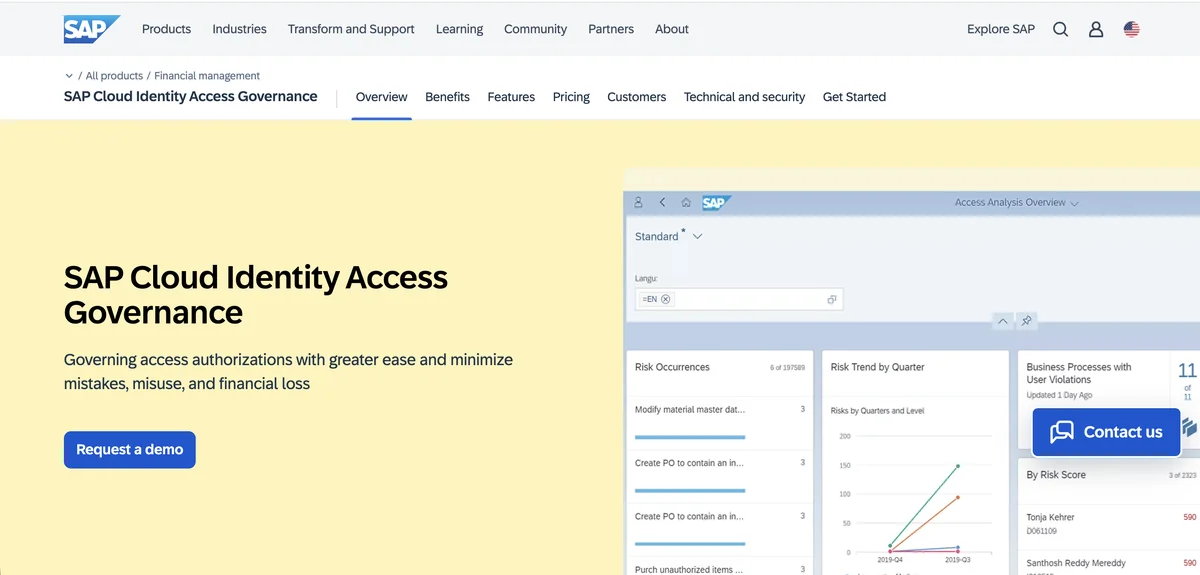
SAP Cloud Identity Access Governance connects to NetSuite through SCIM-based integrations alongside its native coverage of SAP applications. For organizations running both SAP and NetSuite in their finance operations, SAP IAG provides cross-system segregation of duties rules that span multiple ERP platforms, identifying toxic access combinations that would be invisible when reviewing each system in isolation.
The platform delivers five components: Access Analysis for continuous compliance monitoring, Role Design with machine learning optimization, Access Request for self-service workflows, Access Certification for periodic reviews, and Privileged Access Management for log review. This modularity lets organizations start with certification capabilities and expand to broader governance functions as their program matures.
SAP IAG works best for organizations with significant SAP investments who also use NetSuite for specific subsidiaries or business units. The unique SAP Access Control-IAG Bridge allows companies to maintain existing on-premise GRC deployments while extending governance to cloud applications including NetSuite, which no other vendor offers as a native capability.
Pros:
- Cross-system SoD rules span SAP and NetSuite to catch violations invisible in single-system reviews
- Machine learning role optimization helps reduce over-provisioning in complex environments
- Hybrid bridge capability connects on-premise SAP GRC investments to cloud governance
Cons:
- Limited workflow customization compared to on-premise SAP Access Control
- Complex product that requires specialized SAP knowledge for effective implementation
- Enterprise pricing creates significant barrier for organizations without existing SAP investments
Gartner rating: 4.4/5 (114 reviews)
SailPoint IdentityIQ
SailPoint says 53% of Fortune 500 companies are its customers, and it provides deep entitlement-level governance that goes beyond role-based reviews. For NetSuite environments with complex permission structures, SailPoint IdentityIQ enables certification campaigns that examine specific capabilities within each role, not just whether someone should have access to the application.
The platform’s AI recommendations use peer group analysis to identify outliers during access reviews. If a user in the finance department has NetSuite permissions that nobody else in their peer group holds, SailPoint flags this anomaly and suggests revocation. This approach reduces rubber-stamping by surfacing the decisions that actually require human judgment rather than presenting reviewers with hundreds of identical low-risk items.
SailPoint supports up to 500 segregation of duty policies with 50 entitlements each, providing enterprise-grade compliance automation for organizations with extensive SoD requirements around their ERP systems. The platform connects to over 1,100 enterprise applications, which matters for organizations where NetSuite governance represents one piece of a broader identity program spanning dozens or hundreds of systems.
Pros:
- Entitlement-level governance examines specific NetSuite permissions rather than just application access
- AI-based peer group analysis reduces certification fatigue by highlighting genuine outliers
- Comprehensive SoD policy framework supports complex compliance requirements
Cons:
- Average annual cost around $240,000 with entry pricing at $75,000 creates significant budget requirements
- Implementation typically takes 6-12 months with professional services often doubling software cost
- Configuration complexity requires dedicated IAM team and development knowledge
G2 rating: 4.5/5 (161 reviews) Capterra rating: 4.2/5 (21 reviews)
NetSuite environments typically contain dozens of standard roles plus custom roles created for specific business processes. Each role grants access to multiple permission sets covering transactions, reports, custom records, and integrations. A single user certification might involve reviewing dozens of individual permissions, so AI-assisted recommendations and outlier detection help prevent reviewer fatigue and rubber-stamping. Oracle's guidance is blunt about the top role: "The Administrator role is powerful, so access to this role should be extremely limited" (NetSuite Help Center).
One Identity
One Identity provides unified IGA and privileged access management in a single platform, which creates operational efficiencies for organizations that need to govern both standard NetSuite user access and elevated administrative permissions. The company manages over 500 million identities across 11,000 organizations, giving it significant experience with large-scale enterprise deployments.
One Identity positions itself as a cost-effective alternative to SailPoint while maintaining enterprise-grade capabilities. Customers report that pricing runs significantly lower for comparable functionality, which matters for organizations with extensive NetSuite user populations where per-user licensing creates substantial cost exposure.
The platform’s attestation framework supports multiple certification types including user attestation by managers, role certification for application roles, and organization certification for business units. For NetSuite environments, this flexibility enables different certification approaches for different user populations, such as quarterly reviews for standard users but monthly certifications for users with payment approval permissions.
Pros:
- Unified IGA and privileged access management reduces vendor complexity
- Cost-effective pricing compared to SailPoint for similar enterprise capabilities
- Flexible attestation framework supports varied certification schedules by risk level
Cons:
- User experience for attestations receives criticism for outdated interface design
- Implementation typically requires partner assistance due to platform complexity
- Azure AD connector gaps have caused challenges for Microsoft-centric environments
Gartner rating: 4.4/5 (155 reviews)
Oracle Identity Governance
Oracle Identity Governance offers particularly strong capabilities for event-based micro-certifications that trigger automatically when users change jobs, departments, or cost centers. Rather than waiting for quarterly reviews, Oracle OIG can initiate immediate access recertification when HR systems report a role change that might affect NetSuite permissions.
The platform’s automatic vacation management feature monitors when employees take extended leave and can temporarily disable NetSuite access to reduce risk from unattended accounts with financial system permissions. This capability addresses a common audit finding around privileged accounts remaining active during user absences.
Oracle OIG works best for organizations with deep Oracle ecosystem investments who want consistent governance across Oracle databases, Fusion applications, and third-party systems like NetSuite. The platform serves approximately 1,150 companies globally, primarily large enterprises in regulated industries where extensive customization requirements justify the implementation complexity.
Pros:
- Event-based micro-certifications trigger immediate reviews on job changes
- Automatic vacation management reduces risk from unattended privileged accounts
- Role Intelligence feature uses machine learning for automated role discovery and optimization
Cons:
- Implementation complexity significantly exceeds cloud-native alternatives
- User interface has remained relatively unchanged for five years
- Technical support receives mixed reviews for responsiveness and problem resolution
G2 rating: 3.8/5 (71 reviews) Capterra rating: 4.4/5 (7 reviews)
Saviynt
Saviynt received Gartner Peer Insights Customers’ Choice recognition for IGA four consecutive years and holds the highest percentage of five-star reviews in the category. The platform provides unified IGA and PAM built on a common code base, eliminating the integration complexity that comes from bolting together separate governance and privileged access products.
For NetSuite access reviews, Saviynt’s trust scoring feature can automate low-sensitivity approval decisions, reportedly reducing approver workload by up to 75 percent. The platform predicts appropriate access based on peer group analysis with claimed accuracy rates around 94 percent, though actual results vary based on data quality and organizational complexity.
Saviynt offers mobile certification capabilities that allow managers to review and approve NetSuite access requests from their phones. This accessibility helps organizations achieve higher certification completion rates by meeting reviewers where they work rather than requiring them to log into a separate web portal during business hours.
Pros:
- Unified IGA and PAM on single code base simplifies architecture and reduces integration costs
- Trust scoring automation reduces certification burden for routine low-risk approvals
- Mobile certification experience improves completion rates for busy managers
Cons:
- Customer support receives mixed reviews with reports of slow ticket resolution
- Platform complexity despite user-friendly frontend requires significant implementation expertise
- Backend described as challenging even when frontend appears straightforward
Gartner rating: 4.8/5 (185 reviews) Capterra rating: 4.5/5 (2 reviews)
Omada Identity
Omada sells an Identity Cloud Accelerator Package that it markets as “12 weeks time to value”, well short of the 6 to 12 month timelines common with enterprise competitors. Its IdentityPROCESS+ framework provides a structured methodology for rapid deployment that organizations can follow rather than inventing their own implementation approach.
The platform includes an AI assistant called Javi that enables conversational access reviews through Microsoft Teams. Entitlement owners can launch certification campaigns and remediate issues like orphaned accounts directly from their collaboration tool rather than switching to a dedicated governance portal. This contextual approach fits how finance teams actually work rather than forcing them into rigid audit workflows.
For NetSuite environments, Omada provides 50 pre-built audit report templates covering ISO 27001, GDPR, SOX, and other regulatory frameworks. This template library reduces the effort required to generate compliance documentation, though users report that customizing these templates beyond the standard configurations can be challenging.
Pros:
- 12-week Accelerator Package gives a defined implementation timeline
- AI assistant Javi enables conversational access reviews through Teams
- 50 pre-built compliance templates reduce documentation effort
Cons:
- Large-scale certification campaigns can experience performance issues
- Cloud version costs significantly more than on-premise with some feature limitations
- Custom reporting beyond pre-built templates proves challenging
Gartner rating: 4.6/5 (211 reviews) G2 rating: 4.5/5
Avatier
Avatier delivers an all-in-one identity platform that combines IGA, single sign-on, password management, and lifecycle automation in a single solution. This consolidated approach eliminates the integration complexity that comes from assembling separate point products, and the containerized architecture enables deployment on any cloud provider, on-premise, or in hybrid configurations without vendor lock-in.
The platform’s Delta Access Certification feature allows subsequent reviews to focus only on changes since the last audit rather than requiring reviewers to examine every permission assignment again. For NetSuite environments with stable user populations where most access remains constant between review periods, this approach dramatically reduces certification burden while still catching meaningful changes.
Avatier customers consistently report 80-90 percent reductions in password and access-related help desk calls after implementation. While this metric primarily reflects password management capabilities rather than access reviews, it indicates the platform’s focus on practical operational improvements alongside governance compliance.
Pros:
- All-in-one platform eliminates integration complexity across identity functions
- Delta certification reviews only changes since last audit, reducing reviewer burden
- Containerized architecture enables deployment flexibility across any environment
Cons:
- Interface complexity can overwhelm new users during initial rollout
- Small market presence limits community resources and third-party integrations
- Absence from Gartner Magic Quadrant can complicate procurement approvals
G2 rating: 4.6/5 (31 reviews)
How to Choose
Selecting the right platform for NetSuite access reviews depends on your organization’s broader identity governance maturity and specific compliance requirements. Organizations with established IGA programs and complex enterprise environments may find that SailPoint, Oracle, or Saviynt provide the depth of entitlement modeling and compliance automation they need. Teams looking to modernize from legacy tools should evaluate Veza and Saviynt as cloud-native alternatives that deploy faster.
Torii fits organizations that want NetSuite governance as part of a broader SaaS management program rather than an isolated compliance exercise. It pairs shadow IT discovery, license optimization, and SaaS spend tracking with access review campaigns. If your team manages dozens of SaaS applications and wants one view across NetSuite and everything else, Torii can replace separate SMP and IGA products.
For Microsoft-centric environments, Omada and One Identity provide strong integrations with Azure AD and Office 365 ecosystems. SAP shops with NetSuite subsidiaries should evaluate SAP IAG for its unique hybrid governance capabilities. Budget-conscious organizations seeking enterprise features at lower cost should compare One Identity, Saviynt, and Avatier against premium alternatives.
The most important factor remains deployment timeline. Legacy IGA tools can take 6-12 months to implement fully, while cloud-native platforms promise deployment in weeks. If your next SOX audit is approaching and you need NetSuite access reviews operational quickly, prioritize platforms like Veza, Omada, or Avatier that emphasize rapid time-to-value over maximum customization.
Related reading:
Frequently Asked Questions
NetSuite governance expands beyond accounting and inventory to subsidiaries, regional offices, vendors, and contractors. Hundreds of standard and custom roles grant dozens of permissions each, creating SoD risk, over-provisioning, and audit exposure that manual processes rarely detect.
Quarterly spreadsheets and email chains can't keep up with continuous role changes, temporary project access, and contractor churn. Reviews are outdated by the time they're finished, leaving orphaned permissions, unresolved SoD violations, and insufficient evidence for auditors during SOX or SOC 2 audits.
They connect via APIs to NetSuite for continuous permission visibility, automate certification and remediation campaigns, detect SoD and orphaned accounts with AI, and produce time-stamped audit trails auditors require, enabling faster, evidence-rich reviews that reduce fraud and compliance risk.
Prioritize permission-level visibility, SoD detection, HR and Azure AD integrations, fast deployment, AI-assisted anomaly and peer-group analysis, flexible certification schedules, and strong audit reporting. Choose based on whether you need SaaS-wide visibility or focused ERP compliance, plus budget and timeline.
Choose Torii if you need NetSuite governance as part of broader SaaS management, with shadow IT discovery, license optimization, and access review campaigns in one platform. Pick Veza for rapid, permission-centric certification with readable CRUD entitlements and fast, agentless deployment in ServiceNow ecosystems.
They generate tamper-proof, time-stamped audit trails, document who could approve transactions during specific periods, automate certification evidence, and surface activity logs and SoD attestations, making it straightforward to satisfy SOX and SOC 2 auditors' evidence requirements.