

6 ClickUp Identity Governance Tools in 2026
 Chris Shuptrine
•
Feb 5, 2026
•
14 min read
Chris Shuptrine
•
Feb 5, 2026
•
14 min read
Compare six identity governance platforms for ClickUp access reviews in 2026. Find tools for project data compliance and automated certifications.
Ask about this article
Opens Claude in a new tab to answer, using this article as the source.
ClickUp workspaces multiply across organizations in ways that catch IT teams off guard in 2026. A handful of project managers tracking tasks quietly becomes department-wide adoption, with marketing building campaign workflows, engineering documenting sprints, and sales tracking pipelines. External contractors get added along the way, all needing varying levels of access to project data containing roadmaps, client deliverables, and competitive intelligence.
ClickUp's default permission model gives all members full edit access to public Spaces and Lists. This means your baseline state is maximally permissive rather than restrictively secure. Without active governance, former employees keep access to product roadmaps, contractors view client deliverables months after engagements end, and junior staff hold admin permissions they never actually needed.
Manual quarterly reviews through spreadsheet exports cannot keep pace with ClickUp’s rapid permission drift. Someone gets elevated to workspace admin during a product launch and six months later still has that access. A guest collaborator from an agency partnership retains view permissions to competitive intelligence long after the engagement ends. The situation gets worse because ClickUp locks its audit logs, SCIM provisioning, and Space-level permissions behind Enterprise pricing, leaving Business-tier organizations with limited native governance options.
Identity governance platforms address this gap by connecting to ClickUp through APIs and browser-based discovery methods. They provide continuous visibility into who has access to which Spaces, Folders, and Lists while automating certification campaigns and flagging orphaned accounts from departed employees. The audit trails they generate satisfy SOC 2 and ISO 27001 auditors who want evidence of systematic access reviews. The six platforms covered here approach ClickUp access governance differently. They range from broad SaaS management platforms to enterprise access certification tools with deep compliance controls.
★ = low · ★★ = medium · ★★★ = high
| Tool | Ease | Cost | AI Capabilities | Reviews |
|---|---|---|---|---|
| Torii | ★★★ | ★★ | ★★★ | ★★★ |
| ConductorOne | ★★★ | ★★ | ★★★ | ★ |
| Nudge Security | ★★★ | ★★ | ★★ | ★ |
| SailPoint | ★ | ★ | ★★★ | ★★★ |
| MiniOrange | ★★ | ★★★ | ★ | ★★ |
| Avatier | ★★ | ★★ | ★★ | ★★ |
Table of Contents
- Torii
- ConductorOne
- Nudge Security
- SailPoint IdentityIQ
- MiniOrange
- Avatier
- Choosing a ClickUp Access Review Platform
Torii
Torii treats ClickUp access governance as one part of a broader SaaS management program. Its help center describes the base sync plainly: “Torii integrates with your ClickUp account and syncs the user’s data: ID, email, and first & last name” (Torii Help). The ClickUp connector also pulls each user’s role, last used date, and license assignment. One limit is worth knowing. The integration only returns users from the workspaces visible to the person who connected it, because of how the ClickUp API works.
Access reviews run as campaigns. IT picks the apps, then narrows the user scope, for example to privileged users whose ClickUp role contains “Admin.” Reviewers such as the app owner get a notification and work through a guided review in Torii, with usage insights and Torii recommendations next to each user. A separate remediation owner handles rejected access. For ClickUp, that can run as workflow actions like “Remove ClickUp user from workspace” and “Remove ClickUp guest from workspace.” Completed campaigns export as reports for auditors. Details are on the access reviews page.
Torii pairs this with license management, so the same review shows which paid seats sit idle. On ClickUp’s Business plan each of those seats costs $12 per user per month billed yearly. Discovery sources such as SSO and the browser extension can also surface ClickUp workspaces that teams set up outside IT’s view.
Pros
- Direct ClickUp integration pulls users, roles, licenses, and last used dates without manual exports
- Reviewers see usage insights and Torii recommendations for each user during a review
- Eight ClickUp workflow actions, including removing users and guests from a workspace, handle remediation
- License data sits next to access data, so idle paid seats show up in the same review
Cons
- Access reviews are available on the Torii Enterprise plan only, and pricing is quote-based
- The ClickUp connector only sees workspaces the connecting user can access
- Cloud-only architecture does not support organizations requiring on-premise deployment options
G2 Rating: 4.5 out of 5 stars (302 reviews)
Capterra Rating: 4.9 out of 5 stars (26 reviews)
ConductorOne
The founders of ConductorOne came from Okta’s security product team and built a platform focused specifically on access governance. Their Unified Identity Graph pulls ClickUp workspace members, roles, and permission levels into a centralized view that sits alongside access data from other business applications. Security teams can see which employees have ClickUp admin access, who belongs to specific Spaces, and how those permissions compare to peer groups in similar roles across the organization.
Certification campaigns that actually get completed represent the platform’s primary strength. Traditional access reviews suffer from reviewer fatigue that leads to rubber-stamped approvals without meaningful examination of who holds which permissions. ConductorOne addresses this problem through AI agents that handle routine certifications automatically, so human reviewers focus on genuinely risky access grants. A marketing intern holding workspace admin permissions gets escalated for human review while routine member access processes efficiently in the background.
Implementation speed differentiates ConductorOne from legacy IGA vendors. Organizations report running their first ClickUp access review within four weeks of signing the contract, compared to 6-12 months typical for enterprise platforms like SailPoint. The trade-off is less depth in entitlement modeling. ConductorOne works well for cloud-first organizations where ClickUp access reviews focus on workspace and Space-level permissions, but may lack the granular controls heavily regulated enterprises require.
Pros
- AI agents automate routine ClickUp certifications while escalating genuinely risky access
- Four-week average implementation gets access reviews running quickly
- Just-in-time access converts standing ClickUp admin permissions to time-bound temporary grants
Cons
- Reviews can only remove access, not downgrade permission levels within ClickUp
- Newer platform with fewer market references than established IGA vendors
- Technical expertise required for advanced Terraform configurations
G2 Rating: 4.8 out of 5 stars (13 reviews)
Nudge Security
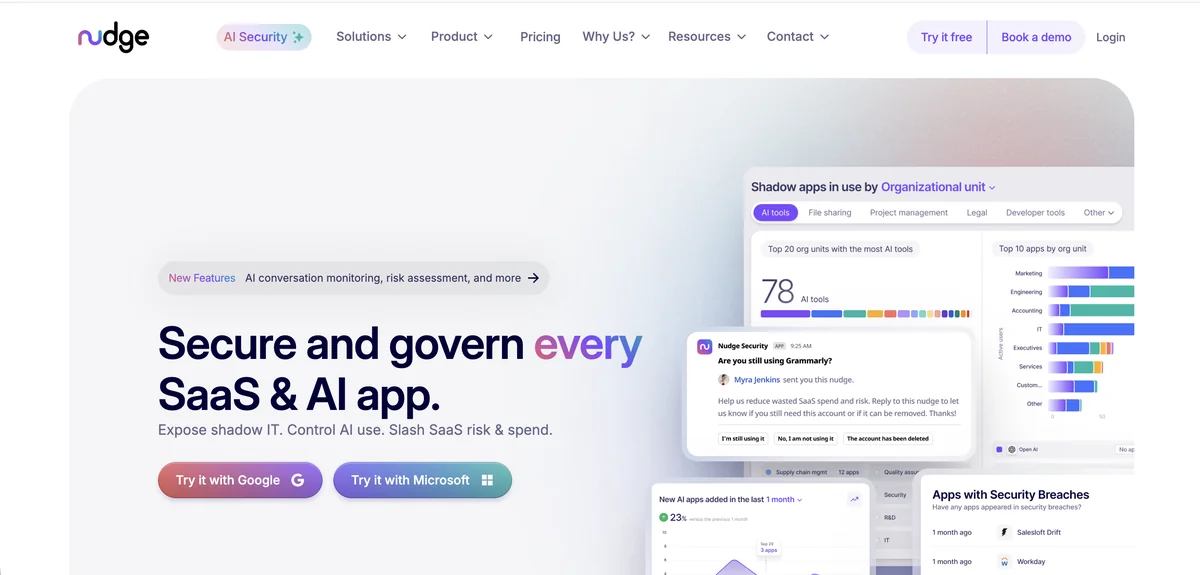
Nudge Security built its approach to ClickUp governance around a patented email-based discovery method that works differently from connector-based tools. The platform monitors email traffic for account creation confirmations, password reset notices, and login alerts rather than requiring IT to configure connectors for each application. Nudge’s own site says “You’ll see your SaaS and AI application inventory begin populating within minutes of connecting your email provider” (Nudge Security). That inventory includes ClickUp workspaces that procurement never approved.
This discovery method catches ClickUp usage that connector-based tools miss entirely. Marketing creates a separate workspace to keep roadmaps away from the broader organization, and Nudge finds it. A departing employee’s personal ClickUp account contains work data, and Nudge surfaces that too. The platform uses behavioral nudges delivered via Slack or email to prompt users toward secure actions rather than blocking access outright.
Access reviews build on that discovery. Nudge categorizes discovered ClickUp workspaces by risk level and routes review tasks to the right owners. A pre-built User Access Review Playbook handles the mechanics of quarterly audits.
ClickUp's pricing page lists the Business plan at $12 per user per month billed yearly, or $19 billed monthly. "SAML SSO & SCIM Provisioning" and "Audit Log" appear only in the Enterprise column, which has no published price. Teams that want automated deprovisioning from ClickUp itself have to negotiate an Enterprise contract. Tools like Nudge Security and Torii review ClickUp access through their own discovery and connectors instead.
Pros
- Inventory starts populating within minutes of connecting the email provider, including shadow ClickUp workspaces
- No connector configuration required, works through email-based discovery
- Behavioral nudge approach achieves higher compliance than blocking methods
Cons
- Requires Google Workspace or Microsoft 365 for email-based discovery
- Cannot enforce mandatory policy controls, relies on user compliance with nudges
- Limited visibility into standalone desktop applications without cloud components
G2 Rating: 5.0 out of 5 stars (limited reviews)
Gartner Peer Insights: 4.7 out of 5 stars (22 reviews)
SailPoint IdentityIQ
SailPoint sits at the enterprise end of the identity governance market. In a September 2024 release, the company said it “remains the top choice for nearly 50% of the Fortune 500” (SailPoint). The ClickUp integration fits within their broader framework designed for organizations managing thousands of applications across hybrid cloud and on-premise environments. SailPoint treats ClickUp as one node in a complex web of entitlements that spans legacy mainframes, ERP systems, and modern project management tools rather than focusing specifically on SaaS governance.
AI-driven recommendations within the platform reduce certification fatigue through peer group analysis. SailPoint compares each user’s ClickUp permissions against others with similar job functions during reviews. If everyone in product management has member access to the Engineering Space but one individual holds admin permissions, the system flags that deviation with a thumbs-down recommendation. Reviewers make final decisions while the AI handles analysis that previously required hours of manual comparison across permission exports.
SailPoint’s segregation of duties controls address scenarios that simpler tools cannot handle. Organizations can create policies that prevent individuals from holding ClickUp admin access alongside admin permissions in connected systems like Salesforce or NetSuite. When policy violations occur, the platform generates alerts and blocks the conflicting access grant. This capability matters for heavily regulated enterprises where auditors require evidence of cross-application SoD enforcement.
Pros
- Deepest entitlement modeling with granular permission-level certification
- AI recommendations through peer group analysis reduce reviewer burden
- Comprehensive segregation of duties controls span ClickUp and connected systems
Cons
- Premium pricing starts around $75,000 annually with average deployments near $240,000
- Implementation typically takes 6-12 months requiring specialized consultants
- Complex interface requires administrator training before productive use
- May be excessive for organizations primarily needing SaaS governance
G2 Rating: 4.5 out of 5 stars (161 reviews)
Capterra Rating: 4.2 out of 5 stars (21 reviews)
MiniOrange
MiniOrange provides ClickUp governance at pricing that sits well below enterprise IGA platforms. At $2-$3 per user monthly, organizations get SCIM provisioning, access request workflows, and compliance reporting without five-figure annual contracts. Mid-market companies that need governance capabilities but cannot justify SailPoint-level investment for project management tool compliance represent the primary target audience for this platform.
SCIM provisioning handles the ClickUp user lifecycle without manual intervention from IT staff. When someone joins the organization, MiniOrange creates their ClickUp account based on role assignments in the identity provider. Departures trigger immediate access revocation rather than waiting for someone to remember manual deprovisioning weeks later. Orphaned ClickUp accounts represent both a security risk and wasted license spend that accumulates $12 per forgotten user every month.
Access governance automation routes through Jira Service Management, which creates a dependency that works well for engineering-focused organizations but may not align with all environments. Users submit ClickUp access requests through the portal, automated workflows route approvals to appropriate managers, and granted permissions get logged for audit evidence. The approach is less sophisticated than purpose-built IGA platforms but sufficient for organizations prioritizing cost efficiency over feature depth.
Pros
- Affordable pricing at $2-$3 per user monthly versus enterprise alternatives
- Automated ClickUp provisioning and deprovisioning through SCIM integration
- Implementation takes hours rather than months
Cons
- Access governance features primarily require Jira Service Management
- Limited native access certification compared to dedicated IGA platforms
- Lacks AI-driven analytics found in modern governance tools
- Support quality varies significantly according to user reports
G2 Rating: 4.5 out of 5 stars (264 reviews)
Capterra Rating: 4.5 out of 5 stars (36 reviews)
Avatier
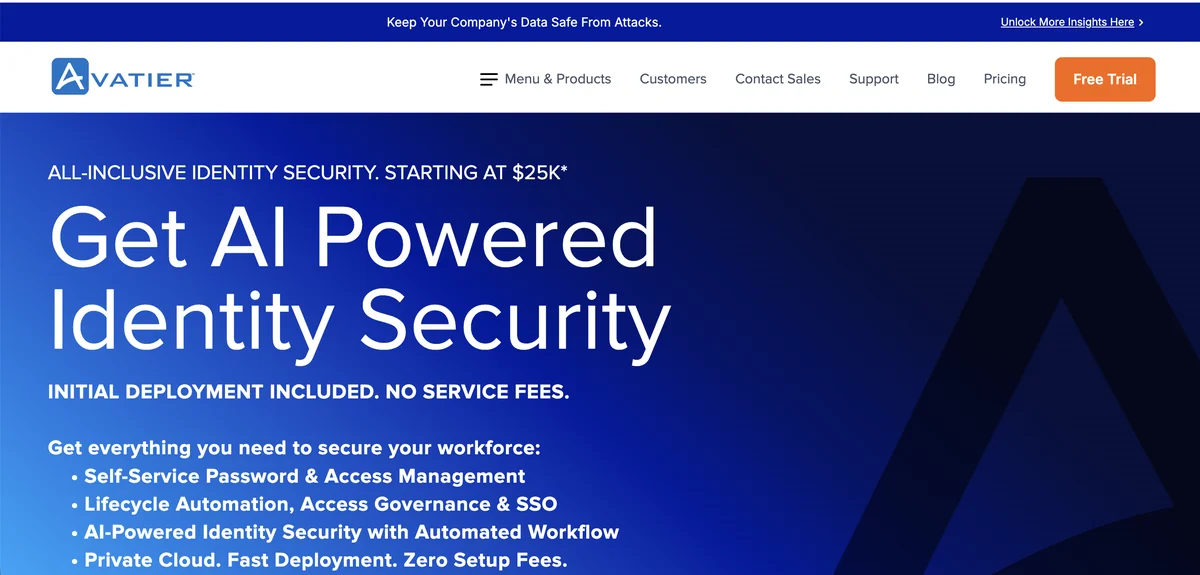
Avatier bundles identity governance, SSO, password management, and lifecycle automation into a single platform. Its homepage promises you can deploy in 14 days or less. The containerized architecture runs on any cloud, on-premise, or hybrid environment without vendor lock-in, appealing to organizations that want infrastructure flexibility for their ClickUp governance tooling. Delta Access Certification reduces review burden by certifying only permissions that changed since the last audit rather than requiring full recertification of every user.
Multi-channel access proves useful for ClickUp reviews involving managers spread across multiple time zones. Reviewers approve or deny access from iOS, Android, Microsoft Teams, Outlook, Slack, or SMS without logging into a separate certification portal. Completion rates increase because managers handle certifications during brief availability windows between meetings rather than scheduling dedicated review sessions.
Avatier positions itself as a lower-cost alternative to SailPoint and Okta. The all-inclusive pricing bundles features that competitors charge separately, and fixed-bid implementation eliminates the professional services cost creep common with enterprise IGA projects. The trade-off is limited analyst recognition. Avatier does not appear in Gartner Magic Quadrants or Forrester Waves, which can complicate procurement approval at organizations requiring analyst validation.
Pros
- Deploys in 14 days or less versus months for enterprise IGA platforms
- Delta certification reviews only changed ClickUp permissions, reducing reviewer fatigue
- Multi-channel access enables reviews from Teams, Slack, mobile devices, or SMS
Cons
- No presence in Gartner or Forrester analyst reports
- Interface complexity can overwhelm new administrators
- Limited out-of-box reporting customization options
G2 Rating: 4.6 out of 5 stars (31 reviews)
TrustRadius: 9.1 out of 10 (89 reviews)
Choosing a ClickUp Access Review Platform
Your ClickUp governance needs should factor into broader SaaS management requirements when selecting a platform. Organizations running dozens of SaaS applications benefit from a platform that handles access reviews, license optimization, and shadow IT discovery together. Companies with compliance needs focused specifically on project management tools may find dedicated IGA solutions more appropriate for their certification workflows.
Selecting the right platform comes down to your specific ClickUp governance requirements and where that fits in your overall identity strategy. Torii works best for organizations wanting unified SaaS management where ClickUp access reviews happen alongside license optimization and shadow IT discovery. ConductorOne fits companies prioritizing AI-automated certifications with rapid implementation timelines. Nudge Security focuses on discovering shadow ClickUp workspaces that IT never knew existed. SailPoint serves heavily regulated enterprises that need comprehensive entitlement modeling and cross-application segregation of duties controls.
Budget-conscious organizations have options too. MiniOrange delivers essential governance capabilities at accessible pricing, while Avatier provides enterprise-grade features with faster deployment than traditional IGA vendors. The evaluation should weigh how ClickUp governance integrates with broader identity management rather than selecting based on ClickUp-specific features alone.
The underlying goal stays the same regardless of which platform you choose. You need consistent visibility into who has access to ClickUp workspaces, Spaces, and the sensitive project data they contain. ClickUp defaults to a permissive model where every member can edit public locations, so organizations must actively govern access rather than relying on built-in restrictions to protect them.
Frequently Asked Questions
ClickUp's default model grants full edit access to public Spaces and Lists for members, creating a maximally permissive baseline. Without governance, former employees, contractors, and junior staff can retain excessive access to roadmaps, client deliverables, and competitive intelligence.
Manual spreadsheet exports and infrequent audits can't keep pace with rapid permission drift. Temporary admin elevations and contractor access often persist months, while locked audit logs and missing SCIM on Business tiers prevent automated, continuous reviews.
They connect via APIs or browser discovery to continuously map who has access to Spaces, Folders, and Lists; automate certification campaigns; flag orphaned or inactive accounts; and produce audit trails that satisfy SOC 2 and ISO 27001 evidence requirements.
The SCIM tax refers to ClickUp charging extra to unlock SCIM provisioning on Enterprise plans, increasing per-user costs significantly. Organizations can avoid this by using governance tools like Torii or Nudge Security that discover and govern access without upgrading to Enterprise.
Match governance needs to identity strategy: pick unified SaaS management for broad app and license control, dedicated IGA for deep compliance and SoD, or budget options for SCIM and lifecycle automation. Consider deployment time, pricing, analytics, and shadow IT discovery.
Torii blends SaaS management with license optimization and shadow IT discovery; ConductorOne emphasizes fast AI-driven certification and rapid deployment; SailPoint delivers enterprise-grade entitlement modeling, segregation-of-duties and cross-application compliance for regulated organizations.